
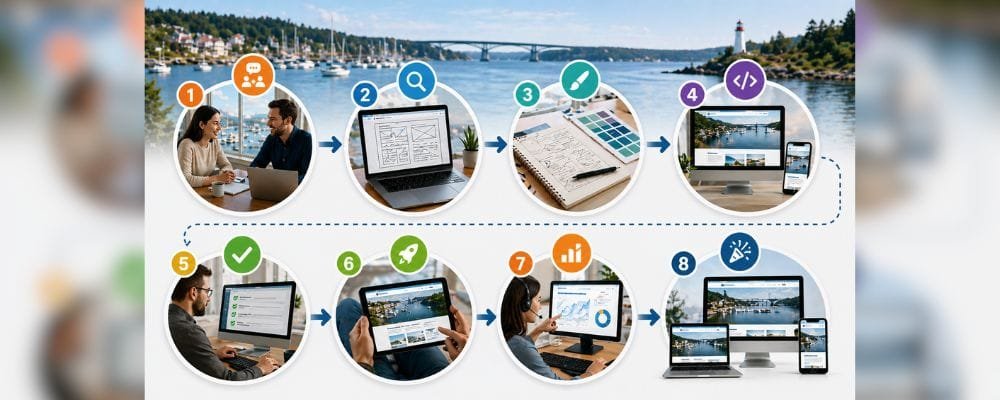
What Actually Happens After You Hire a Gig Harbor Website Designer: A Complete Phase-by-Phase Guide
Most Gig Harbor business owners who recognize the need for a new website have already crossed the first threshold of awareness. The harder challenge is not recognizing the need, it is committing to an unfamiliar process with enough confidence to move forward.
Before a contract is signed, most designers offer a portfolio and a price. What they rarely offer is a clear map of what the experience will actually involve. This guide exists to change that. Every phase of the Hyper Effects website design process is explained here in full, what happens, what is expected of the business owner, and how long each stage realistically takes.
Why the Process Determines the Outcome
A professionally built website is not a design project in the conventional sense. It is a structured system designed to guide visitors, specifically Gig Harbor visitors, whose median household income exceeds $118,000, from their first impression of a business to the moment they decide to make contact.
As per the Nielsen Norman Group, users form usability judgments about websites within the first 10 seconds of a visit, and credibility assessments happen even faster. This means every phase of the design process must serve a defined purpose within that visitor journey, rather than simply producing pages that look polished.
When the process is unclear or executed without strategic discipline, the result is a website that functions more like an online brochure than a conversion system, present on the internet, but not actively working to grow the business. Understanding each phase before the project begins is not just useful for managing expectations; it is part of what allows the final website to perform rather than simply exist.
Phase One: The Discovery Conversation
Understanding the Business Before Designing for It
Every design decision made later in the project is only as strong as the understanding developed in this first phase. A professional Gig Harbor web designer must develop a working knowledge of the business that extends well beyond a list of services and a price range.
The discovery conversation addresses the questions that actually determine how the website will be built: Who is the specific type of person in Gig Harbor who represents the ideal client for this business, not a broad demographic description, but a precise profile of the person whose decision-making behavior the site must be designed around? How do those people currently find this business, and what happens to them when they arrive on the existing website? At what point does the current site lose the visitors it should be converting, and what does a realistic definition of success look like ninety days after a new site launches?
These questions establish the visitor journey, the strategic map of how the website will move a visitor’s attention from arrival to action by removing hesitation at each step rather than leaving it to chance.
Gig Harbor is not a generic market, and a website built for a high-income local buyer requires different decisions than one built for general traffic. As per Pew Research Center, high-income consumers apply significantly more scrutiny to digital credibility signals before making purchasing decisions. The discovery phase is where that understanding is built into the foundation of the project rather than treated as an afterthought.
What you provide: Background on your business, current pain points with your existing website, any brand assets already in your possession, logo files, colors, photography, and examples of websites you find credible or compelling, even outside your industry.
Timeline: One to two conversations completed within the first week.
Phase Two: Fixed Investment Before Work Begins
Pricing Clarity as a Foundation for Trust
The Hyper Effects pricing model differs from most agencies and freelancers in one significant way: the full investment is defined before any work begins, and it does not change. There is no hourly billing accumulating in the background, no mid-project additions when a phase takes longer than initially anticipated, and no surprise line items at the invoice stage for tools, hosting, or services that should have been included from the start.
This model is possible because the process itself is already built. Hyper Effects operates with enterprise-licensed technology, executes all work in-house, and brings more than a decade of experience that eliminates the inefficiencies, rework, delays, guesswork, that cause costs to escalate at agencies still developing their process project by project. As per Harvard Business Review, cost overruns in creative and technical projects are most commonly caused by scope ambiguity and hourly billing structures that transfer risk to the client rather than absorbing it at the agency level.
What a business owner pays is tied to a defined outcome, not to the number of hours required to reach it. For a Gig Harbor business owner who has been through a previous project that cost significantly more than the original number, this structure is not just a pricing preference. It is the first meaningful signal that this engagement will be different.
What you provide: Review of the proposed scope and deliverables, agreement on the project timeline, and the initial investment to begin the work.
Timeline: Handled within the first week, alongside the discovery conversation.
Phase Three: Site Architecture and the Structure of the Visitor Journey
Building the Blueprint Before the Visual Work Begins
Most people think of web design as a visual activity. The most consequential work in the entire process, however, happens before a single color, image, or typeface is chosen.
This phase establishes the architecture of the website: which pages will exist, what each page must accomplish within the visitor journey, how a visitor moves from their initial landing point to the moment of contact, and what the site must communicate at each step to keep their attention moving forward rather than dissipating.
As per research published by the Baymard Institute, decision paralysis is one of the leading causes of abandonment in digital experiences. When the human mind encounters a website that offers too many simultaneous choices without a clear next step, the default response is not to make a decision, it is to leave. The architecture phase is where that outcome is prevented by deliberate design rather than left to chance. Every structural element is evaluated against a single question: does this make the visitor’s next step clearer, or does it introduce additional thinking?
A website that systematically removes friction converts. A website that inadvertently creates friction does not.
This phase also determines how the site speaks to the Gig Harbor audience in a way that feels specific rather than generic. Local authority is not built by placing a stock photograph of the harbor on a homepage. It is built into the structure, the way services are described relative to local expectations, the way credibility is established for a community that evaluates businesses with a higher degree of discernment, and the way the content makes a Gig Harbor visitor feel immediately understood rather than broadly addressed.
What you provide: Review and approval of the proposed sitemap and page structure. This is the single most important approval in the entire project. Design built on an approved structure moves efficiently; design built on an uncertain foundation requires expensive revision that delays every phase that follows.
Timeline: Approximately one week.
Phase Four: Visual Design and the Review Process
Translating Strategy Into the Experience a Visitor Actually Sees
With the site structure approved, the visual design phase begins. This is the phase most business owners are most familiar with in concept, and the one where the quality of client feedback most directly determines the quality of the outcome.
The design phase produces the complete visual experience of the website: layout, typography, color palette, imagery, and the overall impression a Gig Harbor visitor forms within the first moments after a page loads. As per a study published in Behaviour & Information Technology, users form aesthetic judgments about websites in as little as 50 milliseconds, before any content is read and before any interaction occurs. The design either confirms that this business is credible, professional, and worth engaging, or it quietly signals the opposite.
Every design decision made at Hyper Effects is grounded in the visitor psychology work developed during Phase Three. The placement of a contact button is not an aesthetic preference; it is a decision about the precise point in the visitor journey where confidence is high enough to invite action. The selection of photography is not about what looks appealing in the abstract; it is about what makes a Gig Harbor buyer feel that this business understands people like them. Design is the visual expression of the underlying strategy, not a separate creative exercise that happens to be layered on top of it.
Effective feedback in this phase is specific rather than general. A response such as “I like it” or “can we try different colors” provides no actionable direction and tends to produce weaker revisions. A response such as “the primary message on the homepage is not clear within the first three seconds” or “the photography does not reflect the type of client we actually serve” gives the designer a precise brief to work from and produces design revisions that move the project forward rather than sideways.
What you provide: Timely, specific feedback on design mockups. One round of revisions is standard. The precision of the feedback determines how many rounds are needed.
Timeline: One to two weeks, including revisions.
Phase Five: Development, Content Integration, and Backend Infrastructure
The Technical Foundation That Determines Whether the Site Actually Works
Once the design is approved, the site moves into development. The approved visual design becomes a functioning website, pages are built, content is integrated, performance is optimized, and the infrastructure that determines whether the site operates reliably is established in full.
Ownership is a topic most business owners do not consider until something goes wrong, at which point it is already too late to address it cleanly. Before development begins, every ownership question should already have a definitive answer: who holds the domain registration, who controls the hosting account, who owns the analytics data, and who has administrative access to Google Search Console. At Hyper Effects, the answer to all of these questions is always the client. The website belongs to the business that paid for it. Full access and full control are not conditional on maintaining a particular ongoing relationship with the agency.
This phase is also where Private VIP Analytics is established, and the distinction between this system and standard analytics tools is more significant than most business owners initially appreciate.
As per Google’s own documentation, standard Google Analytics reporting operates with a data processing delay of 24 to 48 hours and presents behavioral data in aggregated trends rather than individual session behavior. Private VIP Analytics operates differently. From the day the site launches, the business owner can observe in real time which pages visitors are viewing, where they pause, where they hesitate, and, critically, where they begin filling out a contact form and then abandon it without submitting. This level of visibility replaces guesswork about why the site is not producing inquiries with specific, addressable observations about where visitor attention is being lost.
In a market like Gig Harbor, where each serious prospect represents meaningful revenue, operating a website without this visibility is the equivalent of running a physical storefront without being able to see which products customers pick up and then put back down. Large enterprises have operated with this level of behavioral data for years. There is no principled reason why a Gig Harbor small business should accept less.
What you provide: Final written content for each page, photography, and any business-specific information needed to complete the site. The more complete and organized this material is when it arrives, the faster development moves.
Timeline: Two to three weeks.
Phase Six: Launch, Testing, and the Feedback Loop That Begins on Day One
Why Launch Is the Beginning of the Process, Not the End of It
For a Gig Harbor business that intends to use its website as a functioning conversion system rather than a static digital presence, launch is not the conclusion of the project. It is the point at which real data begins to arrive.
The days immediately preceding launch involve comprehensive final testing, every page reviewed across desktop and mobile devices, every contact form submitted and verified, every internal and external link confirmed, every page load time assessed against current performance standards. As per Google’s Core Web Vitals guidelines, page load performance directly affects both search ranking and user behavior, making technical testing an integral part of the pre-launch process rather than an optional quality check.
A website that displays incorrectly on a mobile device, has a contact form that silently fails to deliver submissions, or loads slowly enough to trigger visitor abandonment is not a functional business asset. It is a liability that happens to have a design attached to it.
After launch, Private VIP Analytics immediately begins reporting real behavioral data from actual Gig Harbor visitors interacting with the live site, not simulated traffic, not estimated behavior, but observable movement through real pages by real people. Which section of the homepage holds attention longest. Which page produces the highest rate of exits. Whether visitors arriving from organic search behave differently than visitors arriving from referrals. Whether the contact form is being abandoned at a specific field.
This visibility changes how decisions about the website are made on an ongoing basis. Rather than assuming the site is working because it looks professional, the business can confirm it is working because the data demonstrates it. When something needs improvement, the data identifies precisely what needs to change and where, transforming optimization from a matter of subjective opinion into a matter of observable evidence.
A website built with this level of ongoing visibility does not remain static after launch. It improves over time as real behavioral data informs specific, targeted improvements. That is the meaningful distinction between treating a website as a completed project and operating it as a living system.
What you provide: Engaged attention to post-launch analytics data. Business owners who actively review and respond to what the data shows improve their results faster than those who treat launch as the point at which their involvement ends.
Timeline: Three to five days of final testing before go-live, followed by ongoing optimization.
The Total Timeline: What to Realistically Expect
For a Gig Harbor small business website built through the complete process described above, the realistic timeline from the initial discovery conversation to launch is six to ten weeks. The range in that estimate reflects the primary variable in every project: how quickly the client reviews work, provides feedback, and delivers content.
A business owner who responds to design reviews within 48 hours and delivers all site content in a single organized package can move through the process in six weeks. A business owner who takes two weeks between feedback rounds and delivers content in separate fragments over the course of a month extends the timeline by a corresponding amount. The process itself does not create delays. Client response time is consistently the most significant factor in how long any given project takes to reach launch.
This is not a criticism of business owners who have demanding schedules. It is an honest observation that helps establish accurate expectations before work begins, so that timeline conversations later in the project are unnecessary.
Frequently Asked Questions
How much of my time will this project actually require?
The level of involvement is greater than most business owners initially expect, and considerably less than most initially fear. The three critical points of involvement are the discovery conversation at the project’s outset, the sitemap review before design begins, and the design feedback round. Outside of these moments, the work proceeds without requiring daily attention from the business owner. The most common source of project delays is not the active phases, it is the response time between phases. A review that takes a week to receive a response extends the timeline by a week. The clients who complete projects fastest are those who treat review requests as time-sensitive business decisions rather than background tasks.
What should I prepare before the project begins?
The most useful preparation involves gathering existing brand assets, logo files in vector format if available, brand colors, fonts if they have been formally defined, along with any existing photography of the business, team, or completed work. A clear sense of the type of client the business most wants to attract is more valuable than a general description of the target market. Examples of websites from any industry that feel credible or compelling are also useful, because they communicate aesthetic and strategic preferences more precisely than descriptive language tends to.
Will I be able to update the website independently after launch?
Every Hyper Effects website is built so that the business owner can manage routine content updates, adding a blog post, updating service descriptions, changing contact information, replacing a photograph, without requiring a developer for each change. Structural modifications, such as adding new pages, rebuilding sections, or integrating new systems, are the appropriate point at which professional support adds real value.
What happens if I want changes after the project is complete?
Changes that fall within the originally agreed scope are addressed as part of the project. Work that represents a meaningful departure from the original scope, new pages, new functionality, significant restructuring, is separately scoped and priced. This conversation is straightforward when the original agreement is clearly defined, which is why the scope definition in Phase Two receives the attention it does.
Do I own the website when the project is complete?
Completely and without qualification. The domain, the hosting account, the website files, the analytics data, and all Search Console access are in the client’s name from the beginning of the project. There is no circumstance in which a business owner would need to negotiate for access to their own digital assets. Full ownership is not a premium feature. It is a baseline standard that should be expected from any professional web designer.
What if the design direction does not feel right?
The sitemap and structure approval in Phase Three exists specifically to prevent significant design surprises. When the architecture of the site has been reviewed and approved before visual design begins, the designer works from a clear, agreed-upon brief. Significant departures from that brief are uncommon precisely because the foundation was established collaboratively before the visual work started. If the design direction genuinely misses the mark despite this foundation, that conversation happens in Phase Four before the design is carried into development, which is the least costly point in the project at which to redirect.
How soon after launch should I expect results?
The answer depends on what results means for the specific business and how visitors are finding the site. Visitors arriving through existing referrals or direct searches for the business name may convert immediately, since the site’s role in that scenario is primarily to confirm the trust that a recommendation has already established. Organic search visibility, the site appearing for Gig Harbor keyword searches conducted by people who do not yet know the business, typically develops over three to six months as Google indexes the content and evaluates its relevance relative to competing pages. As per Ahrefs’ analysis of organic search timelines, the majority of pages that rank in top positions have been indexed for a year or more, meaning organic SEO is a compounding investment rather than an immediate return. Private VIP Analytics makes this development timeline visible and measurable rather than a matter of waiting without information.
What does a Gig Harbor website designer offer that a remote designer does not?
Local authority in a website is not achieved by placing a Gig Harbor address in the footer. It is built into the decisions that shape how services are described, how the audience is addressed, which visual references create immediate familiarity for a local visitor, and what a Gig Harbor buyer expects to feel when they land on a local business site. A designer with genuine understanding of this specific market builds differently than one applying a general template to a local address. The difference is most visible to the people whose response matters most, the Gig Harbor clients the business is trying to reach.
One Observation Worth Considering Before You Begin
The hesitation most Gig Harbor business owners experience before committing to a website project is not rooted in doubt about whether a well-built website creates value. It is rooted in an inability to see the process clearly enough to feel confident that the investment will produce what it is supposed to produce.
A defined, transparent process is the most direct solution to that hesitation. When every phase is understood before it begins, when the investment is fixed before any work starts, and when the visitor journey is mapped before a single design decision is made, the project stops feeling like a speculative commitment. It becomes a clear path toward a specific, measurable outcome, a website that guides the right Gig Harbor visitors toward action, reflects the credibility of the business it represents, and improves over time as real behavioral data informs real decisions.
That clarity is not a secondary benefit of the process. It is part of the product itself.
If you are ready to see this process applied to your specific business situation, the next step is a conversation rather than a pitch. The discussion will cover where your current website is losing visitors, what a redesigned visitor journey would look like for your business, and what the complete process would involve from discovery through launch.
Related reading:
Trust Signals a Gig Harbor Website Must Have in 2026
The 7 Silent Trust Checks Gig Harbor Customers Run on Your Website Before They Call