
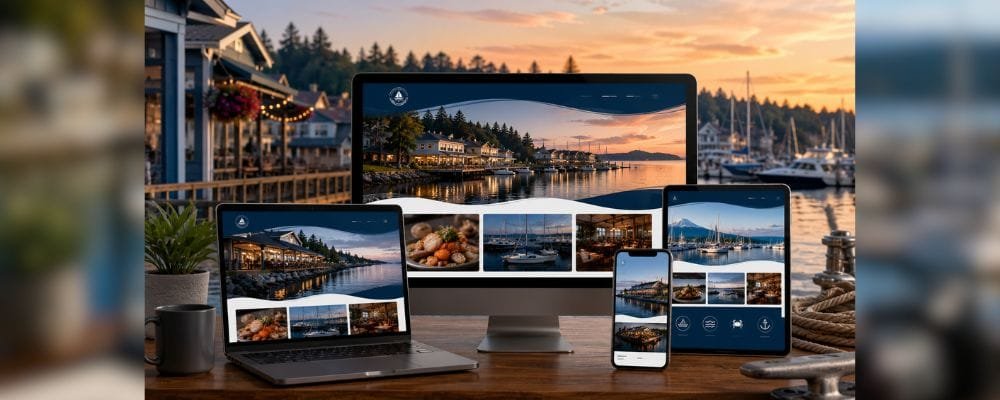
There is a difference between a business website that mentions Gig Harbor and one that feels like it belongs here.
The first type drops the city name into a homepage headline, places a stock photograph of the Narrows Bridge above the fold, and lists a Gig Harbor address in the footer. It is geographically located in this community. It does not feel like it is part of it.
The second type communicates something different, something a Gig Harbor buyer registers in the first few seconds of a visit without being able to articulate it. The website feels familiar. It reflects the character of a place they know and value. It signals that the business behind it genuinely understands this community, not as a marketing target, but as home.
That difference is not aesthetic. It is a trust signal.
In Gig Harbor, where community relationships drive purchasing decisions more than almost any other factor, it determines whether a visitor stays to evaluate or closes the tab and moves on.
What Gig Harbor’s Waterfront Identity Actually Is
Before any argument about web design can be made, the subject of that argument must be understood precisely.
Gig Harbor’s waterfront identity is not a scenic backdrop. It is not a collection of attractive photographs available on stock photography platforms. It is the accumulated character of a community organized, for generations, around its relationship with the water, and it carries specific, documented meaning that shapes how people who live here see themselves and evaluate the businesses they choose to work with.
As per the Washington Trust for Historic Preservation, the Gig Harbor Waterfront Alliance carries forward “a legacy shaped by maritime heritage, small business owners, and a community that cares, with a mission to honor the past while building a vibrant, welcoming waterfront for the future.” The mission of the Alliance itself reflects the depth of this identity: “Bring Together Our Community, Encourage Our Economic Vitality, and Preserve Our Historic Character.”
As per the National Working Waterfront Network, “Gig Harbor’s working waterfronts are home to a significant concentration of historic maritime uses and structures, including contiguous netsheds and commercial fishing vessel moorage facilities on either side of the Eddon Boat Building facility and Eddon Boat Park, that have aesthetic, architectural, historical, and cultural significance that characterize the community’s regional maritime identity and history.”
These are not decorative details. They are the structural elements of a community identity that Gig Harbor residents carry with them into every purchasing decision they make.
The community traditions that animate this identity are equally specific. The Maritime Gig Festival draws 6,000 to 8,000 people each day to Harborview Drive, organized around “classic small-town Americana and waterfront pride.” The weekly farmers market is a fixture of community life. Chalk the Harbor celebrates local artistic expression on the waterfront. The Gig Harbor BoatShop offers hands-on engagement with boatbuilding traditions. These are not tourist attractions. They are the living expressions of a shared identity that residents protect and value.
As per the City of Gig Harbor’s Three-Year Strategic Plan 2024–2026, the city’s economic development priority is “creating an environment where businesses feel supported, visitors are welcomed, and residents can enjoy a thriving local economy that reflects the unique character and charm of Gig Harbor.”
That “unique character and charm” is not a tagline. It is the specific felt sense of place that the Gig Harbor buyer carries when they evaluate a local business, and that a website either reflects or fails to reflect.
The Difference Between Location and Belonging
This distinction is the conceptual foundation of every design decision that follows.
Location is factual. Any business can list a Gig Harbor address. Any website can use the city name in its homepage headline. Any designer can place a stock photograph of the harbor on a landing page. These choices communicate geographic presence. They do not communicate community membership.
Belonging is earned. It is communicated through specificity, through language that reflects genuine familiarity with how this community thinks, imagery that shows real places a Gig Harbor buyer recognizes, and a business story rooted in this community rather than applicable to any market in any coastal city in the Pacific Northwest.
As per CYTICX’s 2026 Local Trust Research, “when visitors see familiar visuals, such as recognizable landmarks or popular gathering spots, they immediately feel a sense of connection and authenticity. This emotional resonance significantly enhances user engagement and trust, especially for businesses that rely on local clientele. Avoiding generic stock photos and instead opting for custom photography that showcases your team, storefront, or community involvement humanizes your brand and reinforces your commitment to the area you serve.”
The distinction carries a financial consequence that most Gig Harbor business owners have never explicitly calculated.
A business that belongs to this community has a stake in its reputation here. Its owners live in the same neighborhoods as their clients. They attend the same community events. They are accountable not just through Yelp reviews but through the social fabric of a community where word travels fast and reputation compounds over time.
A business that is merely located here does not carry that accountability. And the Gig Harbor buyer, educated, experienced, discerning, evaluates belonging as a proxy for accountability before they evaluate credentials, pricing, or service descriptions.
As per RDLB’s Trust Architecture 2026 Research, “earned credibility within specific communities is gaining commercial weight, the brands that will compound trust in this environment are those doing the harder work of cultural proximity, human-centered communication, and authentic earned presence inside the circles that actually matter to their audiences.”
The website is where that cultural proximity becomes visible. Or fails to.
What Waterfront Identity Looks Like in Photography
Photography is where the belonging versus location distinction becomes most visible on a business website, and where the most common failures occur.
The typical approach to “local” photography on a Gig Harbor business website follows a recognizable pattern: a stock image of the Narrows Bridge downloaded from a photo service, a generic harbor view with boats that could be in any Pacific Northwest marina, or a professional headshot taken against a neutral background that could be anywhere on earth.
These choices communicate professionalism. They communicate nothing about belonging.
Real waterfront identity photography is specific. It shows the Harborview Drive storefront on a clear Pacific Northwest morning with the familiar waterfront district visible in the background. It shows the team photographed at Skansie Brothers Park, or on the waterfront with the marina visible behind them, or on a job site in a neighborhood that Gig Harbor residents recognize. It shows project work completed in settings that reflect the architectural character of this community, the craftsman-style homes of the residential neighborhoods, the waterfront properties of the harbor district, the commercial spaces of the Finholm Marketplace.
As per RDLB’s Trust Architecture Research, “the brands that earn trust within specific communities do so through cultural proximity and authentic earned presence, not through volume or production speed.” A single real photograph of a business owner standing on the Gig Harbor waterfront communicates more cultural proximity than a professionally staged photo shoot using stock-level imagery, because it places the business inside the community visually in a way that a Gig Harbor resident recognizes on sight.
Practical guidance: commission real photography in real Gig Harbor locations. Prioritize the waterfront district, the community spaces that residents use and recognize, and the actual settings where work is performed. Update photography seasonally to reflect the community’s rhythm, the summer Maritime Gig Festival, the autumn harbor light, the winter waterfront at dusk. These seasonal updates are not decorative maintenance. They are evidence of ongoing community presence that AI search systems evaluate as freshness signals and human visitors read as active engagement.
Never substitute stock imagery of generic harbor scenes when real Gig Harbor photography is available. The Gig Harbor buyer identifies the substitution immediately, and it costs the business something that no credential listing can recover.
What Waterfront Identity Sounds Like in Language
If photography is where most Gig Harbor business websites fail visually, language is where they fail most consistently, and where the fix is most immediately within reach.
The language of belonging in Gig Harbor is specific in ways that are immediately recognizable to residents and immediately invisible to anyone who does not genuinely know this community.
It references the waterfront district rather than “downtown.” It mentions Harborview Drive rather than “the main street.” It knows the difference between the historic working waterfront with its netsheds and fishing vessel moorage, the Finholm Marketplace district, the residential harbor neighborhoods, and the peninsula communities extending toward Kitsap County. It speaks about the community’s maritime heritage with the matter-of-fact familiarity of someone who has worked here for years, not with the enthusiasm of a tourism brochure.
The language of location, by contrast, is entirely interchangeable. “Serving the Gig Harbor community” could be written by a business in Phoenix that appended the city name to a generic service description. “Proud to be part of the Gig Harbor area” communicates nothing specific about what that pride is based on or what understanding of this community it reflects.
As per the 2026 Edelman Trust Barometer research documented by RDLB, “the strongest driver of sustained engagement within communities is perceived authenticity and immediate personal relevance, two qualities that generic, manufactured content tends to erode rather than amplify.” For the Gig Harbor business whose primary buyers are community members with decades of local experience, language that sounds generic does not simply miss an opportunity. It actively signals that the business does not know its audience as well as it claims to.
The practical application is a direct content audit.
Read every page of the website and identify every instance where “Gig Harbor” functions as a location label rather than a reference to something genuinely specific about this community. Then replace each instance with language that demonstrates actual local knowledge, specific neighborhoods, specific community landmarks, specific characteristics of the Gig Harbor buyer that only someone genuinely familiar with this market would know to mention.
The test is simple: remove the city name from a paragraph and ask whether any specific knowledge of Gig Harbor remains. If nothing does, the paragraph is location language, not belonging language.
Community Presence as a Trust Signal on the Website
In Gig Harbor, community participation is one of the primary ways local buyers evaluate whether a business is genuinely embedded in the community or simply operating within it. The distinction matters because it speaks directly to accountability, and accountability is the foundation on which trust in a relationship-driven market is built.
The Gig Harbor Waterfront Alliance’s small business grant program, the Maritime Gig Festival’s sponsorship and parade participation, the farmers market vendor and sponsor relationships, the Rotary and Kiwanis partnerships, the Chalk the Harbor community involvement, these are the activities that define a Gig Harbor business as part of the community fabric rather than a business that happens to hold a local license.
A business that participates in these activities and does not document that participation on its website is leaving one of its most powerful local trust signals entirely invisible to the people who most value it.
As per New Target’s Brand Authenticity Research, “open communication about company practices, including behind-the-scenes content about community involvement and participation, reinforces transparency and builds trust in a way that promotional content cannot achieve.” For a Gig Harbor business, this means the website should document community participation specifically and with evidence: photographs from the Maritime Gig Festival, a note about farmers market presence, named recognition of local organizations supported, and specific references to community partnerships rather than generic statements about community commitment.
These details are not self-congratulatory additions to a service page. They are verifiable evidence of belonging that a Gig Harbor buyer evaluates, consciously or not, when deciding whether to trust a business enough to make contact.
The verification matters because this community is small enough that claims can be checked. A business that states its community commitment in general terms but has no specific, verifiable evidence of that commitment on its website is making a claim that a Gig Harbor buyer will quietly dismiss. A business that shows photographs from the Maritime Gig Festival, names the local organizations it supports, and documents its farmers market presence is making a claim that can be verified in thirty seconds by anyone who has lived in this community for more than a year.
Verifiable community presence is not a marketing tactic. It is documentation of belonging that this market demands before extending trust.
Evaluating Your Website’s Local Identity: Five Specific Questions
The practical application of everything this post has argued is a direct evaluation of your current website against the standard of genuine local belonging.
Five questions structure that evaluation. Each one has a clear answer, yes or no, that reveals whether the website is communicating belonging or merely location.
Does the photography show real Gig Harbor? If every image on the website could belong to a business in any Pacific Northwest coastal city, the photography is communicating location rather than belonging. Real Gig Harbor photography is specific: recognizable places, real people in community contexts, and the particular visual character of this waterfront community that residents identify on sight.
Does the language demonstrate specific local knowledge? Read the homepage and service pages as a long-term Gig Harbor resident who has lived in this community for twenty years. Does the language reflect someone who genuinely knows this community, its neighborhoods, its waterfront character, its seasonal rhythms, its community events, or does it sound like a city name was inserted into generic service copy that could apply anywhere?
Does the website document community participation? If the business sponsors the Maritime Gig Festival, participates in the farmers market, supports the Waterfront Alliance, or is involved in any local organization, is that participation documented specifically on the website, with photographs and named references rather than general statements of community commitment? Community participation is verifiable evidence of belonging, and verifiable evidence is what converts the Gig Harbor buyer.
Is the local identity consistent across every platform? A Gig Harbor business whose website communicates waterfront identity but whose Google Business Profile uses stock imagery and generic language is presenting inconsistent signals to both human visitors and AI search systems. As per the Lucidpress research cited by Robiz Solutions, consistent brand presentation across all platforms increases revenue by up to 33%. Consistency is not a design preference. It is a conversion signal that AI systems now evaluate as part of their credibility assessment.
Does the website tell the business’s Gig Harbor story? Every business operating in this community has a story that is specific to its presence here, how long it has operated, what it understands about this market that an outside competitor does not, what connection it has to the waterfront community that shapes its work and its standards. That story, told specifically on the About page and reflected in the language throughout the site, is the most powerful local identity signal available. It cannot be replicated by a national competitor. It cannot be generated by an AI website builder. It belongs to the business alone, and it is exactly what the Gig Harbor buyer is looking for when they evaluate whether to trust a business enough to call.
The Principle That Makes This a Business Decision, Not a Design Decision
The Hyper Effects philosophy begins with a clear position: when you talk to everybody, you talk to nobody.
For a Gig Harbor business, that principle has a specific local application: when your website could belong to any business in any city, it belongs to no community in particular. And the Gig Harbor buyer, who makes decisions based on community trust and local accountability, whose median household income is $118,395, whose median property value is $767,100, and who has decades of experience evaluating the difference between businesses that belong here and businesses that are simply present, feels that absence in the first seconds of a website visit.
Waterfront identity on a business website is not decoration. It is not a design theme or a visual style choice.
It is the evidence that the business is genuinely embedded in this community, that it understands the buyer it serves, that it has a stake in the reputation it builds here, and that the relationship between this business and Gig Harbor is real rather than geographic.
That evidence, built into every layer of the website, photography, language, community participation documentation, and consistent local signals across every platform, is what makes a Gig Harbor buyer feel, in the first seconds of a visit, that they have found the right place.
And that feeling is where trust begins.
Hyper Effects builds websites for Gig Harbor businesses that communicate genuine local belonging, not through stock photography and city-name placement, but through the specific, documented, community-grounded identity that the Gig Harbor buyer actually evaluates. If you would like an honest assessment of how your current website reflects, or fails to reflect, this community, that conversation starts here. No commitment required. Just a clear, specific picture of where things stand.
Resources Referenced in This Post
- Washington Trust for Historic Preservation, Gig Harbor: A Maritime City for the Past and the Future, preservewa.org
- Gig Harbor Downtown Waterfront Alliance, Mission and About, ghdwa.org
- National Working Waterfront Network, Case Study: Gig Harbor’s Historic Working Waterfront, nationalworkingwaterfronts.com
- Gig Harbor Chamber of Commerce, Maritime Gig Festival 2026, gigharborchamber.net
- City of Gig Harbor, Three-Year Strategic Plan 2024–2026, gigharborwa.gov
- RDLB, Trust Architecture 2026: Why Community Beats Broadcast for Brands, rdlb.nyc
- New Target, Building Brand Authenticity and Earning Trust Online, newtarget.com
- Lucidpress, Consistent Brand Presentation Research, cited via Robiz Solutions
Related reading:
The 7 Silent Trust Checks Gig Harbor Customers Run on Your Website Before They Call
Trust Signals a Gig Harbor Website Must Have in 2026
Why Gig Harbor Businesses Are Disappearing from Search, and What AI Has to Do With It