
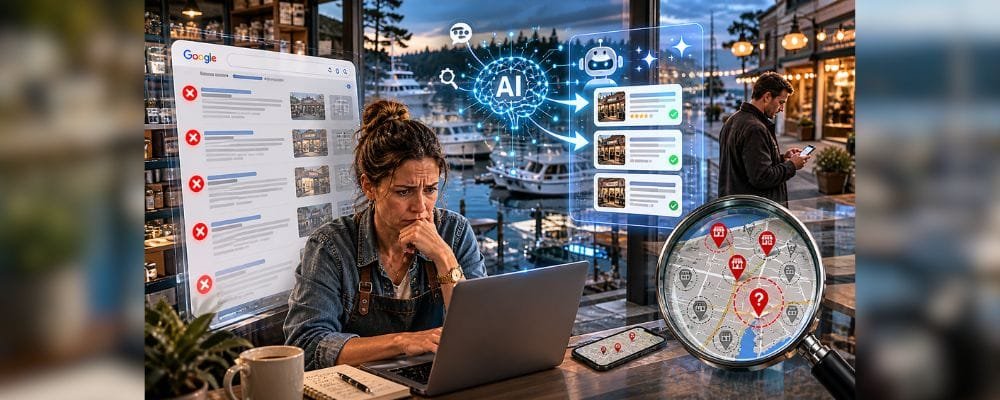
A Structural Shift in How Local Customers Find Businesses
Across Gig Harbor, business owners are noticing an unsettling pattern: phone calls no longer align with website traffic, competitors appear prominently without obvious cause, and established local names quietly fade from visibility despite doing nothing differently. This is not the result of random fluctuation or a temporary algorithm update. It reflects a fundamental change in how search engines now surface and recommend local businesses to buyers who are actively ready to purchase.
The mechanism driving this shift is identifiable, its impact is measurable, and its consequences are already reshaping competitive standing across local markets. Businesses that recognized and adapted to this change are being recommended by AI-powered search systems. Those that have not are being systematically filtered out of the answers that buyers see first.
How AI Overviews Have Replaced the Traditional Search Result
The Old Model and the New Reality
Search, as most business owners still understand it, presented a list of ten links arranged by relevance. That familiar hierarchy is being steadily replaced by something fundamentally different. According to Google’s Search documentation, many local queries now begin with an AI-generated Overview, a paragraph-length recommendation that summarizes options, names specific businesses, and frames a buyer’s decision before a single link is ever clicked.
This feature appears with particular frequency on exactly the queries that matter most to local service businesses:
- “web design Gig Harbor”
- “best contractor near Gig Harbor”
- “website designer Gig Harbor WA”
As per Google’s Search Central Blog, AI Overviews are designed to deliver synthesized answers rather than lists, which means the competitive landscape has compressed from ten visible options to a curated recommendation of two or three. A business cited inside that AI-generated answer is seen immediately. A business excluded from it is competing for attention after a buyer’s initial impression has already been formed. Ranking first in the traditional results below the AI Overview no longer guarantees meaningful visibility, because many buyers do not scroll past the AI-generated answer at all.
Why Business Performance Feels Inconsistent Without an Obvious Cause
Compression Is the Hidden Variable
Many Gig Harbor business owners report that nothing appears broken on the surface. The website still exists and still ranks. Analytics still register traffic. Yet revenue leads feel unstable and unpredictable. The underlying explanation is search result compression.
Traditional search distributed attention across many results, giving multiple businesses a reasonable share of visibility. AI-generated answers concentrate that same attention into a single synthesized response with a small number of cited names. Buyers trust these AI-generated answers and act on them quickly, some calling the recommended business immediately, others refining their search, and still others moving to alternative AI tools such as ChatGPT or Perplexity AI, each of which generates its own recommendation before a buyer ever visits a website.
As per BrightEdge Research (2024), generative AI features now influence more than 50% of search interactions in key commercial categories, meaning that the decision-making process for a significant portion of buyers now begins and sometimes ends inside an AI-generated response, not on a business’s website.
The Two Audiences That Every Local Website Now Must Serve
Human Visitors and AI Evaluation Systems
A local business website no longer serves a single audience. It simultaneously serves two distinct evaluators with overlapping but distinct needs. The first is the human visitor, someone evaluating credibility, scanning for clarity, and deciding within seconds whether to take the next step. The second is the AI evaluation system that processes a business’s online presence before that visitor ever arrives and determines whether the business merits inclusion in its generated recommendations.
Both audiences evaluate the same core signals: clear and consistent information, demonstrated local relevance, direct answers to practical questions, and verifiable expertise. There is no separate “AI optimization strategy” that exists apart from the fundamentals of building a clear and trustworthy website. What has changed is the severity of the penalty for failing to meet those standards, now that AI systems are making inclusion decisions before buyers reach a business’s content at all.
What Determines Whether AI Systems Recommend Your Business
The Four Factors That Drive AI Visibility
AI search systems do not make arbitrary recommendations. They evaluate structured signals from a business’s complete online presence and make probabilistic judgments about trustworthiness, relevance, and authority. Four factors carry the most weight in those evaluations.
1. Consistency of Business Identity
AI systems draw on data from multiple sources simultaneously, a business’s website, its Google Business Profile, its directory listings, and third-party mentions across the web. When those sources present inconsistent information, whether differing phone numbers, varying service descriptions, or misaligned business names, the AI system’s confidence in that business decreases. As per Moz’s Local Search Ranking Factors Report, NAP consistency (Name, Address, Phone) across all platforms remains one of the most foundational signals in local search, and its importance has grown rather than diminished in the AI era.
Consistency is not a cosmetic detail. It is the foundational layer on which all other visibility is built.
2. Depth of Locally Relevant Content
Generic content, descriptions of services that could apply equally to any city or region, no longer competes effectively in local search. A business that addresses the specific context of its market, including local costs, local timelines, and locally relevant considerations, holds a structural advantage over larger competitors whose content is broader but less specific. As per Semrush’s Content Marketing Study (2023), pages that directly answer specific local questions demonstrate significantly higher engagement and organic visibility than generalized service pages.
Relevant questions a Gig Harbor business website should answer directly include: What does this service cost in the Gig Harbor area? How long does this type of project typically take? What should a local homeowner or business expect from this process?
3. Verifiable Expertise and Demonstrated Authority
AI systems apply a version of the same judgment a careful buyer applies when evaluating a service provider: Does this business actually know what it is doing? Named authors, specific technical explanations, evidence of real work completed, and consistent professional messaging all contribute to the credibility signals that AI systems use to evaluate authority. As per Google’s Quality Evaluator Guidelines, the concept of E-E-A-T (Experience, Expertise, Authoritativeness, and Trustworthiness) now explicitly shapes how content is evaluated for both human quality raters and AI-driven systems.
Authority is not declared through credentials listed on a page. It is demonstrated through the depth and specificity of the information provided.
4. Immediate, Front-Loaded Answers
AI systems extract information from the earliest portions of a page’s content, giving substantial weight to what appears in the first paragraph or the first two hundred words. A page that builds slowly toward its main point, spending several paragraphs on introductions and background before delivering its core answer, is less likely to be used as a source in AI-generated recommendations. The correct structure leads with the clearest, most direct answer to the question a buyer is asking, then expands and supports that answer in subsequent paragraphs. This structure serves both human readers, who also benefit from clarity at the outset, and AI systems, which favor content organized around immediate utility.
What This Means Specifically for Gig Harbor Businesses
Three Competitive Realities That Define the Current Landscape
Geographic Proximity Is No Longer a Sufficient Competitive Advantage
Operating in Gig Harbor no longer guarantees preferential treatment in local search results. A competitor based outside the immediate area but maintaining a stronger content profile and more consistent online presence can and does appear prominently in local results. Conversely, a well-established local business with a weak or outdated online presence can disappear from local visibility entirely. The competitive advantage now flows from the quality and consistency of information, not the proximity of the business.
Being Cited Inside the AI Answer Matters More Than Traditional Ranking Position
The goal of local search strategy has shifted from achieving a high position in the traditional ranked list to being referenced inside the AI-generated answer that appears above that list. This distinction is critical. A business ranked third in traditional results but cited inside the AI Overview receives more effective visibility than a business ranked first in traditional results but excluded from the AI answer. Achieving citation requires demonstrating authority, maintaining consistency, and producing content that is genuinely responsive to the questions buyers are asking.
Content Depth Across Multiple Related Pages Outperforms Single-Page Approaches
AI systems evaluate a business’s authority across its full content footprint, not from a single page in isolation. A business that builds connected, mutually reinforcing content, including detailed service explanations, transparent cost information, project timelines, hiring guides, and locally relevant insights, signals expertise more convincingly than a business with a single well-written service page. As per Ahrefs’ Content Strategy Research, topical authority, the depth and breadth of content coverage around a defined subject area, has become a primary driver of organic visibility in AI-influenced search environments.
Where Most Local Business Websites Currently Fall Short
The Gap Between Basics and What AI Systems Require
Most Gig Harbor businesses have established the foundational elements of local search presence: a Google Business Profile, a collection of customer reviews, and accurate contact information. These elements remain necessary, but they are no longer sufficient to drive consistent AI-generated visibility. The gaps that now create competitive disadvantage are structural and content-related.
Structured data, commonly referred to as schema markup, provides AI systems and search engines with machine-readable context about a business, identifying it explicitly as a local service provider, specifying its service area, and clarifying the nature of its offerings. As per Schema.org and Google’s Structured Data documentation, businesses that implement relevant schema markup provide AI systems with significantly clearer signals and are more reliably included in local recommendations.
The more substantial gap, however, is in content depth. Most local business websites describe their services in general terms. They communicate what the business does without answering the specific questions buyers are actually searching for. Buyers are not searching for service descriptions. They are searching for answers to practical questions, and the businesses that provide those answers directly and accessibly are the ones being surfaced by AI systems as credible recommendations.
Three High-Impact Actions to Improve AI Visibility Now
Practical Steps for Gig Harbor Businesses
Treat Your Google Business Profile as an Active, Ongoing Asset
A Google Business Profile is not a static directory listing. It is a dynamic signal that AI systems monitor for recency, responsiveness, and accuracy. Regular updates to business hours, services, and photos, combined with consistent, professional responses to customer reviews, signal to Google’s systems that the business is actively managed and credible. As per Google’s own guidelines for Business Profiles, businesses that engage regularly with their profiles receive preferential treatment in local discovery results.
Restructure Pages to Lead with Direct Answers
Conducting an honest audit of your current website pages reveals whether they are structured to serve AI visibility or working against it. Pages that open with introductions, background context, or general descriptions before reaching their core point are losing the opportunity to be used as AI sources. Restructuring those pages to answer the buyer’s most likely question within the first paragraph, and then supporting and expanding that answer, serves both the human visitor and the AI system evaluating the page’s usefulness.
Audit Your Business’s Presence Across AI Platforms Directly
The most efficient way to identify gaps in your current AI visibility is to search for your business and your service category directly within Google Search, ChatGPT, and Perplexity AI. Reviewing what each platform surfaces reveals whether your business is being recommended, whether the information presented is accurate, and which competitors are currently being cited in your place. This audit, conducted quarterly, provides more actionable intelligence than most formal reporting tools.
The Principle That Remains Constant Amid Changing Technology
Clarity and Trust Are Still the Foundation
The tools through which buyers find local businesses have changed substantially. The underlying principle that determines which businesses are found has remained consistent. Businesses that communicate clearly, maintain consistent and accurate information across all platforms, and demonstrate genuine expertise in their field will be found, increasingly, they will be recommended before buyers ever make an active choice.
As Search Engine Land observed in its 2024 coverage of AI-driven local search, “The businesses winning in AI-generated results are, almost without exception, the ones that have built the clearest and most trustworthy online presence over time.” AI systems are not replacing the standards that have always defined effective local marketing. They are enforcing those standards earlier and more systematically in the buyer’s journey.
A website that guides a visitor clearly and efficiently from the question they are asking to the answer they need will be the same website that AI systems select to recommend. The work required to achieve that clarity is the same work it has always been. The consequences of neglecting it, in an environment where AI systems make recommendations before buyers even begin browsing, are now considerably higher.
Hyper Effects specializes in web design and digital marketing for local businesses in Gig Harbor, WA. For more information about improving your business’s AI search visibility, visit hypereffects.com.
Related reading:
Trust Signals a Gig Harbor Website Must Have in 2026
What a Website Really Costs in Gig Harbor, And What It Returns