
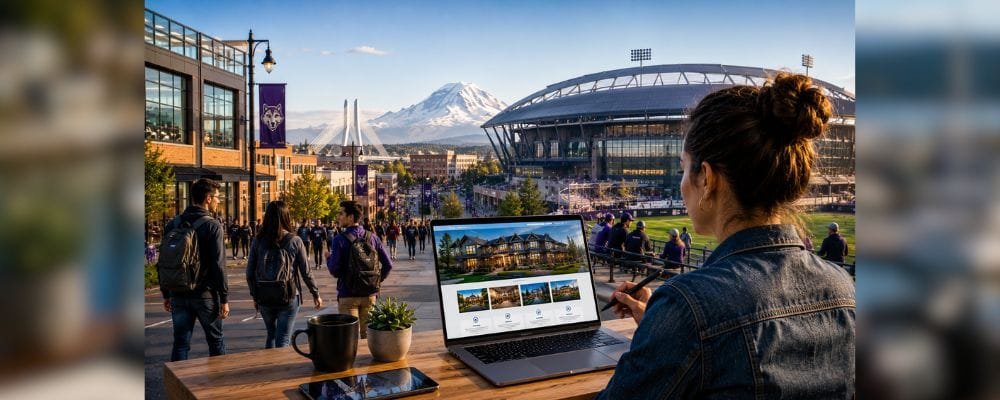
Here’s what Stadium District business owners miss: Your customers are split between two distinct groups with completely different decision-making psychology.
Stadium District is Tacoma’s most unique neighborhood. It’s adjacent to University of Puget Sound, which creates a fascinating customer mix: college students and faculty with limited budgets, established professionals with higher spending power, and longtime residents with community loyalty.
A website that works for one group fails spectacularly for the other. College students evaluate businesses differently than 45-year-old homeowners. Faculty evaluate differently than undergraduates. Your website needs to speak to all of them simultaneously—or strategically choose your primary audience.
This guide reveals exactly how to position Stadium District businesses online, capture both the college and community demographics, and build a website that converts your neighborhood’s unique customer base.
Stadium District: The Unique Neighborhood Context
Who Lives and Works in Stadium District?
Stadium District spans the area around University of Puget Sound, featuring a mix of residential, commercial, and institutional presence.
The demographic split:
- UPS students: ~2,500 (mostly ages 18-22, limited budgets, trendy preferences)
- UPS faculty/staff: ~400 (professional, educated, regular customers)
- Established residents: Families, professionals, long-term community members
- Young professionals: Graduate school, early career, building careers
- Young families: Homeowners, establishing household preferences
This mixed demographic is both Stadium District’s greatest opportunity and greatest challenge.
What Stadium District Customers Actually Want
College students and young adults want:
- Affordability and value
- Trendiness and novelty
- Social atmosphere and hangout space
- Convenience and accessibility
- Instagram-worthiness (visual appeal)
Established residents and professionals want:
- Quality and reliability
- Expertise and credibility
- Community integration and loyalty
- Convenience and efficiency
- Relationship and personalization
Website Strategy: Choosing Your Positioning
The Stadium District Choice: Broad Appeal vs. Niche Focus
Option 1: Broad Appeal Position your website to attract both college customers AND established community members. This works if your service is genuinely appealing to both groups.
Best for: Restaurants, coffee shops, retail, gyms, general services
Option 2: Niche Focus – College-Adjacent Deliberately position toward college/young professional demographic. Accept you’re not targeting established residents.
Best for: Trendy restaurants, bars, apparel, entertainment, services
Option 3: Niche Focus – Established Community Deliberately position toward established professionals and longtime residents. Accept you’re not targeting college market.
Best for: Professional services, specialty retail, higher-end restaurants, health services
Most Stadium District businesses thrive with Option 1 or Option 3—not trying to equally appeal to both.
Positioning for Mixed Demographics
Homepage Messaging That Works
If you’re pursuing broad appeal, your homepage must immediately communicate value to both segments without feeling generic.
What WORKS: “Premium quality at Stadium District prices. Trusted by UPS faculty and neighborhood families since 2008.”
What FAILS: “Great place for everyone!” (too generic, appeals to nobody specifically)
Visual Design for Stadium District
College customers evaluate visual design as trendiness indicator. Established professionals evaluate it as quality/credibility indicator.
Design elements that work for both:
- Clean, professional layout (credible to professionals, appeals to trendy crowd)
- Real photography featuring actual customers (authentic to both groups)
- Balance of contemporary style with established aesthetic
- Mobile-first (college students research on phones exclusively)
- Fast load times (both demographics respect efficiency)
What fails:
- Overly trendy design that screams “college bar” (alienates professionals)
- Formal corporate design that screams “stuffy” (alienates young people)
- Underdeveloped mobile experience (college customers abandon immediately)
Stadium District-Specific Content Strategy
Content Addressing Both Demographics
For college customers:
- Events and happenings
- Social media integration
- New menu items or offerings
- Student specials or discounts
- Active, dynamic content
For established customers:
- Longevity and history (“Serving Stadium District since…”)
- Community involvement and loyalty
- Consistency and reliability
- Established customer testimonials
- Proven track record
Both groups value:
- Transparency (pricing, policies, what to expect)
- Convenience (hours, location, access)
- Quality signals (photos, reputation, reviews)
Local Authority in Stadium District
Stadium District customers want to support local businesses. Your website should demonstrate local commitment.
What builds local authority:
- “Owned and operated by Stadium District residents”
- Visible community involvement (sponsorships, partnerships, events)
- Stadium District landmark references
- Customer testimonials from recognizable neighborhood businesses
- Support of UPS and Stadium District causes
Conversion Strategy for Mixed Demographics
Different CTAs for Different Audiences
College customers and professionals use different paths to conversion.
College customer journey: Research → Instagram/social → Visit → Purchase/Return
Professional customer journey: Research → Website → Review → Contact → Purchase
Your website should support both:
- Prominent social media links (for college customers)
- Easy contact options (for professionals)
- Student specials/discounts (for college market)
- Premium service/quality signals (for professionals)
FAQ Section: Stadium District Questions
Q: Should I specifically mention University of Puget Sound on my website?
A: Yes, but carefully. Reference UPS and campus connection, but don’t position exclusively for students. Many professionals and residents value UPS connection too.
Q: How do I capture both college AND professional customers?
A: Position as “Stadium District institution” that serves the entire neighborhood. Mention both groups specifically: “Favorite of UPS students AND established Stadium District families.”
Q: What if my business is specifically targeting students?
A: Then position accordingly. Trendy design, social media focus, student testimonials, affordability emphasis. But understand you’re deliberately choosing to exclude professionals.
Q: How important are Google reviews for Stadium District?
A: Very important. College customers read reviews. So do professionals. Aim for 30+ reviews minimum, with mix of both demographics represented.
Q: Should my website include student discounts?
A: If you serve students, yes. Make them visible and easy to claim. Student specials are marketing tool that drives traffic while maintaining price perception for professionals.
Common Stadium District Website Mistakes
Mistake 1: Trying to Please Everyone
Attempting to equally appeal to college students AND older professionals usually pleases neither. Choose your primary audience.
Fix: Clearly position toward one group, acknowledge the other exists, position as neighborhood institution.
Mistake 2: Ignoring Mobile Experience
College students research exclusively on mobile. Poor mobile experience eliminates your largest demographic.
Fix: Mobile-first design that works flawlessly on phones.
Mistake 3: Lack of Social Integration
Young customers expect social media integration. Absence signals you don’t understand your market.
Fix: Prominent social media links, Instagram feed integration, social proof visible.
Mistake 4: No Community Connection Signals
Both demographics value community. Websites that show no community connection fail both groups.
Fix: Visible community involvement, neighborhood references, establishment longevity.
Mistake 5: Unclear Value Proposition
Vague messaging fails Stadium District customers. Be specific: What exactly do you do? Why choose you?
Fix: Clear positioning that immediately communicates value to your primary audience.
Implementation Strategy
Phase 1: Clarify Positioning (Week 1)
- Decide: Broad appeal, college-focused, or professional-focused?
- Define your primary audience
- Develop positioning statement
- Identify secondary audience messaging
Phase 2: Website Optimization (Weeks 2-3)
- Rewrite homepage for chosen positioning
- Optimize mobile experience completely
- Add social media integration
- Develop community connection signals
- Create student/professional-specific content
Phase 3: Local SEO (Week 4)
- Optimize Google Business Profile for Stadium District area
- Build local citations
- Create neighborhood-specific landing page
- Generate Stadium District customer reviews
Phase 4: Content & Promotion (Weeks 5+)
- Create Stadium District-specific content
- Build email list specific to demographics
- Develop social media strategy for target audience
- Regular community involvement/sponsorships visible on site
Taking Action
Schedule a free Stadium District web design strategy consultation to evaluate whether your website is actually positioned for your primary Stadium District audience and identify optimization opportunities.