

Your Website Might Be Costing You Thousands
Not Because It’s Bad, But Because It’s Quiet
Your website might be costing you thousands. Not because it is ugly, slow, or outdated, but because it is quiet. Quiet like a storefront with the lights on and the door unlocked, but nobody welcoming visitors or showing them where to go. That silence creates financial loss. It does not scream. It simply lets opportunities walk away.
If that idea feels uncomfortable, you are not alone. Many business owners believe a website’s job is to act as a digital business card. It proves the business exists and nothing more. That creates an illusion of completion while revenue leaks through the gaps.
The Root Cause: A Website That Doesn’t Guide Decisions
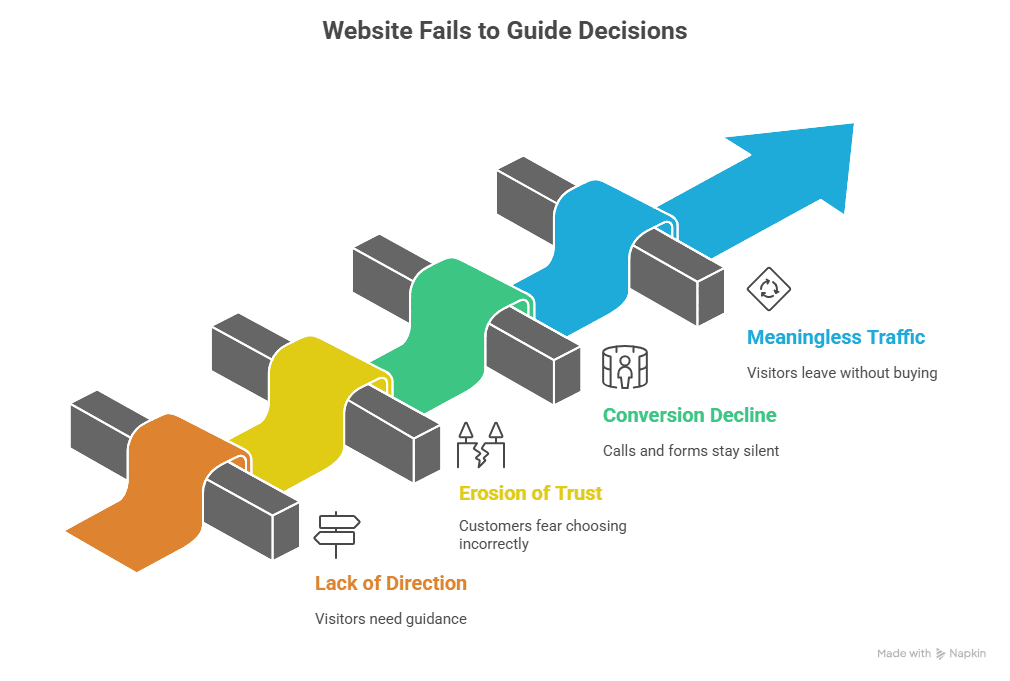
Customers do not arrive ready to buy. They land with questions, hesitation, and fear of choosing incorrectly. A quiet website forces them to figure everything out on their own. Most will not. They leave.
The core issue is not design. The issue is direction. A website can look great and still be passive. Visitors need guidance, not decoration.
When a site does not guide:
• Trust drops
• Conversions fall
• Calls and forms stay silent
• Traffic becomes meaningless
A passive site whispers when it should lead.
The Real Cost of Silence
The impact shows up slowly:
• Missed leads
• Abandoned carts or forms
• Short visits with no action
• Great traffic but low sales
Silence is expensive. It drains potential without warning. Most owners blame marketing, competitors, or pricing before they consider the website itself.
If this sounds familiar, there is nothing wrong with you or your intentions. The expectations for what a website must do have changed. Your strategy needs to change with it.
The Mindset Shift: From Digital Card to Digital Sales Assistant
Growth starts when a website stops acting like a static brochure and starts acting like a guiding assistant. Not aggressive. Not salesy. Just clear, human, and helpful.
A website can be a:
Navigator that helps visitors self-identify
Advisor that answers questions before they are asked
Reassurance tool that reduces risk
Pathway that leads to a decision
This requires structure, not slogans.
The Solution Framework
Principle 1: Assign Every Page a Job
A homepage is not a gallery. Its job is to help visitors find themselves and choose a path.
• Service selector instead of lists
• “Who are you?” navigation paths
• Problems before offerings
When visitors see themselves, they stay.
Principle 2: Start With Questions, Not Features
People care more about their problem than your solution. Speak to the situation before the service.
Understanding comes before selling.
Principle 3: Make Decisions Easy
Quiet websites force people to think. Thinking creates friction.
Replace friction with:
• Guided pathways (Choose your situation)
• Clear next steps
• Contact options that match personality types
Ease builds confidence.
Principle 4: Prove Value Without Boasting
Visitors need to feel safe, not impressed.
Use:
• Typical timelines
• Measurable outcomes
• Before and after clarity
Understatement feels more trustworthy than hype.
Principle 5: Reveal What Others Hide
Silence around pricing, scope, and timelines creates fear.
Transparency, even partial, increases trust.
Examples:
• “Most projects fall between…”
• “Here is what happens on the first call…”
• “Typical turnaround is…”
This replaces doubt with clarity.
Principle 6: Ask for Action at the Right Time
A call to action should meet readers where they are.
• Low commitment step for early readers
• Strong CTA for ready buyers
You are not chasing them. You are walking beside them.
Reassuring Close
If you suspect your website is costing you money without showing you the invoice, your instinct is valid. The issue is not effort, intelligence, or intention. It is misalignment between what the website is doing and what customers need.
Start with one change.
One pathway.
One page with a clear job.
Progress compounds. Silence fades. Clarity grows. Revenue follows.
When your website stops being quiet, your business stops being invisible.
You finally stop losing money you never knew was leaving.