

Website traffic without leads feels like a quiet failure. You watch your analytics climb, visitor numbers rise, and maybe even organic search improve. Yet the inbox stays empty, calls are rare, and form submissions feel accidental.
Most business owners assume that if SEO is working, leads should automatically follow. That assumption makes this problem feel personal, like something is wrong with the business or that people simply are not interested. The truth is more practical and less painful.
Traffic is not the same as demand. Ranking on Google and being persuasive are two different skill sets. SEO brings people to the door. Conversion gives them a reason to walk inside. When the conversion layer is weak, even successful SEO cannot save lead generation.
Why This Happens (In Real-World Terms)
Most websites are built like brochures. They share who you are, what you do, and maybe a few testimonials. What they do not share is what to do next.
They rely on visitors to figure out how to become a lead. Confused visitors leave. Visitors who do not feel seen leave. Visitors who cannot find value for them leave.
No blame here. Most designers focus on visuals and speed. Most business owners believe traffic equals results. Nobody teaches conversion psychology or guided sales flow by default. So you end up with a site that looks clean but fails to move anyone toward contact.
The Real Consequences
If nothing changes, the impact grows:
• Ads get more expensive because landing pages fail to convert
• Organic traffic feels like wasted effort
• Competitors with weaker rankings still win more leads
• Confidence drops and marketing decisions become reactive
• The business starts to feel invisible even while being found
This is not an SEO problem. It is a conversion problem.
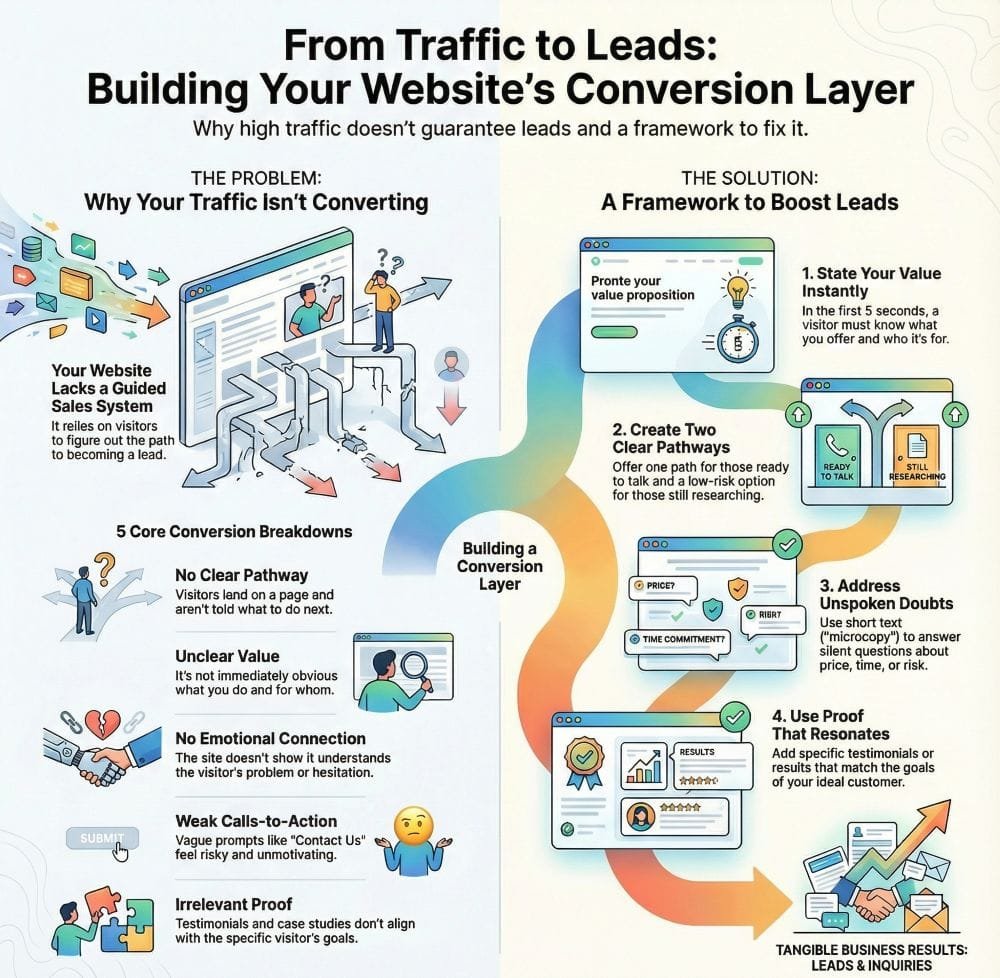
The Five Core Breakdowns Blocking Your Leads
1. No Friction-Free Pathway
There is navigation, but not direction. Websites hope visitors explore rather than guiding them. Exploration is not conversion.
2. Unclear Value Above the Fold
Visitors must understand what you do, who it is for, and why they should care within three to five seconds. If clarity is missing, attention drops instantly.
3. No Emotional or Functional Anchoring
Buyers want proof you understand their situation. They need to feel seen. When websites skip this and go straight to features, offers feel generic.
4. Weak Offers and Weak CTAs
“Contact us” is not a motivation. People need low-pressure stepping stones that feel safe and predictable.
5. Proof Without Relevance
Testimonials are not convincing by default. They must match the buyer’s category, pain point, or hesitation to move them forward.
The Fix: Add a Conversion Layer
Solving this does not require a full redesign. It requires treating the website like a guided system instead of a digital brochure.
Here is a clear and practical framework.
Step-by-Step Solution Framework
Step 1: Audit the First 10 Seconds
Ask someone unfamiliar with your site:
• What do we do?
• Who do we help?
• What is the next step?
If they hesitate, your clarity is missing.
Step 2: Rewrite the Hero Section
One sentence: what you offer
One sentence: who it is for
One short list: what problem it solves or outcome it creates
One clear action: the next step
Step 3: Answer Silent Objections
Visitors wonder:
• Will this be expensive
• What will happen after I click
• Is this relevant to my situation
Use short supportive lines to relieve these doubts. Guidance, not pressure.
Step 4: Create Two Conversion Pathways
One for action takers: book a call or instant quote
One for cautious visitors: pricing guide, quiz, lead magnet, or demo
Movement matters more than speed.
Step 5: Add Relevant Proof
Choose your top three customer types.
Pair each with one aligned proof point.
Relevance beats quantity.
Step 6: Simplify Navigation
Limit options. Lead decisions. Remove distractions.
Navigation should feel like a guided journey, not a menu.
Step 7: Align SEO Traffic With Intent
Research keywords that attract early-stage vs buying-intent visitors.
Match pages to their stage.
Mismatch is one of the main reasons traffic does not convert.
What Happens When You Fix This
• Visitors stay longer
• Engagement rises naturally
• Calls and submissions feel consistent
• Paid ads become more profitable
• SEO finally translates into revenue
Growth becomes predictable.
Your website stops waiting for leads and starts earning them.
A Reassuring Close
If your website gets traffic but no leads, you are not failing. The site is signaling that the conversion layer is missing.
When you add structure, clarity, guidance, and human psychology, growth becomes possible again.
Understanding the problem is the first win.
Applying the framework is the second.
Watching lead flow change is the third.
This is where momentum begins.
And now you know what to fix.
Ready to turn traffic into leads instead of guesswork?
If you want a website built to guide buyers, reduce hesitation, and convert consistently, Hyper Effects can help. We design sites that act like sales systems, not online brochures. Every page is built with clarity, psychology, and lead flow in mind so your marketing finally pays off.
Start with a conversation, not a pitch.
Tell us what is happening on your website right now, and we will show you what to fix first.
Book a free clarity call with Hyper Effects and see how your site can become a revenue engine: