
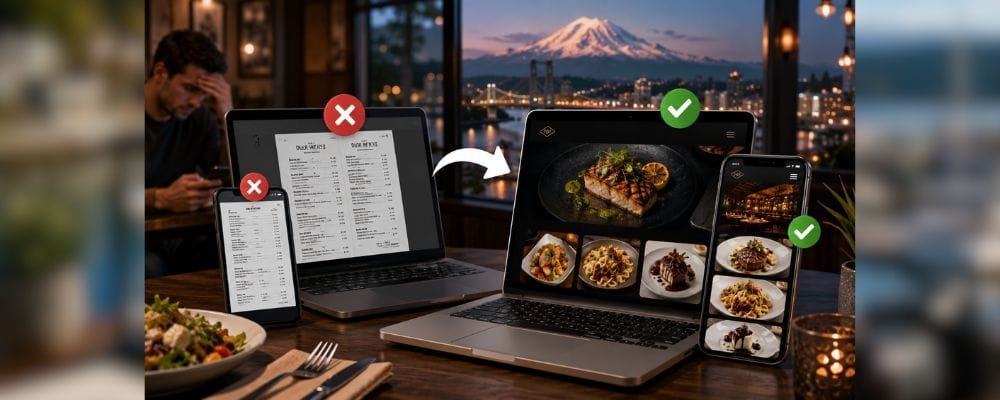
Someone in Tacoma is deciding where to eat tonight.
They may be walking near Ruston Way after work, searching on their phone before a concert downtown, or comparing dinner options while sitting in a parked car outside another restaurant. A menu page opens on their screen, and within seconds they begin making judgments that directly influence whether they continue forward or quietly move on.
The decision rarely starts with food quality alone. The decision begins with confidence.
Customers evaluate whether the restaurant feels organized, trustworthy, modern, easy to navigate, and worth their time. A confusing or outdated menu page immediately creates hesitation, even when the actual restaurant experience is excellent.
That reality has changed the role of Tacoma restaurant website design entirely.
A restaurant website in 2026 is no longer functioning as a simple online business card. The website now operates as a trust-validation and decision-guidance system. At the center of that system sits the menu page, which often determines whether a visitor becomes a reservation, an online order, or a lost opportunity before the restaurant ever has a chance to serve the customer.
The Menu Page Has Become the Real First Impression
The first interaction many customers now have with a Tacoma restaurant happens digitally rather than physically.
As per source “Toast Restaurant Marketing Guide,” customers increasingly expect restaurants to make menus, online ordering, reservations, operating hours, and location information immediately accessible because these elements influence dining decisions directly.
A customer searching for dinner is rarely evaluating only one restaurant. Most diners compare several restaurants simultaneously, especially in competitive areas such as downtown Tacoma, Ruston Way, Proctor District, and Tacoma’s growing waterfront dining scene.
This creates an important shift in customer psychology.
The restaurant that removes uncertainty first usually gains the advantage.
A strong menu page answers critical questions immediately. Customers want to know what the restaurant serves, whether pricing aligns with expectations, whether online ordering is available, whether reservations are simple, and whether the experience feels aligned with the type of evening they are planning.
The website that communicates those answers clearly keeps the visitor engaged. The website that forces visitors to search, guess, zoom, or interpret information creates exits.
Why PDF Menus Quietly Damage Restaurant Conversions
Many restaurant owners still upload menus as PDF files because the process feels operationally simple. Customers experience those PDF menus very differently.
PDF menus often create a frustrating mobile experience involving zooming, sideways scrolling, loading delays, and poor readability. These problems appear precisely at the moment when customers are trying to make quick dining decisions.
As per source “Chowly Restaurant Website Design Research,” mobile-friendly searchable menus consistently outperform PDF menus because they reduce friction and improve usability during high-intent dining searches.
The Tacoma customer comparing restaurants is not approaching the process patiently. Multiple browser tabs are often open simultaneously. A restaurant menu that feels difficult to navigate creates immediate comparison against competitors whose websites offer cleaner and faster experiences.
This issue extends beyond usability alone.
Search engines and AI-driven recommendation systems struggle to interpret PDF-based menu structures effectively. Restaurants hiding menus inside static files reduce their visibility for searches such as:
- Tacoma seafood restaurant
- best brunch Tacoma
- Tacoma waterfront dining
- family restaurants Tacoma
- vegan restaurant Tacoma
Google increasingly evaluates structured, searchable information when determining which businesses deserve visibility. Restaurants forcing search engines to interpret incomplete or inaccessible menu structures lose opportunities before rankings are even established.
A Restaurant Website Should Remove Thinking, Not Create It
One of the most important principles behind modern restaurant website design is simple: a website should remove thinking rather than create it.
Visitors arrive with intent already established. The website’s responsibility is to guide that intent toward action with as little friction as possible.
The strongest Tacoma restaurant menu pages follow deliberate decision architecture. Categories are visible immediately. Typography is readable on mobile devices. Pricing is clear. Ordering pathways are obvious. Dietary information is accessible. Reservations remain visible throughout the browsing experience.
This structure matters because hungry customers do not want complexity. They want certainty.
As Hyper Effects’ customer journey philosophy explains, hesitation begins the moment visitors start trying to figure things out on their own. When structure, messaging, and navigation quietly guide attention instead of scattering it, trust develops naturally and decisions become easier.
A high-performing Tacoma restaurant menu page should therefore include:
- Clear menu categories
- Mobile-first formatting
- Readable typography
- Visible pricing
- Reservation access
- Online ordering integration
- Dietary indicators
- Fast loading speed
- Authentic photography
- Clear operating hours
The purpose of these elements is not decorative presentation. The purpose is friction reduction.
Tacoma Diners Expect Authenticity Immediately
Local trust cannot be manufactured through generic branding tactics.
As Hyper Effects explains within its local authority philosophy, adding Tacoma in a footer or placing stock imagery of waterfront scenery on a homepage does not create genuine local credibility. Customers recognize authenticity through familiarity, relevance, and specificity.
This principle is especially important in hospitality.
Restaurant decisions are emotional long before they become practical. Customers want to imagine themselves inside the experience before arriving physically. Authentic visuals therefore become one of the strongest conversion tools available to Tacoma restaurants.
A waterfront restaurant should communicate atmosphere visually. A Tacoma brewery should showcase the real taproom experience. A family-oriented restaurant should immediately feel welcoming and approachable. A premium dining experience should project clarity, confidence, and refinement.
As per source hospitality marketing research from BentoBox, restaurants using authentic photography and experience-based visual storytelling create stronger emotional engagement than businesses relying on generic imagery.
People trust what feels familiar.
The restaurant website that feels connected to Tacoma itself builds credibility significantly faster than one relying on generic visual presentation.
High-Income Diners Evaluate Websites Differently
Customer psychology changes significantly in higher-income dining environments.
Hyper Effects’ audience analysis explains that higher-income buyers prioritize clarity, ease, confidence, and personalization over excessive explanation.
This behavioral pattern directly affects restaurants serving premium dining audiences in Tacoma.
A confusing menu structure quietly signals operational disorganization. A clean and intentional structure communicates professionalism, consistency, and confidence before the customer ever places an order.
This becomes especially important for:
- Waterfront dining establishments
- Chef-driven restaurants
- Premium casual dining
- Wine-focused restaurants
- Date-night dining experiences
- High-ticket dining concepts
Customers spending significantly on dining experiences expect the digital experience to reflect the same level of refinement as the physical environment itself.
A restaurant website attempting to sound generic and universally appealing often feels uncertain to audiences expecting personalization and clarity.
Online Ordering and Reservation Flow Must Feel Effortless
The menu page should function as a guided path toward action rather than an informational dead end.
Many Tacoma restaurants unintentionally create friction by hiding reservation systems, separating online ordering unnecessarily, or forcing visitors through confusing navigation structures before conversion can occur.
As per source “BentoBox Restaurant Platform Research,” direct reservation and ordering systems create stronger customer journeys because they reduce unnecessary interruptions between interest and action.
Customers should never need to wonder:
- How do I order?
- Can I reserve online?
- Is online ordering available?
- What are the restaurant hours?
- Can I contact the restaurant directly?
Every unanswered question introduces hesitation. Every hesitation creates an opportunity for competitors to capture attention instead.
The strongest restaurant websites maintain visible conversion paths throughout the browsing experience so customers can act immediately whenever decision confidence appears.
Mobile Performance Quietly Determines Which Restaurants Win
Restaurant searches are highly intent-driven and heavily mobile-based.
Customers searching for dining options are often already hungry, already nearby, or already prepared to spend money. A poorly optimized mobile experience interrupts that momentum immediately.
As per source Google mobile usability research, users abandon slow-loading mobile pages rapidly when attempting to complete intent-based actions.
This creates major consequences for Tacoma restaurants.
A slow menu page does not simply create inconvenience. It changes perception. Customers frequently associate slow, outdated, or frustrating websites with operational inefficiency before ever interacting with the restaurant itself.
Mobile usability therefore becomes part of the restaurant’s perceived professionalism.
A Tacoma restaurant website should load quickly, display cleanly across all screen sizes, and make ordering or reserving possible without forcing visitors through unnecessary steps.
Private VIP Analytics Reveals Where Restaurants Quietly Lose Customers
Most restaurant owners never actually see the moments where customer attention disappears.
They assume.
Private VIP Analytics changes that entirely by revealing real visitor behavior rather than delayed summaries alone.
This level of visibility allows restaurants to understand:
- Which menu sections receive the most attention
- Where visitors stop scrolling
- Which devices create friction
- Whether reservation forms are abandoned midway
- Whether mobile ordering paths are functioning properly
- Which pages quietly create exits
As Hyper Effects explains within its analytics philosophy, websites should never operate in the dark. Real-time behavioral visibility allows businesses to identify hesitation points precisely instead of relying on assumptions about customer behavior.
That visibility transforms how restaurants improve digital conversion systems over time.
The Menu Page Is Deciding More Than Most Restaurants Realize
Most Tacoma restaurant websites still treat the menu page as a secondary feature attached to the main website structure.
The restaurants growing consistently in 2026 approach the menu page differently.
They understand the menu page controls first impressions, customer confidence, mobile usability, local search visibility, ordering behavior, reservation conversion, and emotional trust simultaneously.
That changes the role of restaurant website design completely.
A restaurant website is not hired simply to exist online. The website is hired to guide customers toward action with clarity and confidence.
The menu page determines whether that process feels effortless or frustrating.
The Tacoma customer deciding where to eat tonight is evaluating far more than food. They are evaluating trust, ease, atmosphere, clarity, and confidence within seconds.
The restaurant website that removes uncertainty fastest usually becomes the restaurant that wins the customer first.