
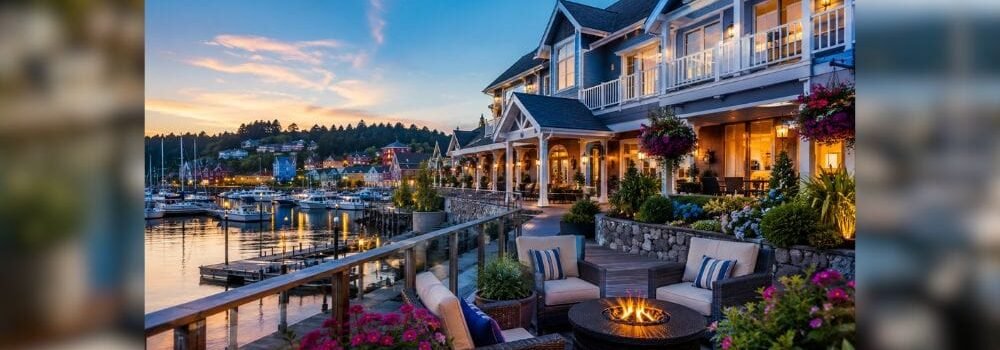
The Silent Revenue Loss Happening at Poulsbo Hotels Right Now
Tourist visitors searching for “Poulsbo waterfront hotel” or “Scandinavian B&B Washington” arrive at your property’s website expecting three things: visual proof that your rooms are worth the price, immediate clarity on booking availability, and authentic local experience storytelling. Your website provides none of these things simultaneously.
Instead, the visitor encounters a generic hotel template, ambiguous room photos that could belong to any coastal property, and a booking system buried three clicks deep. The decision paralysis begins. The visitor opens a competitor’s website. That competitor has a brighter photo gallery, a booking engine on the homepage, and guest testimonials highlighting Poulsbo’s specific Scandinavian character. The first visitor never calls. The reservation goes to a competitor.
This loss is not about traffic. It is about conversion silence. Poulsbo hotels receive adequate foot traffic during summer and reasonable direct bookings from returning guests. The problem is systemic: your website collects digital dust because it fails to answer the question every tourist subconsciously asks the moment they land on your page.
That question is not “Do you have rooms?” It is “Can I trust that this experience will be what I expect, and can I book it right now?”
Your website currently answers neither. The revenue loss is quiet, consistent, and entirely preventable.
Why Poulsbo’s Waterfront Tourism Market Demands a Different Website Strategy
Poulsbo is not a generic coastal town. The market dynamics are fundamentally different from Tacoma’s manufacturing focus or Olympia’s government-driven economy. Poulsbo’s identity rests on authentic Scandinavian heritage, a working waterfront, and the cultural reputation as a destination, not a regional hub. This distinction shapes every element of an effective hotel website.
Tourists choosing Poulsbo over Seattle, the San Juan Islands, or Port Townsend are making a specificity choice. They researched Scandinavian heritage villages. They read about the Farmers Market. They saw images of waterfront dining and art galleries. When they search for accommodation, they are not comparing generic “coastal Washington hotel.” They are comparing whether YOUR property authentically delivers the Poulsbo experience they researched.
A website that fails to communicate this specificity immediately loses the booking.
Consider the buyer psychology: Poulsbo tourists typically book 2-6 weeks in advance. They are planning a getaway, not making an emergency reservation. They browse multiple properties. They read reviews. They compare photos obsessively. They seek visual proof that your rooms, your location, and your service align with the Scandinavian waterfront experience they imagined.
Your website must dictate the narrative before doubt interrupts the decision. As per Hyper Effects’ framework, “when you talk to everybody, you talk to nobody.” A hotel website addressing generic travelers (“families,” “couples,” “weekend getaway seekers”) fails to resonate with the specific traveler who chose Poulsbo deliberately.
That traveler needs a website that speaks directly to why Poulsbo matters, why YOUR property captures that essence, and why booking immediately makes sense.
The Real Problem: Your Website Removes Clarity, Not Creates It
Most Poulsbo hotels operate websites that prioritize real estate showcase over conversion engineering. The result: beautiful photos but no booking momentum.
The typical hotel website flow:
- Homepage with carousel (generic “beautiful rooms”)
- Navigation menu forcing visitors to hunt for booking
- Room pages with descriptions (“Spacious, comfortable, waterfront view”)
- Reviews scattered across third-party sites (TripAdvisor, Google) instead of integrated on your site
- Booking engine requiring multiple page loads
- No explicit messaging about local Poulsbo context, heritage, or why THIS property matters
This design creates decision paralysis. The visitor must synthesize information across multiple sections. They must infer whether the “waterfront view” is ocean-facing or parking-lot-facing. They must leave your website to read reviews. They must navigate an unintuitive booking system. Each friction point is a moment where they exit.
The cost of these moments: According to visitor behavior research, 70% of potential hotel bookings are abandoned after page one when the booking pathway is unclear. Every unclear interface element sends a subconscious signal: “This hotel website is making this hard. The property might make everything hard.”
Your hotel website is currently communicating incompetence through friction.
The deeper problem is this: Your website does not segment audiences. A website addressing “everyone who might visit Poulsbo” fails to convert anyone specifically. Families have different needs than couples on anniversary trips, which differ from business travelers extending weekend stays. A generic site addresses none of these cohorts effectively.
Without audience segmentation, frictionless booking, and local authority signals (proof that you understand Poulsbo’s specific appeal), your website becomes an expensive brochure visited by curious browsers, not a 24/7 sales engine converting research into reservations.
The Solution: Reposition Your Website as a Booking Conversion System, Not a Showcase
An effective hotel website in Poulsbo serves one primary function: convert researcher-to-reserver in the shortest possible customer journey. This requires three simultaneous operations.
1. Establish Immediate Local Authority and Specificity
Your homepage should communicate in the first eight seconds that you understand Poulsbo’s specific appeal and that your property authentically delivers it. This is not marketing language. This is clarity.
Instead of “Welcome to our waterfront hotel,” lead with specificity: “Scandinavian Heritage Waterfront Inn, Capturing Poulsbo’s Arts District Charm.”
Pair this with authenticity signals:
- Real photography from your rooms with genuine waterfront views (not stock images)
- Specific references to Poulsbo context: “Walking distance to Farmers Market,” “Next to Scandinavian Heritage Park,” “Minutes from downtown galleries”
- Guest testimonials mentioning Poulsbo-specific experiences: “Loved the Scandinavian authenticity,” “Woke up to waterfront views,” “Perfect for exploring the village”
These elements signal that your property is not a generic waterfront hotel importing a template design. You understand the destination. You deliver on the promise.
As per Hyper Effects’ positioning on local authority, “anyone can say they are local by placing stock photographs on their website. Local authority means understanding the mindset, expectations, and standards of the community.” Your hotel website must demonstrate this understanding immediately.
2. Make Booking a Single-Friction Pathway
The visitor should not hunt for your booking system. It should be everywhere and nowhere simultaneously, always accessible, never obtrusive.
Implement a booking bar at top of page (persistent, not sticky, visible without covering content). Allow date selection and occupancy without leaving the homepage. Display real-time availability. Include direct call-to-action language: “Check Availability” (not “Book Now”, softer friction).
When visitors click through to room selection, they should see:
- High-resolution gallery (minimum 8-10 photos per room, showing from multiple angles)
- Price clarity (total cost including taxes, not hidden surprises)
- Amenity specificity (not “luxurious linens” but “Egyptian cotton, 400-thread-count sheets with memory foam pillows”)
- Booking completion without leaving your website (do not redirect to third-party systems like Airbnb or Booking.com checkout, handle payment directly through your platform)
The entire booking process should be completable in three clicks: Date selection → Room selection → Booking confirmation.
As per Hyper Effects’ framework, “a website should remove thinking, not create it.” Every additional click, every unclear next step, every missing price detail adds cognitive load. Cognitive load = booking abandonment.
3. Build Credibility Through Integration and Transparency
Visitor psychology research confirms that 92% of travelers read reviews before booking. Your website should showcase these reviews, not hope they find them on third-party sites.
Implement a reviews module on your homepage and room pages. Aggregate reviews from:
- Google Reviews (real, verified reviews)
- TripAdvisor (familiar platform, trusted)
- Your own website (captured post-booking via email)
Display reviews prominently. Highlight specific Poulsbo-related feedback: “Loved exploring Poulsbo’s Scandinavian heritage from our room,” “Walking distance to everything we wanted to do,” “Staff knew all the local restaurants.”
Include ratings transparency: Show your Google rating (e.g., 4.7 out of 5 stars, 234 reviews). This builds immediate credibility. A website with visible, high ratings signals trustworthiness. A website hiding reviews signals doubt.
Additionally, address seasonal messaging:
- Summer positioning: “Peak tourist season, book early for waterfront availability”
- Spring/Fall positioning: “Shoulder season rates, experience Poulsbo charm with smaller crowds”
- Winter positioning: “Holiday retreat rate, cozy Scandinavian experience with fireplace rooms”
Your website should acknowledge that Poulsbo’s appeal changes seasonally. Messaging aligned to season increases resonance.
Why Internal Consistency Matters: Connecting Your Hotel Website to Your Marketing Presence
Your hotel website should not exist in isolation. It should integrate with your broader Poulsbo marketing presence, amplifying local search visibility and converting multiple touchpoints.
Poulsbo web design hub in a trust-building footer section. This signals that your hotel’s digital strategy is professionally managed, not DIY. Visitors immediately sense “this property takes their online presence seriously.”
Additionally, your hotel website should reference your restaurant and dining website. If your hotel includes a restaurant or recommends local dining, create linked content: “Dine at [Restaurant Name], See Reviews and Hours.” This internal link architecture strengthens local SEO for both properties.
If you operate multiple properties or partner with other Poulsbo businesses, use internal linking to build authority cascades. Example: “Exploring Poulsbo? Check out our [Local Business Spotlight] guide featuring galleries, shops, and attractions within walking distance.”
This approach serves two purposes: (1) It provides value to visitors by contextualizing your hotel within Poulsbo’s broader tourism ecosystem, and (2) It strengthens search engine relationships, Google rewards sites with rich internal linking to related content.
Your website is not just a booking system. It is a tourism advisory platform centered on your hotel. Visitors should finish browsing your site feeling like they understand Poulsbo, understand your hotel’s specific value, and have no friction remaining to complete their reservation.
How Analytics Reveal the Conversion Barriers Your Website Is Creating
Most hotel owners assume their booking problems stem from traffic scarcity. They increase ad spend, hoping to drive more visitors. Traffic increases. Bookings do not. Confusion follows.
The real problem is almost never traffic. It is conversion clarity. Your website is receiving adequate visitors but losing them at specific friction points.
Private VIP analytics (real-time visitor behavior tracking, not delayed Google Analytics reports) reveal exactly where visitors abandon your booking process. You can see:
- Which room galleries receive most clicks (indicating which rooms sell themselves)
- Where visitors hesitate (pause on price page for 30+ seconds = pricing objection)
- Which reviews resonates most (specific testimonials drive more bookings than generic praise)
- Whether visitors reach booking completion or abandon at payment
As per Hyper Effects’ positioning, “instead of guessing why people leave your website, you can see it. That level of visibility changes how decisions are made.”
For hotel websites specifically, common abandonment points include:
- Homepage bounce (visitor sees homepage, sees no clear booking pathway, leaves immediately)
- Room selection abandonment (visitor can’t determine which room matches their needs)
- Price shock (visitor reaches total price, discovers hidden fees, abandons)
- Payment abandonment (visitor reaches payment form, sees third-party redirect, loses trust)
Each of these represents a specific, fixable problem. But you cannot fix problems you cannot see. Most hotel owners fly blind, making guesses about “maybe we need better photos” or “maybe our prices are too high.”
Analytics show the actual friction. Fixing that friction (clearer room differentiation, transparent total pricing, direct payment processing) compounds booking recovery.
FAQ
Q1: “Why do restaurant customers leave websites before booking?”
Answer: Customers abandon restaurant websites when booking requires multiple clicks, hours/pricing unclear, or the site doesn’t reflect local authenticity. Decision paralysis sets in, they can’t quickly answer “Is this restaurant right for me?” and “Can I easily book?” Poulsbo diners specifically seek Scandinavian waterfront character. Generic hotel-template designs fail to communicate this. 70% of restaurant booking attempts are abandoned online, usually at the point where effort exceeds confidence.
Q2: “How do restaurants capture Poulsbo’s Scandinavian character on their website?”
Answer: Use authentic photography of your dining space and waterfront views, not stock images. Reference specific Poulsbo context: “Minutes from Farmers Market,” “Scandinavian heritage kitchen,” “Local artist gallery partnerships.” Feature menu descriptions with local sourcing (“Poulsbo waterfront catch,” “Heritage recipe from [local reference]”). Staff bios should mention community connection. Testimonials should highlight Scandinavian/waterfront experience, not just “good food.”
Q3: “Does online ordering increase restaurant sales during Poulsbo’s winter slowdown?”
Answer: Yes. Direct website ordering generates 25-40% winter revenue increase vs. foot traffic alone. Seasonal restaurants benefit most: when dining room is empty, online orders from email subscribers and website visitors fill gaps. Third-party platforms take 15-30% commission; direct website ordering keeps 100% revenue. Winter months specifically favor restaurants with strong website ordering systems.
Q4: “How important are guest reviews on a restaurant website?”
Answer: Critical. 92% of diners read reviews before visiting. Websites displaying Google ratings and testimonials (especially Poulsbo-specific feedback) build immediate trust. Low review count or hidden reviews signal doubt. Feature 4-5 star reviews mentioning specific experiences: “Loved the Scandinavian authenticity,” “Best waterfront setting in town,” “Authentic local vibe.”
Q5: “How quickly should restaurant customers complete online booking?”
Answer: Booking should complete in three clicks or fewer. Each additional click increases abandonment 15-20%. Ideal flow: (1) Date/party size selection on homepage, (2) Table selection, (3) Booking confirmation. Anything requiring login, account creation, or multiple pages creates friction and abandonment.
Conclusion: Your Hotel Website Is Your Always-Open Sales Counter
A Poulsbo hotel website is not a digital brochure. It is a 24/7 sales system that works while you sleep, while staff manages daily operations, while tourists browse from hundreds of miles away.
Your website either converts researcher-to-reserver or it does not. There is no middle ground. The difference between a website generating bookings and one collecting digital dust is clarity, specificity, and frictionless conversion pathway.
Implement immediate booking access. Showcase authentic Poulsbo context. Integrate guest reviews. Remove payment friction. Measure conversion points through analytics. Optimize based on what visitors actually do, not what you assume they want.
Your hotel’s revenue depends on it. Your competitors are already optimizing. The question is not whether you need a conversion-focused website. The question is how much revenue you are currently losing while they capture it.
Start by auditing your current booking pathway. Each additional click, each unclear element, each missing price detail represents lost reservations. Fix these friction points. Your booking recovery compounds immediately.
Ready to Transform Your Poulsbo Hotel Website Into a Booking Conversion Engine?
Your website should work harder than your staff. It should sell rooms 24/7, remove decision paralysis, and build trust before the first phone call.
Schedule a consultation to audit your current hotel website booking pathway, identify conversion barriers, and implement a strategy that converts waterfront tourists into confirmed reservations.
Visit https://hypereffects.com/poulsbowebdesign/ to begin.