
What most Tacoma bar and nightlife venue owners don’t realize: Your website is either filling seats on a Tuesday night or it’s costing you customers you never knew you lost.
Most bar websites operate as digital flyers, showing hours, a menu, maybe some photos of the space. Visitors land on these sites with specific intent: they want to know right now whether your venue is the place for tonight. Your website either removes the uncertainty and drives them to you, or it creates friction that sends them to your competitor’s website instead.
The fundamental problem runs deeper than design. Bars and nightlife venues face a unique conversion challenge that restaurants don’t face to the same degree. Restaurant customers plan meals. Bar customers make spontaneous decisions based on atmosphere, who’s there, what’s happening, and whether the experience justifies the trip. Your website needs to communicate atmosphere, energy, and experience in ways that traditional websites cannot.
Most Tacoma bar websites fail at this conversion moment because they were built with assumptions about what customers need rather than understanding what customers actually evaluate in those critical decision seconds.
Why Bar & Nightlife Websites Fail (Before the Customer Ever Visits)
The Atmosphere Problem: Digital Isolation
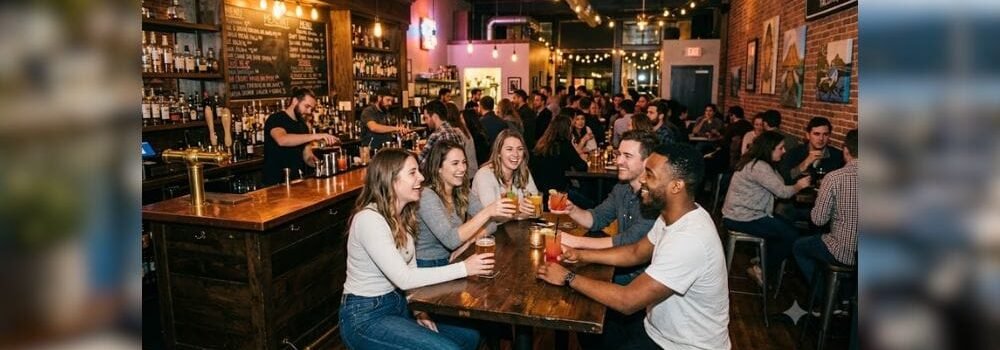
A photograph of your bar on a crowded Saturday night tells a story. Your website must tell that same story in multiple formats simultaneously, through visuals that communicate energy, through social proof that demonstrates popularity, through clear information about what’s happening right now.
Most bar websites show generic interior photos and expect customers to imagine the atmosphere. Customers don’t imagine. Customers move to the next venue’s website.
Your website needs to communicate three things immediately:
Energy Level — Is this a quiet wine bar or a high-energy dance venue? Are Thursday nights chill or does the DJ transform the space into something entirely different?
Current Activity — What’s happening tonight? Do you have live music? Trivia? Special promotions? Customers need to know event status before committing to the drive.
Social Proof — Is this venue where people actually go, or is it a place that should be popular? Visible crowd indicators matter enormously to bar customers.
The Decision Paralysis Problem
Bar customers experience decision paralysis when information gaps exist. They research on mobile phones while standing with friends debating where to go. Your website has seconds to remove uncertainty.
Common information gaps that kill conversions:
- No clear indication of tonight’s atmosphere or events
- Hidden drink menu or outdated pricing
- No social media integration showing real-time activity
- No customer reviews or social proof
- Unclear parking information
- Confusing entry point or location details
Each information gap adds friction to the decision-making process. Customers choose the venue whose website removed the most uncertainty.
The Atomized Experience Problem
Customers research bars across multiple platforms simultaneously, your website, Instagram, Facebook, Google reviews, TikTok. Your website must integrate these platforms rather than exist in isolation.
Most bar websites operate independently from social media. Your website should be the hub pulling together social proof from every platform where your venue has an online presence.
The Solution: Strategic Website Architecture for Bar & Nightlife Venues
Section 1: Homepage Design That Communicates Atmosphere Immediately
Your homepage has 3 seconds to communicate atmosphere. Static images fail this test. Your homepage needs:
Dynamic Visual Storytelling — Your hero section should feature your venue during peak energy (Saturday night crowd, live music moment, special event atmosphere). Video performs better than static images for bars because movement communicates energy that still images cannot convey.
Clear Event Messaging — Prominently display what’s happening tonight, this weekend, this week. Include day-of-week breakdown if events vary (Live Music Friday, DJ Saturday, Trivia Tuesday). Make this information immediately visible without scrolling.
Social Proof Integration — Display recent Instagram posts or social media mentions showing real customers enjoying your venue. Embed customer reviews from Google or other platforms. Show count of followers or engagement metrics that communicate popularity.
Atmosphere Indicators — Use descriptive language that communicates the specific experience (upscale cocktail lounge, dive bar authenticity, dance club energy, craft beer taproom focus). Customers want to know exactly what to expect.
Section 2: Event Calendar Architecture
Your event calendar isn’t a feature, it’s the conversion engine of your website.
Daily Event Clarity — Every day should have an associated event or descriptive phrase (Live Acoustic Trio, High-Energy DJ, Latin Dance Night, Karaoke & Crowd, Craft Beer Flight Night). Customers evaluating whether to visit your venue tonight need immediate clarity about the experience type.
Time-Specific Information — Some venues have happy hour (different vibe), early evening (quieter), late night (energy escalates). Your calendar should communicate these rhythm changes. Customers know the difference between 6 PM and 11 PM at a venue.
Link to Ticketing — If you sell event tickets, make this obvious. If you have special events with covers or reserved seating, integration with ticketing platforms removes friction.
Social Integration — Each event should link to corresponding social media posts so customers can see real attendance photos, comments, and energy level indicators.
Section 3: Social Proof Architecture
Your website’s social proof strategy should operate on three levels:
Real-Time Social Feed — Embed your Instagram or TikTok feed showing recent customer photos and videos. This communicates current popularity and provides authentic atmosphere documentation. As per marketing research on conversion psychology, potential customers trust peer-generated content more than business-controlled content by a 2:1 ratio.
Customer Reviews & Ratings — Feature your Google reviews, Yelp ratings, and other platform reviews prominently. Don’t bury them. Customers expect to see what other customers experienced. Aim for 4+ star average with 25+ reviews minimum for credibility.
“Seen Here” Moments — Feature customer testimonials or stories about memorable experiences at your venue. Quotes like “My engagement happened here” or “Best night out I’ve had in years” communicate emotional value that pricing and features cannot.
Section 4: Practical Information Architecture
Practical information removes friction from the decision journey:
Hours & Location — Display hours clearly for each day of the week. Include parking information prominently (free lot, street parking, nearby parking garage). Include public transit information if applicable. Link to Google Maps showing your exact location. Location uncertainty kills conversions.
Drink Menu & Pricing — Feature your drink menu with descriptions and pricing for signature cocktails. If you rotate drinks seasonally, note that clearly. Customers want pricing transparency. Hidden pricing communicates you’re hiding something.
Door Policy & Dress Code — If you have a door policy, dress code, ID requirements, or age restrictions, state them clearly. Ambiguity about entry requirements stops customers from attempting to attend.
Reservation System — If you accept reservations for special events or large groups, make this obvious and easy to execute. Integrate with reservation platforms (Resy, Yelp Reservations) if applicable.
Content Strategy: Building Authority in Tacoma’s Bar Scene
Positioning Your Venue as a Cultural Institution
Bars and nightlife venues operate as gathering places within neighborhood cultures. Your website should reflect this positioning.
Document Your History — If you have 20 years in Tacoma, tell that story. Longevity communicates you understand the community and customers keep returning because you’ve earned loyalty.
Highlight Local Connection — Feature local musicians, local breweries on your tap list, local events you sponsor or host. Connect your venue explicitly to Tacoma’s cultural identity.
Create “Why This Venue” Content — Develop content explaining what makes your space unique in Tacoma’s bar landscape. This isn’t marketing fluff, it’s positioning clarity. “We’re the only live music venue in Tacoma showcasing local jazz” or “We source exclusively from Washington craft breweries” creates differentiation.
Building Reputation Through Review Strategy
As per reputation management research, venues with 30+ positive reviews experience 3x higher conversion rates than venues with fewer than 10 reviews.
Create systematic review-collection processes:
Soft Prompts — Train staff to mention Google reviews naturally (“We’d love to hear what you thought about tonight on Google or Yelp”).
QR Code Strategy — Place QR codes on tables/bar that link directly to your review pages. Mobile customers can leave reviews immediately while the experience is fresh.
Response Protocol — Respond to every review, positive and negative. Positive responses build reputation. Negative responses, handled professionally, demonstrate commitment to customer satisfaction.
Technical Integration: Building the Infrastructure
Mobile Optimization as Non-Negotiable
Customers research bars on mobile phones. Mobile optimization isn’t optional, it’s the baseline for visibility.
Mobile Checkout for Reservations — If customers reserve tables online, the mobile checkout must be seamless. Friction in the reservation process loses customers.
Fast Load Times — Mobile users expect pages to load in under 2 seconds. Video backgrounds look impressive on desktop but kill mobile load times. Optimize ruthlessly.
Mobile-First Navigation — Navigation must work intuitively on small screens. Large tap targets for buttons. No dropdown menus that are difficult to access on phones.
Integration Architecture
Your website should pull information from multiple platforms into a unified experience:
Social Media Integration — Real-time Instagram/TikTok feed from your account or location tag.
Google Business Integration — Google Maps, hours, reviews, photos pulling directly from your Google Business Profile.
Calendar Integration — Event calendar synced with your Instagram/Facebook event postings.
Review Integration — Google, Yelp, and other platform reviews displayed together showing consistent quality messaging.
Local SEO for Bars & Nightlife Venues in Tacoma
Keyword Strategy for Venue Discovery
Customers searching for bars use specific query patterns:
Broad Intent Searches (“bars near me,” “nightlife in Tacoma,” “live music venue Tacoma”) require Google Business Profile optimization and local search visibility.
Specific Venue Searches (“Does [Your Venue] have live music tonight?” “What time does [Your Venue] open?”) require FAQ schema and detailed on-page content.
Neighborhood-Specific Searches (“bars in Downtown Tacoma,” “nightlife Proctor District”) require neighborhood-specific content and local authority signals.
Your website should address all three query types through targeted content and optimization.
Google Business Profile Optimization
Your Google Business Profile is your most powerful local SEO tool:
Photos — Upload 10-15 high-quality photos showing your venue during different times (happy hour atmosphere, late-night energy, special events, food/drinks). Update monthly with fresh content.
Posts — Use Google Business Posts to announce events, specials, and weekend happenings. Update 2-3x weekly for maximum visibility.
Questions & Answers — Proactively add common questions (“Do you have happy hour?” “What’s the dress code?” “Do you take reservations?”) with clear answers.
Attributes — Complete all venue attributes (outdoor seating, happy hour, full bar, live music, etc.) to appear in relevant local searches.
Schema Markup Implementation
Implement LocalBusiness and Event schema markup so search engines understand your venue type, location, hours, and upcoming events. This improves visibility in local search results and Google’s Knowledge Panel.
FAQ: Bar & Nightlife Website Questions
Q: How often should I update my website with event information?
A: Update event calendar at minimum weekly, ideally immediately after announcing events on social media. Customers expect your website to reflect current event information.
Q: Should my website sell drinks or tickets online?
A: Consider e-ticket sales for large events (DJ residencies, concerts, special nights). Online drink sales generally don’t apply to bars, though some venues use platforms for bottle service pre-orders.
Q: How do I show atmosphere through my website?
A: Use dynamic content (video, social media integration, real customer photos). Static images don’t communicate the energy and atmosphere that drives bar customers. Video from your busiest nights beats professional photography every time.
Q: What should I do about negative reviews?
A: Respond professionally and offer to make it right offline. Negative reviews, handled transparently, actually increase trust more than venues with no negative reviews (because venues with perfect reviews appear fake).
Q: How important is Instagram for bar websites?
A: Instagram isn’t separate from your website, it should be integrated. Embed your Instagram feed on your homepage. Link your website to Instagram prominently. For bars, Instagram drives discovery; your website confirms the decision.
Q: Should I feature food menus prominently?
A: Only if food is a primary offering. Most bars use website space for drinks, atmosphere, and events. Food operations mention menus but don’t emphasize them unless you’re a destination food venue.
Measurement: Knowing Your Website Actually Works
Your bar website’s success metrics differ from other business websites.
Track Conversion Indicators:
- Foot traffic increase (survey customers: “How did you hear about us?”)
- Reservation increases (if applicable)
- Event attendance growth (scan QR codes at door)
- Repeat customer indicators (loyalty program sign-ups, email list growth)
Track Engagement Signals:
- Average time on site (customers researching should spend 1-3 minutes)
- Event calendar page views
- Photo/video engagement rates
- Mobile vs. desktop traffic patterns
Track Business Outcomes:
- Week-to-week revenue trending
- Busy night consistency (fewer slow nights)
- Event-specific attendance numbers
- Customer acquisition cost through website vs. other channels
Most bar owners track none of these metrics. Tracking reveals whether your website actually drives business or exists as a digital afterthought.
Related Resources for Tacoma Bars & Nightlife Venues
Service Business Web Design for Tacoma: Generate Qualified Leads — Lead generation principles that apply to venue foot traffic generation.
How to Rank on Google Maps in Tacoma — Local search visibility strategy critical for bar discovery.
Website Analytics for Tacoma Business Owners: What Actually Matters — Measuring whether your bar website drives actual business results.
Tacoma Restaurant Website Design: Menu Page Conversions — Similar hospitality conversion mechanics applicable to bar/nightlife venues.
Downtown Tacoma Web Design: Positioning for the Revitalization Opportunity — Downtown venue positioning strategy specifically for Tacoma’s revitalizing bar scene.
Affordable Web Design in Tacoma: Professional Websites Without Overspending — Building bar websites efficiently without excess budget.
Cost of NOT Having a Professional Website — Quantifying the revenue impact of poor bar website design.
Best Web Design Companies in Tacoma: What Businesses Should Actually Look For — Evaluating web design partners who understand hospitality venue needs.
Taking Action
Your bar or nightlife venue’s website is either filling seats or it’s costing you customers you never knew you lost. Most Tacoma venues operate websites that were built once and forgotten, they accumulate outdated information, fail to communicate atmosphere, and create friction rather than removing it.
Venues that treat their website as a dynamic extension of their brand, updated regularly with events, social proof, and atmosphere, consistently outperform venues with static websites. The difference manifests as foot traffic on slow nights, event attendance growth, and customer loyalty that compounds over time.
Schedule a free website strategy consultation for your Tacoma bar or nightlife venue to evaluate whether your website is actually converting browsers into regulars, identify specific barriers preventing customers from choosing your venue, and develop a clear roadmap for building a website that fills seats consistently.