

If you have ever paid for a quick website fix and felt uneasy afterward, that feeling makes sense. Many small business owners choose low cost fixes because the pressure feels immediate.
The site is broken, leads are slowing down, or something looks off. Spending less feels safer in the moment, especially when budgets are tight and every decision carries weight.
This is not about poor judgment or lack of effort. It is about survival mode. When a website problem shows up, the fastest solution often feels like the smartest one. The regret usually arrives later, when the issue returns or something else breaks along the way.
The problem is not the desire to save money. The problem is how most cheap fixes are designed to work.
Why this keeps happening to so many businesses
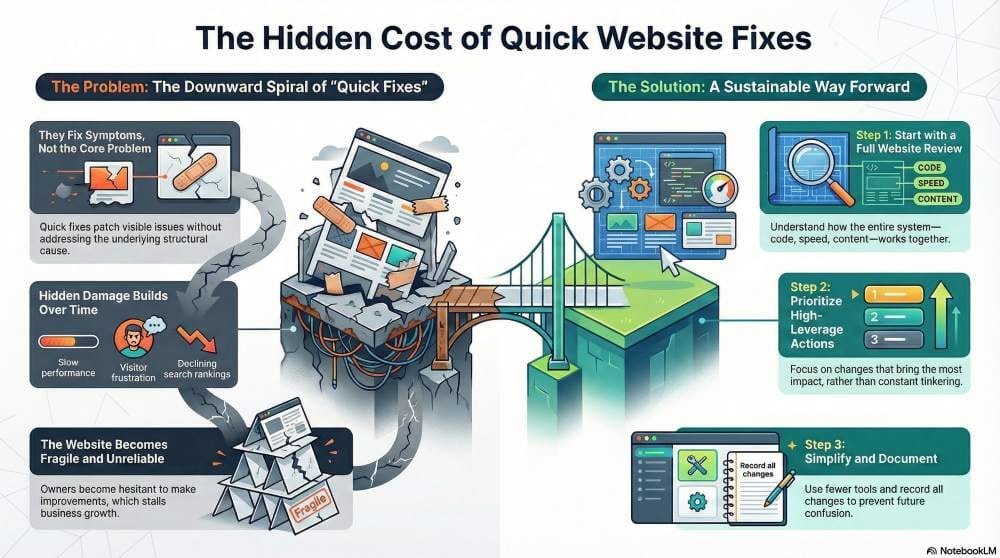
Most quick website fixes focus on symptoms, not structure. A button stops working, so a patch is added. The site loads slowly, so an image plugin is installed. The layout looks broken on mobile, so a small tweak is made without reviewing the whole page.
These fixes feel helpful because they create visible change fast. Something looks better. Something works again. The relief is real.
What usually gets skipped is the deeper question. Why did this break in the first place.
Websites are systems. Design, code, hosting, content, plugins, and user behavior all affect each other. When one part is patched without understanding the rest, stress builds elsewhere. Over time, these patches stack on top of each other like uneven repairs on an old building.
This happens more often when fixes are handled by different people, different tools, or different services with no shared plan. Each one solves a small piece without seeing the whole picture.
The quiet damage that builds over time
The real cost of cheap fixes rarely shows up as a single big failure. It appears slowly, in ways that are easy to miss until growth stalls.
One of the first signs is performance decay. Pages take longer to load. Mobile users struggle. Search engines notice. Rankings slip without a clear reason.
Another issue is trust erosion. Visitors may not consciously spot the problem, but they feel it. Forms feel clunky. Navigation feels confusing. The site does not feel solid. That hesitation often means fewer calls, fewer bookings, and fewer conversions.
Maintenance also becomes harder. Each new update risks breaking something else. Simple changes start taking longer and costing more because no one is fully sure how the site is held together anymore.
Eventually, the website becomes fragile. Owners hesitate to improve it because every change feels risky. Growth slows not because the business lacks demand, but because the digital foundation cannot support it.
This is where financial anxiety often peaks. Money has already been spent, yet the website still feels unreliable.
What is actually wrong beneath the surface
The core issue is not price. It is approach.
Cheap fixes usually lack context. They are reactive instead of intentional. They treat the website like a collection of parts rather than a connected system designed to guide real people toward action.
There is often no shared understanding of goals. Is the site meant to generate leads, bookings, calls, or trust before a sale. Without clarity, fixes are made blindly.
Documentation is often missing. Changes are not tracked. Decisions are not explained. When the next issue appears, the cycle repeats.
This is how short term savings quietly turn into long term costs.
A sustainable way forward that reduces stress and cost
A better approach does not start with rebuilding everything. It starts with understanding.
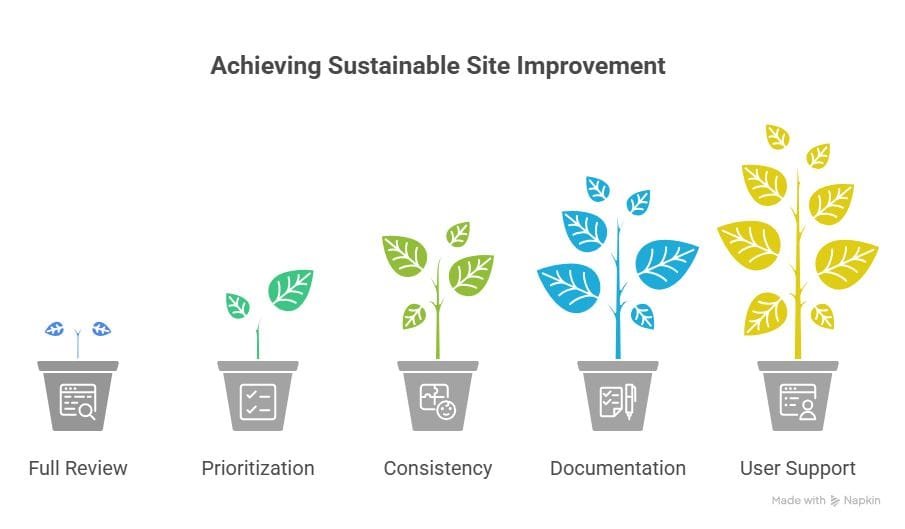
The first step is a full review, not just of what is broken, but of how the site functions as a whole. This includes structure, speed, mobile experience, content flow, and how visitors move through key pages.
The goal is clarity. What works. What does not. What is helping growth. What is quietly holding it back.
The second step is prioritization. Not every issue needs immediate fixing. Some changes bring real impact. Others can wait. Sustainable improvement focuses on high leverage actions rather than constant tinkering.
The third step is consistency. Fewer tools, fewer plugins, fewer overlapping solutions. Simpler systems are easier to maintain, easier to improve, and cheaper over time.
The fourth step is documentation and ownership. Every meaningful change should be understood, recorded, and connected to a goal. This prevents future confusion and reduces dependency on emergency fixes.
Finally, improvements should support how people actually use the site. Clear navigation. Clear messaging. Clear paths to action. When users feel comfortable, growth follows naturally.
What this looks like in practice
Instead of paying repeatedly for small fixes, businesses invest in stabilizing the foundation. This might mean cleaning up outdated plugins, simplifying layouts, improving loading speed, or restructuring key pages to match user intent.
Costs become more predictable. Changes become safer. Decisions feel calmer instead of rushed.
Most importantly, the website starts working as a tool rather than a source of stress.
A calmer way to think about growth
If you have relied on cheap website fixes before, it does not mean you failed. It means you acted with the information and resources you had at the time.
The shift happens when you move from reacting to planning.
A stable website does not demand constant attention. It supports growth quietly in the background. It gives you confidence to market, promote, and expand without fear of something breaking every time traffic increases.
Growth is still possible, even if the past feels messy. Once the foundation is understood and strengthened, progress becomes clearer and more sustainable.
The relief that comes from knowing exactly what is wrong, and knowing how to fix it properly, is often the biggest return on investment of all.