

Why misalignment, not malfunction, is the real cause of low leads and stalled growth
Emotional Recognition Opening
Your website is not actually failing. It is speaking to the wrong person. That realization can feel like a punch in the gut. You spent months building pages, tweaking colors, adding sections, hoping it would click.
When leads do not come in or visitors bounce instantly, it is natural to panic and assume something technical is broken. Most of the time the tech is fine. The issue is alignment. The site sounds like it was built to impress peers instead of guide buyers.
Root Cause: Why Misalignment Happens
This mistake is common among service providers, consultants, designers, home service pros, medical providers, and anyone proud of their craft. When you care deeply about your work, you talk like a craftsperson.
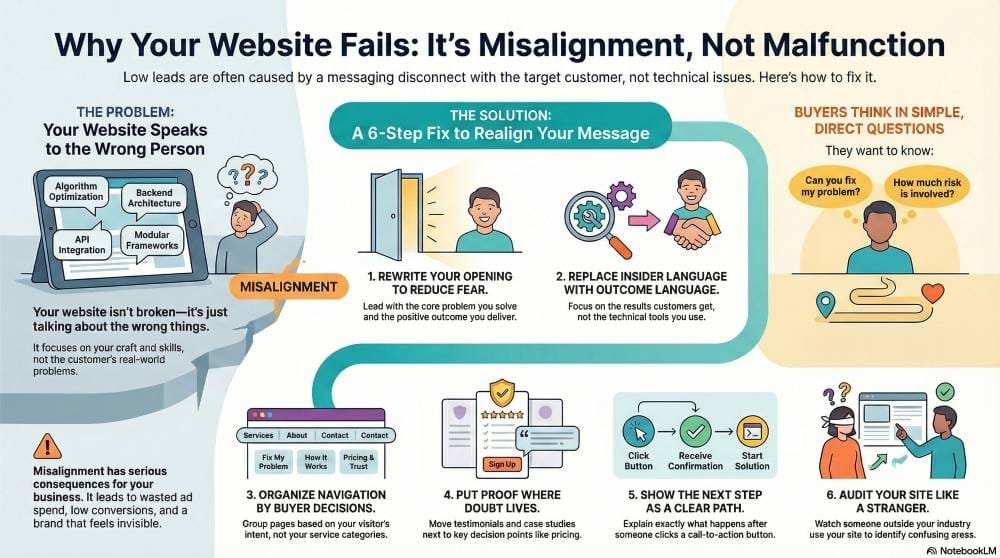
You highlight technique, background, and insider language. A potential client does not think in those terms. They think in simpler questions:
Can you fix my problem
How much risk is involved
Will I be safe in your hands
What happens next if I say yes
If a site answers the wrong set of questions, the right customer never feels seen.
Misalignment usually happens because websites are built in a vacuum. People either copy competitors or create content based on what they would want to read. Neither reflects the buyer mindset.
Your competitors are not your customers. Your peers are not your customers. You are not your own customer.
Real Consequences of Getting This Wrong
The damage from staying in this pattern is subtle but serious.
• Visitors click once and never return
• Paid ads burn cash with nothing to show
• Organic traffic comes in, but conversions do not
• Your brand feels invisible, even if the visuals look great
• Trust evaporates before it ever begins
A visitor who does not understand you in ten seconds rarely tries again.
There is nothing wrong with your skills. The issue is how they are framed. A buyer does not care about the tool until they understand the outcome. The order of information must match the order of concern in the buyer’s mind.
How to Reframe Your Website Around the Right Customer
Reframing is not complicated. It requires clarity more than creativity.
Start with the core question: Who is this website truly for
If your answer includes more than one primary audience, split them into separate paths. If your answer is only demographics, go deeper. Focus on situation, fear, hopes, and the cost of doing nothing.
A Six-Step Fix You Can Apply Today
1. Rewrite your homepage opening to reduce fear.
Lead with the core problem you solve and the outcome you deliver. Avoid clever phrasing. Aim for spoken clarity. If someone reads your first line and feels relief, you are aligned.
2. Replace insider language with outcome language.
If a phrase requires industry knowledge, change it. Focus on results, not tools. Lower cognitive load. Raise understanding.
3. Organize navigation by decisions, not categories.
Group pages based on buyer intent: New to this problem. Already tried solutions. Ready to invest. Meet visitors where they are.
4. Put proof where doubt lives.
Move testimonials, case studies, certifications, and guarantees near hesitation points. Proof is a decision tool, not decoration.
5. Show the next step like a path, not a button.
Explain what happens after clicking. Example: Schedule a free 15-minute call so we can understand your situation and confirm if we can help. If not, we will direct you to a better resource.
6. Audit like a stranger.
Have someone outside your industry review the homepage while recording their screen. Their hesitations show where messaging breaks.
Why Alignment Works Faster Than Rebuilding
Alignment does not require tearing everything down. Most of your existing structure is still usable. The shift is in words, order, and clarity. Growth often follows quickly because the right people finally recognize themselves in your message.
A well-aligned site becomes a filter. It draws in those who are a fit and filters out those who are not. Sales cycles shorten. Calls feel easier. Questions become clearer. Confusion fades.
Reassuring Close
You are not starting from zero. You are recalibrating. You already have the tools. You just need the right aim. When a message fits the buyer, the buyer fits the offer. That is when a website feels alive again.
That is when trust forms before you even speak. Growth becomes possible the moment a customer feels understood.
If you want help applying this, tell me your business type and ideal buyer. We will help you draft a homepage opening that aligns with this framework.