
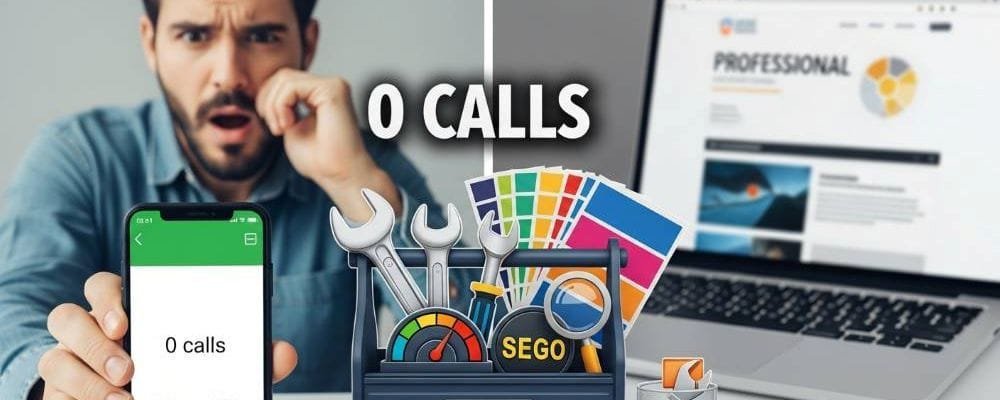
You’re not imagining it.
A lot of small business owners do the “right” things on paper. They speed up the site. They tighten SEO. They pay for a cleaner design. And still… the phone stays quiet. No calls. No real inquiries. Just traffic numbers that don’t turn into customers.
That’s one of the most exhausting kinds of frustration because it makes you feel like you’re chasing a moving target. You fix what everyone tells you to fix, but the result you actually need never shows up.
Here’s the truth most people never explain clearly:
Speed, SEO, and design are not the final problem. They’re the support system. If the human path is broken, technical improvements can’t save it.
You don’t have a website problem.
You have an intent and trust flow problem.
The Exhausting Trap: “We Fixed Everything… Why Is Nothing Happening?”
It feels unfair because you did what business owners are told to do.
You invested time, money, and energy into:
- improving page speed
- cleaning up SEO
- modernizing the design
- publishing content
- updating the site structure
And if you look at the site objectively, it probably looks decent.
But calls don’t come from “decent.”
Calls come from clarity and trust.
And what most websites accidentally do is this:
They look functional and polished… but they still don’t make a visitor feel confident enough to reach out.

What People Don’t Realize: Visitors Aren’t Thinking Like Marketers
When someone lands on your website, they are not analyzing your SEO.
They’re not thinking about your page speed score.
They’re thinking like a stressed human with a real problem.
They land on your website and subconsciously ask:
- “Is this exactly what I’m looking for?”
- “Can this business solve my problem?”
- “Do they seem trustworthy?”
- “Is contacting them going to be simple?”
- “What happens after I call?”
- “How much will this cost me?”
And here’s the part that changes everything:
They decide most of that within seconds.
So when you fix speed and SEO, you’re only doing one part of the job:
you’re getting them to the page.
But if the page doesn’t guide their brain toward certainty, they won’t call.
The Root Cause: Your Website Doesn’t Match Intent and Trust Flow
Think of your website like a well-organized toolbox.
Everything is arranged neatly:
- fast loading pages
- modern design
- SEO keywords in place
- clean layout
But one key piece is missing.
That missing piece is the human flow:
the step-by-step path that makes a stranger feel safe contacting you.
Most small business sites fail because they’re missing one (or more) of these:
1) Intent Match
The visitor doesn’t immediately feel like the website is meant for their exact need.
2) Clarity
They don’t understand what to do next, what the process looks like, or what they should expect.
3) Trust Proof
There is no strong evidence that real people choose you, trust you, and get results.
4) Conversion Path
The action step doesn’t feel obvious, easy, or low-risk.
When even ONE of these breaks, you lose calls.
Not because people hate your business, but because uncertainty always wins.

The Silent Damage: What Happens When This Continues
This problem doesn’t just reduce leads. It affects your momentum.
You Start Doubting Yourself
A quiet phone creates a mental weight:
“Is my business failing?”
“Is the market dead?”
“Am I wasting money?”
Even when the issue is simply the website flow.
You Waste Money on Upgrades That Don’t Increase Revenue
You pay for fixes that improve numbers, not outcomes.
Better speed.
Better SEO.
Better layout.
But the conversion leak stays open.
You Attract Low-Quality Inquiries
When trust isn’t clear, serious buyers hesitate.
So the only people who message you are:
- price shoppers
- vague inquiries
- people who are “just checking”
Your best customers avoid friction. They want confidence.
Competitors Win by Being Clearer, Not Better
This part hurts.
A competitor might have a worse website than you technically…
but still get more calls because they make their offer easier to understand and safer to trust.
The Fix That Actually Changes Everything: Align Tech With Human Behavior
Here’s the shift that makes everything click:
Stop building your website like a business owner.
Start building it like a nervous buyer.
A buyer needs:
- clarity
- reassurance
- proof
- simple next steps
So the solution is not another speed upgrade or redesign.
The solution is building a conversion path that follows human psychology.
A powerful website flow moves people through four stages:
- Intent Match
- Clarity
- Trust
- Low-friction action
Let’s make this practical.
A Simple Framework That Turns Traffic Into Calls
Step 1: Fix the First 10 Seconds (Intent Match)
In the first few seconds, your visitor should immediately know:
- what you do
- who you help
- where you serve
- what to do next
Your headline must be specific.
Weak headline:
“We provide quality services and great results.”
Strong headline:
“Same-day emergency plumbing in Tacoma for leaks, clogs, and water heater repairs.”
Strong doesn’t mean boring.
Strong means obvious.
A quick test:
If you remove your logo, can someone still tell what you do in 5 seconds?
If not, your intent match is broken.
Step 2: Make the Process Predictable (Clarity)
People don’t fear buying.
They fear confusion.
So remove uncertainty by explaining:
- what happens after they reach out
- how the process works
- what steps they’ll go through
- what timelines look like
Add a section like:
Here’s What Happens Next
- You call or request a quote
- We ask 3 quick questions
- You get a clear price range
- We schedule service
- We complete the job and confirm everything is done
This tiny section can increase calls dramatically because it removes mental friction.

Step 3: Place Trust Proof Where Decisions Happen
Most websites hide reviews on a separate page.
That’s not how humans work.
Trust proof should be placed:
- near the top of the page
- near pricing or service details
- right next to the call-to-action
Trust proof can include:
- short reviews (with real names if possible)
- “licensed and insured” proof
- years in business
- local service area references
- real photos (not stock)
- guarantees you truly honor
Trust is not one section.
Trust is a repeated feeling.
Step 4: Remove Contact Anxiety (Conversion Path)
Even when someone wants to call, they hesitate.
Because contacting businesses often feels like:
- pressure
- uncomfortable selling
- awkward phone calls
- long response delays
- being ignored completely
So your job is to make contact feel safe.
Use microcopy that lowers fear:
- “No pressure. Just quick answers.”
- “We reply within 1 business day.”
- “Text us if that’s easier.”
- “We’ll give you a clear range upfront.”
Then offer simple options:
- Call now
- Text now
- Quick quote form (keep it short)
- Book appointment
If reaching out feels easy, calls increase.
Step 5: Build Pages Around One Intent (Not Everything)
This is where SEO and conversions finally connect.
Instead of one generic services page, build intent-based pages such as:
- “Roof repair Tacoma”
- “Wheelchair transportation Tacoma”
- “Handyman Silverdale”
- “Restaurant marketing Kitsap”
- “Web design Bainbridge Island”
Each page should speak directly to:
- the exact problem
- the exact audience
- the exact local area
- the exact next step
This is alignment.
SEO brings the right person.
Clarity and trust make them call.
Sometimes the real problem isn’t speed, SEO, or design at all. It’s that your website sounds professional… but it doesn’t sound human, and people don’t trust what feels robotic:
https://hypereffects.com/business/your-website-sounds-professional-but-doesnt-sound-human/
The Real Reason Your Website Isn’t Getting Calls (In One Sentence)
Your website is technically good, but psychologically unclear.
It doesn’t guide a stranger from uncertainty to confidence.
That’s why people leave.
Not because they hate your business.
But because confusion feels risky, and risk makes people exit.
You’re Not Far Off (You’re Just Missing the Key Piece)
If you already improved speed, SEO, and design, your foundation is strong.
That work wasn’t wasted.
Now you just need to add what most businesses ignore:
Intent + trust flow.
And once you fix that, calls stop being random.
They become predictable.
You’ll finally feel this:
“I understand what was wrong… and now I know exactly what to do.”