

If you’re asking “how much does a website designer cost?” you’re probably not shopping for the cheapest option.
You’re trying to avoid overpaying, avoid making a mistake, and understand what you’re really getting for your money.
That’s the right mindset.
The truth is, website design pricing isn’t random. It varies because designers solve very different problems, in very different ways, for very different types of businesses.
Let’s break this down properly.
If you’re asking “how much does a website designer cost?” you’re probably not shopping for the cheapest option.
You’re trying to avoid overpaying, avoid making a mistake, and understand what you’re really getting for your money.
That’s the right mindset.
The truth is, website design pricing isn’t random. It varies because designers solve very different problems, in very different ways, for very different types of businesses.
Let’s break this down properly.
Why Website Designer Costs Vary So Much
You’ll see prices all over the place:
- A freelancer offering a site for a few hundred dollars
- An agency quoting several thousand
- Another agency quoting much more and sounding very confident about it
That doesn’t automatically mean someone is overpriced or underpriced.
It usually means they’re pricing different levels of responsibility, thinking, and risk.
Here’s what actually changes the cost.
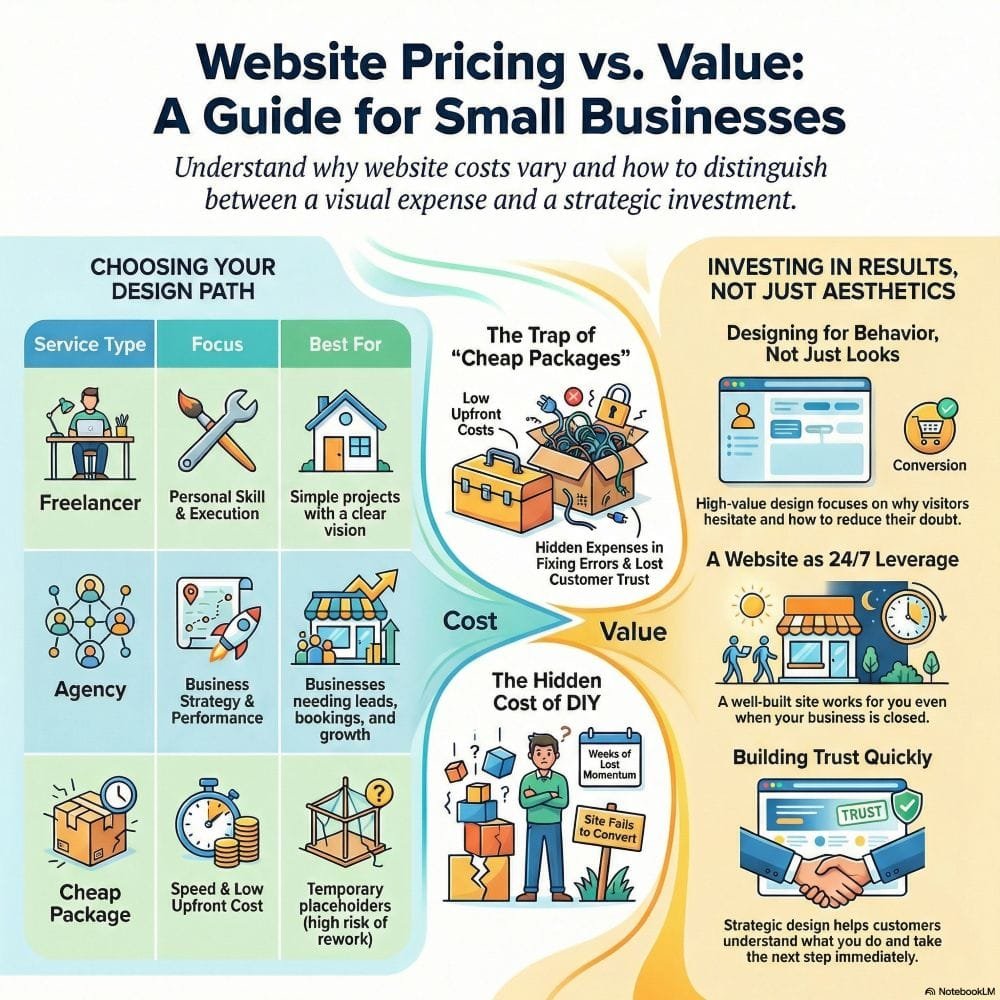
Freelancer vs Agency vs “Cheap Package” Designers
Freelancers
A freelancer is often the most affordable option.
Typical cost range:
- Lower upfront cost
- Often charges per page or per hour
What you’re paying for:
- Their personal skill
- Design execution
- Basic setup
Pros:
- Lower cost
- Direct communication
- Good for very simple projects
Cons:
- Strategy is usually limited
- SEO, content structure, and conversions may not be fully considered
- If they get busy or disappear, support can stop
Freelancers are a good fit when you already know exactly what you want and don’t need guidance.
Agencies
Agencies cost more because they take on more responsibility.
Typical cost range:
- Higher upfront investment
- Usually project-based pricing
What you’re paying for:
- Business understanding
- User behavior planning
- Structure that supports growth
- Design, content flow, and performance working together
Pros:
- Clear process
- Broader skill set
- Long-term support
- Better alignment with business goals
Cons:
- Higher cost
- Not all agencies are equally transparent or local
Agencies make sense when your website is meant to bring in leads, bookings, or revenue, not just exist online.
“Cheap Website Packages”
These often look attractive at first.
What usually happens:
- Templates reused across many clients
- Minimal customization
- Little understanding of your business
- Extra fees later for changes or fixes
Hidden cost:
- Time spent fixing things later
- Lost trust from customers
- Missed opportunities
Cheap websites often cost more after launch than they did upfront.
What You’re Actually Paying For When You Hire a Website Designer
When you ask “how much does it cost to hire a website designer?”, the better question is:
What problem are they solving for you?
A good website designer is not just arranging colors and images. They are helping you:
- Explain what you do clearly
- Build trust quickly
- Make it easy for customers to take the next step
- Avoid common mistakes that hurt credibility
That thinking time, planning, and experience is part of the cost, and it’s the part DIY tools don’t replace.
What You’re Actually Paying For When You Hire a Website Designer
When you ask “how much does it cost to hire a website designer?”, the better question is:
What problem are they solving for you?
A good website designer is not just arranging colors and images. They are helping you:
- Explain what you do clearly
- Build trust quickly
- Make it easy for customers to take the next step
- Avoid common mistakes that hurt credibility
That thinking time, planning, and experience is part of the cost, and it’s the part DIY tools don’t replace.
Why Two Designers Can Charge Very Different Prices
Two designers might build a website that looks similar at first glance.
The difference is often:
- One is designing for appearance
- The other is designing for behavior
One focuses on:
- Fonts
- Layout
- Visual polish
The other focuses on:
- What visitors look for first
- Why they hesitate
- When they decide to call or leave
- How to reduce doubt
That second approach costs more, but it’s also why those sites perform better.
Why Two Designers Can Charge Very Different Prices
Two designers might build a website that looks similar at first glance.
The difference is often:
- One is designing for appearance
- The other is designing for behavior
One focuses on:
- Fonts
- Layout
- Visual polish
The other focuses on:
- What visitors look for first
- Why they hesitate
- When they decide to call or leave
- How to reduce doubt
That second approach costs more, but it’s also why those sites perform better.
Why DIY Website Builders Feel Cheaper But Often Aren’t
If you’re excited about building your own website, that excitement makes sense. Learning something new, experimenting with AI website builders, and taking control of your online presence can feel empowering. You invest your time, follow tutorials, tweak layouts, and before long, you have a website that looks decent. That’s an achievement.
But the real question is not whether you can build it.
It’s what happens after it’s built.
Most DIY platforms help you create a basic structure quickly. They are great for getting something online. But when your business needs change, a new feature is required, or something stops working the way you expected, things slow down. Even with AI assistance, core implementation decisions still rely on experience. That’s where many business owners get stuck.
Another quiet cost shows up over time. A DIY website often sits there unchanged. It looks fine, but it doesn’t actively help your business grow. No clear conversion path. No insight into why visitors leave. No strategy guiding what should be improved next. The site starts collecting digital dust.
At the same time, your attention shifts. Instead of focusing on your actual business, you’re troubleshooting layouts, learning technical workarounds, and managing something that has quietly become a second job.
The cost isn’t just money.
It’s divided focus, delayed growth, and momentum that never quite builds.
That’s why many small business owners eventually decide to hire help. Not because DIY failed, but because their time is better spent growing the business the website was meant to support in the first place.
So, How Much Is a Website Designer Really Worth?
A better way to think about pricing is this:
If your website helps you:
- Get even a few more calls per month
- Convert visitors who were already looking for you
- Make your business feel more credible
Then the cost isn’t just design, it’s leverage.
A well-built website works every day, even when you’re busy or closed.
That’s why many small businesses choose to hire instead of DIY, once they see the full picture.
How to Decide What’s Right for You
Ask yourself:
- Is my website supposed to help me grow?
- Do I want clarity and guidance, not just design?
- Do I want something built for now, or built to last?
If the answer is “yes,” hiring a professional website designer isn’t an expense, it’s a strategic decision.
Final Thought
There’s no single answer to “how much does a website designer cost?”
But there is a clear difference between buying a website and investing in one.
Understanding that difference is what helps small business owners make confident decisions and avoid regret later. Still feel confuse book a free consultation