
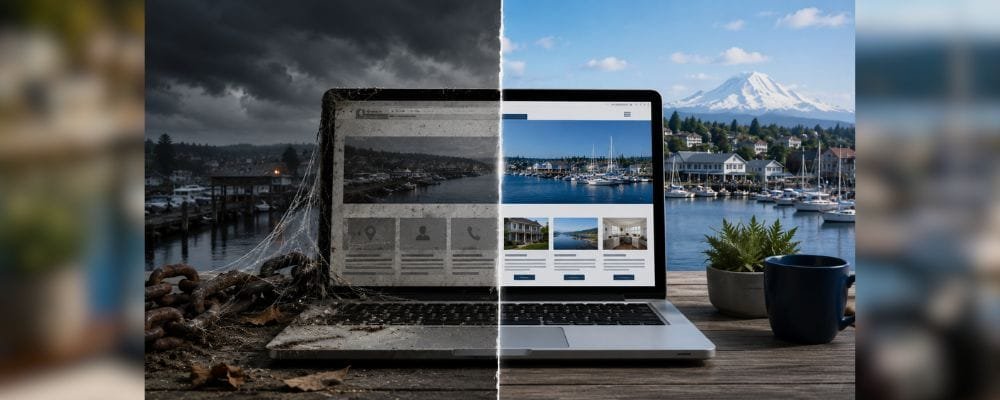
The website is still there. It still loads when someone searches the business name. The phone number is visible, the services are listed, and the design looks approximately the same as the day it launched.
From the outside, nothing appears wrong.
From the inside, from the perspective of Google’s evaluation systems, from the perspective of the security vulnerabilities accumulating with every month of missed updates, from the perspective of the Gig Harbor buyer who visits and measures the site against every competitor who has continued investing, the picture is significantly different.
A website that stops receiving attention does not stay where it was. It declines.
Gradually, invisibly, and at a cost that most business owners never calculate because the losses are impossible to see without knowing where to look.
Here is where to look.
The False Comfort of a Website That Loads
Most Gig Harbor business owners who have not updated their website in twelve months or more are operating on a reasonable but incorrect assumption: that a live, indexed, functioning website is a working website.
Functioning and working are not the same thing.
A website functions when it loads correctly and displays the business’s contact information. A website works when it earns and converts the right visitors, when it passes the trust checks a Gig Harbor buyer runs in the first thirty seconds, when it appears in the search results and AI-generated recommendations where prospective clients are actually looking, and when it represents the current state of the business rather than the state it was in when the site was built.
As per TechGlobe IT Solutions’ 2026 Website Performance Report, “the issue is not always that a website suddenly became bad. In many cases, it simply stopped keeping pace with how search and user behavior have evolved.” For a Gig Harbor business competing for the attention of a $118,000 household buyer, stopping pace is not a neutral outcome. It is a competitive disadvantage that compounds with every month of inaction.
The consequences fall into four distinct categories, search visibility, security exposure, trust erosion, and competitive displacement. Each one is documented, measurable, and avoidable.
Consequence One: Search Visibility Begins to Erode
The most immediately quantifiable consequence of website neglect is the gradual loss of search visibility, a decline that begins invisibly and becomes undeniable only after months of compounding.
As per TechGlobe IT Solutions, “one week, things look stable. Organic sessions seem normal, pages are bringing in visitors, and lead flow feels predictable enough. Then performance starts to soften. Traffic dips a little. Some pages stop bringing in the same number of visits. A few important keywords lose visibility. Over time, that small decline starts to look more serious.”
The mechanism driving this decline in 2026 is more complex than it was in previous years, because Google’s evaluation systems have become more sophisticated in precisely the way that hurts static websites most.
As per ThatWare’s 2026 Google Core Update Analysis, “Google’s 2026 core updates reward real expertise, real experience, and real trust, not volume, not automation, and not shortcuts. Brand authority plays a larger role. Similar content is being grouped together, leaving less room for sites that do not clearly stand out. Blogs that performed well for years can lose visibility while newer or more authoritative brands move ahead.”
The practical translation for a Gig Harbor business is direct. A website that was competitive in 2023 is now competing against sites that have continued publishing specific, locally grounded, expertise-demonstrating content, while standing still. As per Beacon Media’s February 2026 Traffic Analysis, “in 2026, not changing might be the issue. Search is evolving quickly, and strategies that worked even six months ago may no longer deliver the same results.”
The AI search dimension compounds this problem. As per Tabula’s May 2026 SEO Report, “generic information gets absorbed by AI. Specific, experience-driven content gets cited by it.” Google’s AI Overviews, which now appear on roughly 15% of all searches and are growing, select sources based on content depth, local specificity, and evidence of ongoing expertise. A website with no new content in twelve months scores poorly on every dimension that AI citation systems evaluate.
As per WeCre8’s May 2026 SEO Recovery Analysis, “from 2024 to 2026, these situations are appearing more regularly, businesses that had strong organic traffic see steady declines over a six to twelve month period while competitors who adapted to new search standards gained the positions they vacated.”
The positions vacated are not held empty. Competitors fill them.
Consequence Two: Security Vulnerabilities Accumulate Without Warning
The second consequence of website neglect is less visible than declining traffic, and significantly more dangerous in its potential impact on the business.
Most Gig Harbor business owners do not think of website maintenance as a security activity. This misunderstanding is precisely what makes neglected websites valuable targets.
As per Optuno’s April 2026 Website Security Guide, “cyber threats have become more automated. Attackers no longer need to manually target a site. They use bots that scan thousands of websites per hour looking for weak points. If a site has an outdated plugin, a weak password, or no SSL certificate, those bots will find it. The consequences of a breach go beyond a temporary outage.”
The specific vulnerability landscape in 2026 makes this concrete rather than theoretical. As per Belov Digital’s WordPress Security Report, “plugins account for 96 to 97% of all WordPress vulnerabilities, making them the number one culprit in 2026. Outdated or abandoned extensions create backdoors for malware injection and data theft. Shockingly, only 30% of users enable auto-updates, leaving sites exposed.”
The most recent and significant illustration of this risk occurred in April 2026. As per KC Web Design’s May 2026 Security Report, “security researchers discovered that backdoors had been secretly planted inside dozens of popular WordPress plugins, installed on thousands of business websites across the world. The malicious code sat dormant for months before activating and pushing harmful software to every site running the affected plugins. The attack was highly automated, which means it happened at scale, and quickly. When a critical flaw is disclosed, exploitation typically begins within five hours.”
This incident is not an outlier. It is the pattern. As per Osom Studio’s March 2026 WordPress Security Guide, “security issues rarely come from sophisticated attacks. They come from neglect, sites that have not been updated in months, admin passwords that have never been changed, plugins installed years ago and forgotten.”
The business consequences of a successful attack on a Gig Harbor small business website are specific and serious. As per KC Web Design, a breach can result in Google blacklisting the domain, the site being taken offline entirely, customer contact data being exposed, and a reputation recovery process that costs significantly more than any maintenance program would have required. For a Gig Harbor business whose clients are high-income professionals who evaluate trust signals carefully, a Google blacklist notice or a security warning displayed in the browser is a trust-destroying event from which some businesses do not recover.
As per Nucleosys Tech’s 2026 Security Analysis, “rebuilding a reputation after a hack is significantly more expensive and time-consuming than investing in website maintenance services from the start. Security is a confirmed ranking factor for search engines, Google prioritizes sites that use HTTPS and maintain technical security standards, meaning a compromised site loses visibility as well as credibility.”
Consequence Three: The Gig Harbor Buyer Notices What the Owner Does Not
The third consequence is the most insidious, entirely invisible to the business owner, immediately visible to the prospective clients the business most wants to reach.
The Gig Harbor buyer who arrives on a website that has not been updated in two years does not read a maintenance log. They simply experience the site as it is today. And what they experience communicates something about the business, not through any single dramatic failure, but through the accumulated weight of small signals that are each individually minor and collectively disqualifying.
Photography from three years ago showing team members who have since left, or equipment that has since been upgraded, tells the buyer that the business has not been paying attention to its own presentation. Blog posts dated 2022 tell the buyer that the business stopped demonstrating expertise publicly at that point. Testimonials from the early years of the business, with no recent additions, tell the buyer that the business either stopped collecting them or stopped caring whether the website reflected current client experiences.
As per Viacon’s February 2026 Traffic Analysis, “demand for first-hand experience over generic content means users are now clearly preferring content that demonstrates current, active expertise over content that merely exists. Post-click satisfaction is key, users are becoming increasingly impatient, and minor issues following a website visit are triggering the bounce rate.”
For the Gig Harbor buyer, whose median age is 46.6 years, whose household income averages $150,420, and who has three decades of experience evaluating the difference between a business that is actively investing in its standards and one that has become complacent, the signals of an unmaintained website register immediately and intuitively.
The instinct that fires is not “this website is outdated.” It is quieter and more powerful: “this business may not be operating at the level I require.”
That instinct does not produce a complaint or a negative review. It produces a closed tab and a call to a competitor.
As per TechGlobe IT Solutions, “pages that once looked strong can now look ordinary. User expectations have risen. People want faster answers, clearer structure, more practical guidance, and stronger trust signals. If a page feels vague, outdated, or too generic, users may ignore it even if it remains visible.”
The Gig Harbor market is too small and too relationship-driven for this pattern to be sustainable. Every visitor who arrives, evaluates, and leaves without contacting is a lost opportunity that the business never sees, and never counts.
Consequence Four: Competitors Who Update Move Ahead
The fourth consequence is structural rather than acute. It does not announce itself in any single event. It accumulates as a compounding competitive disadvantage across months and years.
As per Prisham’s April 2026 Traffic Recovery Guide, “competitors improve their content, update their SEO strategy, and strengthen authority over time. Even if a page still ranks, reduced relevance can lower engagement and decrease traffic over time. Moving from position 2 to position 5 may not seem significant, but it can reduce click-through rates considerably.”
For the Gig Harbor business owner who has not updated their website in twelve months, the relevant question is not “did my website get worse?” It is “did my competitors’ websites get better?”
In almost every case, the answer is yes.
A competitor who published four locally specific blog posts in the past year, refreshed their photography, updated their service pages to reflect current offerings, and maintained an active Google Business Profile has moved ahead, not by doing anything extraordinary, but by doing the ordinary things that a static website cannot accomplish on its own.
The high-income Gig Harbor buyer who evaluates multiple providers online makes a relative judgment, not an absolute one. A website that was the most credible option in the local market in 2023 can be the second-best option in 2025 and the third-best option in 2026, without a single element of it having changed, simply because competitors have continued investing while it stood still.
As per ThatWare, “in 2026, this effect feels even stronger because Google is changing how search results are displayed. AI-generated summaries now take up more space. Brand authority plays a larger role.” The businesses gaining that brand authority in AI-generated answers are the ones with active, specific, locally grounded content. The businesses losing ground to those AI recommendations are the ones whose websites have been static while the search landscape evolved around them.
What “Not Updating” Specifically Means
Clarifying what the maintenance activities actually are, and what their absence produces, helps the Gig Harbor business owner assess their own situation precisely.
Content freshness is the most visible dimension of maintenance. Search engines evaluate content recency as an ongoing signal of relevance and active expertise. For a Gig Harbor business, content freshness means blog posts published within the past 90 days, service pages that reflect current offerings and accurate pricing, testimonials with recent dates, and photography that shows the current team, the current work, and the current standards of the business.
As per Beacon Media, “refreshing content is not just good for SEO, it is good for building trust and keeping the brand voice relevant.” A service page that was written in 2022 using 2022 pricing, 2022 service descriptions, and 2022 photography is not a neutral asset. It is a source of potential miscommunication with every visitor who arrives expecting current information.
Technical maintenance is the less visible but equally consequential dimension. As per Osom Studio, “WordPress releases security patches regularly, when a vulnerability is discovered, the core team typically patches it within days. That patch only helps if it is installed.” Plugins, themes, and core software that have not been reviewed and updated within the past month carry accumulating risk with each new vulnerability disclosure. The April 2026 backdoor incident demonstrated that this risk is not hypothetical, it is documented, automated, and operating continuously against every vulnerable site on the web.
Google Business Profile maintenance is the dimension most directly connected to AI search visibility. Google’s AI Overviews draw directly from Business Profile data when generating local business recommendations. A profile with photographs from 2022, hours that may have changed, and a business description that has not been reviewed since the site launched is feeding outdated, potentially inaccurate information into the AI systems that decide whether to recommend the business in local Gig Harbor searches.
Each of these three dimensions, content freshness, technical security, and Business Profile accuracy, requires regular attention. None of them maintains itself.
The Cost of Recovery Increases With Every Month of Inaction
The consequences described above are reversible. A website that has declined in search visibility can recover it. Security vulnerabilities can be identified and patched. Content can be refreshed and dated forward. Trust signals can be rebuilt through current photography, recent testimonials, and active publishing.
The question is not whether recovery is possible. It is what recovery costs relative to what ongoing maintenance would have cost, and how that ratio changes with every additional month of inaction.
As per Optuno, “rebuilding a reputation after a hack is significantly more expensive and time-consuming than investing in website maintenance services from the start.” The same principle applies to search recovery.
As per ThatWare, “recovery from a core update does not happen overnight, improvements made may not be reflected until the next update rolls out, which means the work done now positions a site to recover, but the recovery itself takes time.” A website that has been static for six months requires months of active, consistent maintenance work to recover the ground it lost, plus time for Google’s systems to re-evaluate and re-rank the improved content. A website static for two years requires proportionally more, on both dimensions.
Every month of additional inaction raises the cost of recovery, extends the recovery timeline, and increases the competitive gap that must be closed. Every month of continued maintenance, by contrast, prevents the loss rather than attempting to reverse it.
A website is not a completed project. It is a system that either improves continuously or declines continuously.
There is no stable middle state in 2026, because the environment in which the website operates, the search landscape, the security threat surface, the buyer’s expectations, the competitive set, is changing continuously whether the website changes or not.
The cost of maintaining that system is known, predictable, and bounded. The cost of allowing it to decline is larger, less predictable, and owed all at once when recovery becomes unavoidable.
A Practical Starting Point
For a Gig Harbor business owner who has recognized their own situation in this post, the starting point is an honest assessment of where the website currently stands, not a guess based on how it looks, but a specific evaluation of what has changed in the search environment since the site was last actively maintained, what security vulnerabilities may currently be present, and what the traffic and visibility data actually shows.
That assessment takes less time than most business owners expect. It produces a specific, prioritized picture of what needs attention and in what order. It is the difference between knowing what recovery costs and discovering it at a moment of crisis.
Hyper Effects conducts website audits for Gig Harbor businesses that reveal specifically what has happened to a site during a period of inaction, across search visibility, security exposure, trust signals, and competitive position. If you would like to know where your website actually stands today, that conversation starts here. No commitment required. A specific, honest picture of what is working and what has quietly been working against you.
Resources Referenced in This Post
- ThatWare, Why Did Website Traffic Drop After the Google Core Update?, thatware.co
- Prisham, Why Your Website Traffic Dropped in 2026 (And How to Recover It Fast), prisham.com
- Tabula, Why Your Website Traffic Is Dropping in 2026, yourtabula.com
- Beacon Media + Marketing, Why Am I Seeing a Decline in Organic Traffic?, beaconmm.com
- TechGlobe IT Solutions, Website Traffic Down in 2026? Here’s What You Need to Fix, techglobeitsolutions.com
- WeCre8, I’ve Had a Sudden Website Traffic Drop in 2026, What Happened?, wecreate.com
- Viacon, Why Is My Website Traffic Dropping Suddenly?, viacon.io
- Optuno, Website Security in 2026: What Small Businesses Need to Know, optuno.com
- KC Web Design, WordPress Plugins Hijacked, What This Means for Your Business Website, kc-webdesign.co.uk
- Belov Digital, Common WordPress Security Vulnerabilities in 2026, belovdigital.agency
- Osom Studio, WordPress Security Guide 2026, osomstudio.com
- Nucleosys Tech, Why Website Security Matters in 2026, nucleosystech.com
Related reading:
Trust Signals a Gig Harbor Website Must Have in 2026
Why Gig Harbor Businesses Are Disappearing from Search, and What AI Has to Do With It
What a Website Really Costs in Gig Harbor, And What It Returns
The 7 Silent Trust Checks Gig Harbor Customers Run on Your Website Before They Call