

A potential client hears about your business from a neighbor. Maybe a friend mentioned you at the marina. Maybe they saw your truck outside a job on Harborview Drive. They’re already warm. They already have a reason to like you.
Then they go home, type your name into Google, and your website loads.
What happens in the next eight seconds determines whether they call you, or quietly move on to someone else.
In Gig Harbor, that moment carries more weight than most business owners realize. This isn’t a market where people click the first result and dial without thinking. With a median household income above $118,000 and nearly half of all adults holding a college degree, Gig Harbor buyers are experienced, careful, and used to evaluating quality. They compare providers. They research before they reach out. And they run a series of silent checks on your website that happen so fast, they may not even be conscious of them.
These aren’t technical checks. They don’t involve page source code or SEO audits. They’re instinctive, emotional, and immediate, and they happen whether you’re ready for them or not.
Here are the seven things Gig Harbor customers are checking before they ever pick up the phone.
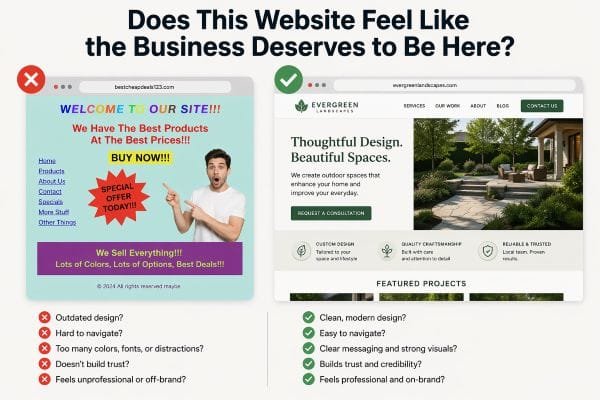
Check 1: Does This Website Feel Like the Business Deserves to Be Here?
Before a visitor reads a single word on your website, their brain has already formed an impression.
It happens in milliseconds. Researchers call it the aesthetic-usability effect, the tendency for people to judge something as more capable and trustworthy when it looks more polished. In the context of a website, this means your design speaks before your copy does.
Gig Harbor buyers have high visual standards. They live in a community defined by intentional aesthetics, waterfront properties, boutique shops, well-maintained marinas. They notice when something doesn’t match that standard.
A cluttered layout, mismatched fonts, or a color palette that looks like it was chosen in 2011 doesn’t just look dated. It signals neglect. And neglect in design raises a quiet question in the visitor’s mind: If they haven’t invested in how their business presents itself, what does that say about how they’ll treat my project?
This check happens before trust can even begin. It’s the foundation everything else is built on.
What to look for in your own site: Open your homepage on both your laptop and your phone. Does it feel calm and intentional, or cluttered and uncertain? Does the design reflect the level of quality you actually deliver?
Check 2: What Are Other People Saying, and Does It Sound Real?
Reviews are not optional in 2026. Ninety-three percent of customers read reviews before making a purchase, and 72% say positive reviews make them more likely to trust a local business. But Gig Harbor buyers don’t just look for stars, they look at what the reviews actually say.
Generic praise doesn’t move this audience. A review that says “Great service, highly recommend!” registers as almost meaningless. What this market responds to is specificity: a review that describes a recognizable situation, names a real outcome, and sounds like it was written by an actual person who had an actual experience.
They’re also checking where the reviews are. Google reviews carry the most weight, 67% of consumers trust Google-based reviews more than any other platform. But they’ll also look at whether the reviews are recent. A handful of glowing reviews from three years ago, with nothing since, raises questions.
And they’re reading the responses. A business that ignores its reviews, positive or negative, signals that it stops paying attention once the transaction is over. For a service-based business in a relationship-driven community like Gig Harbor, that’s a significant red flag.
What to look for in your own site: When did you last receive a Google review? Do your testimonials include real names, specific details, and recent dates? Are you responding to reviews consistently and personally?
Check 3: Is There Proof You Actually Know This Community?
This check is subtle, but it’s one of the most powerful filters Gig Harbor buyers use.
Anyone can put “Serving Gig Harbor” in their website footer. Anyone can use a stock photo of the Narrows Bridge on their homepage. That’s not local presence, it’s local decoration. And this market can tell the difference immediately.
Real local authority shows up in the details. It’s in copy that references the waterfront business district rather than just “Gig Harbor.” It’s in photos of actual completed work in recognizable local settings, not stock imagery. It’s in case studies that mention the specific neighborhood, the specific challenge, the specific result. It’s in language that reflects a genuine understanding of how businesses operate here, the commuter population, the seasonal patterns, the community character.
Gig Harbor buyers trust businesses that feel embedded in the community, not ones that appear to be marketing to it from a distance. If your website reads like it could belong to a business in Phoenix or Dallas, you are invisible to the clients who matter most.
This is why local content, real blog posts about real local experiences, real photos, real names, is worth far more than most business owners give it credit for.
What to look for in your own site: Remove the city name from your homepage copy. Does anything else suggest this business actually operates in Gig Harbor? If not, you’re relying on geography instead of authority.
Check 4: Can I Actually Reach a Real Person?
This check takes about three seconds, and it’s a hard filter for the Gig Harbor market.
Buyers here are not interested in submitting a form and waiting. They want to know there is a real human being behind this business who can be reached when needed. What they’re looking for is specific: a local phone number (not an 800 or out-of-state number), a physical address or service area they can verify, a named contact person or team, and some indication of when and how they can expect a response.
When this information is missing, buried in a contact page, inconsistent across the site, or replaced entirely by a generic contact form, trust drops quickly. The unconscious question the visitor asks is: If I have a problem with this business, will I be able to reach anyone?
In a community built on relationships and word of mouth, accountability is everything. A website that makes it hard to identify who is behind the business, or how to reach them, signals that the business may prefer distance. And distance is exactly what high-value Gig Harbor clients are unwilling to accept.
What to look for in your own site: Is your phone number visible without scrolling on every page? Does your contact information include a real name? If you have a physical location, is it easy to find?
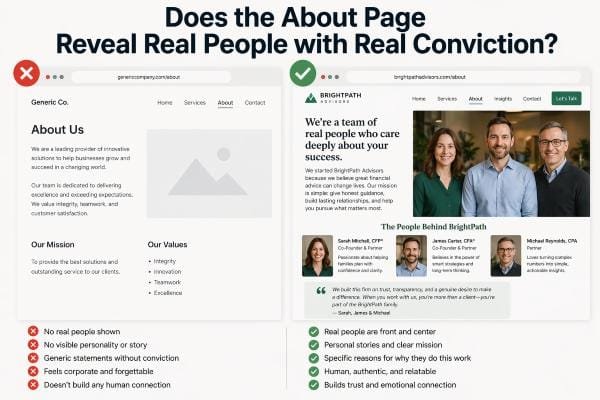
Check 5: Does the About Page Reveal Real People with Real Conviction?
Most small business About pages say the same thing: “We’re passionate about what we do. We’ve been serving our community for X years. We believe in quality and customer service.”
In Gig Harbor, that copy does almost nothing.
Buyers in this market read About pages looking for evidence, not claims. They want to see the people behind the business. Real photos, not stock images of someone in a hard hat who looks nothing like the person who will show up at their door. They want to understand what this business actually believes, not just what it sells. They want a point of view, a story, a reason this particular business exists rather than some other one.
What makes an About page work in this market is specificity and humanity. How long have you been in this community, and what does that mean in practice? What do you understand about Gig Harbor clients that someone from outside the area doesn’t? What happened that made you start this business, or shaped how you run it?
When an About page answers these questions honestly, something shifts. The visitor moves from evaluating a business to connecting with people. And in a market driven by relationships and referrals, that shift is where trust actually begins.
What to look for in your own site: Read your About page as if you were a prospective client who has never heard of you. Does it feel like a real story, or a marketing brochure? Does it make you want to call, or does it feel like every other About page you’ve ever read?
Check 6: Are the Technical Details Telling a Hidden Story?
Most Gig Harbor business owners don’t think of technical performance as a trust signal. But their customers do, even if they don’t know the technical vocabulary.
A website that takes more than three seconds to load on a phone communicates something. A site that breaks its layout on a tablet screen communicates something. An HTTP address, without the S, communicates something. Broken links, missing images, and forms that don’t submit all communicate something.
None of these technical issues say anything about the quality of your actual work. But they say something about the quality of your attention. And for a buyer who is about to spend significant money on a service, attention to detail is exactly what they’re evaluating.
Gig Harbor’s population skews toward experienced professionals and retirees, people who have dealt with enough contractors, service providers, and vendors to know that small signs of carelessness tend to predict larger patterns. A slow website, a broken mobile layout, or an outdated security certificate are small signs. They’re noticed. And they accumulate.
The technical health of your website is not separate from the trust it builds. It is part of the same message.
What to look for in your own site: Open your website on your phone, not your laptop. Does it load quickly? Does every element display correctly? Does the URL begin with https://? Try clicking through to your contact form and submitting it. Did it work?
Check 7: Does Everything Match Everywhere?
This is the check most business owners don’t even know their customers are running, and it’s one of the most common ways trust quietly breaks.
Before calling a business, experienced buyers often cross-reference. They look at the website, then check the Google Business Profile, then glance at Facebook or LinkedIn. What they’re looking for is consistency: the same phone number, the same address, the same hours, the same story.
When things don’t match, when the website says one phone number and Google shows another, when the hours on the site conflict with what’s listed on Yelp, when the photos on the website look like a different era of the business than the photos on social media, it creates a subtle but powerful sense of disorder.
Inconsistency signals that someone isn’t paying attention. And in a community where trust is built slowly and word travels fast, the impression that a business is disorganized or unmonitored can be enough to send a prospect somewhere else.
This is increasingly important because more buyers are also checking AI-powered search tools like Google’s AI Overview and ChatGPT before making local service decisions. These tools pull information from multiple sources and synthesize it. If your information is inconsistent across platforms, the picture those tools paint of your business may be incomplete, inaccurate, or simply unflattering.
What to look for in your own site: Search your own business name on Google. What appears? Does the phone number match your website? Are your hours up to date? Do the photos on your profile look like the same business presented on your site?
The Quiet Verdict
None of these seven checks involves a buyer sitting down with a rubric and scoring your website. It doesn’t happen that way. What happens is faster and more instinctive, a series of micro-impressions that accumulate into a feeling. Either the website creates confidence, or it doesn’t.
In Gig Harbor, where most new clients come through referrals, your website rarely needs to generate interest from scratch. What it needs to do is confirm the trust that was already started by a conversation, a recommendation, or a neighbor’s experience. When it does that well, the referral converts. When it doesn’t, the trust that someone else built for you quietly evaporates, and you never know it happened.
The good news is that every one of these checks is addressable. None of them require a complete rebuild from scratch. Most require clarity, consistency, and the willingness to look at your website through your customer’s eyes rather than your own.
If you’re not sure how your website holds up across these seven areas, that’s worth finding out, before the next referral arrives and checks for themselves.
Hyper Effects helps Gig Harbor businesses build websites that pass the checks buyers actually run. If you’d like an honest look at how your current site measures up, start a conversation with our team. No pitch, no pressure, just a clear picture of where things stand.
Related reading: