
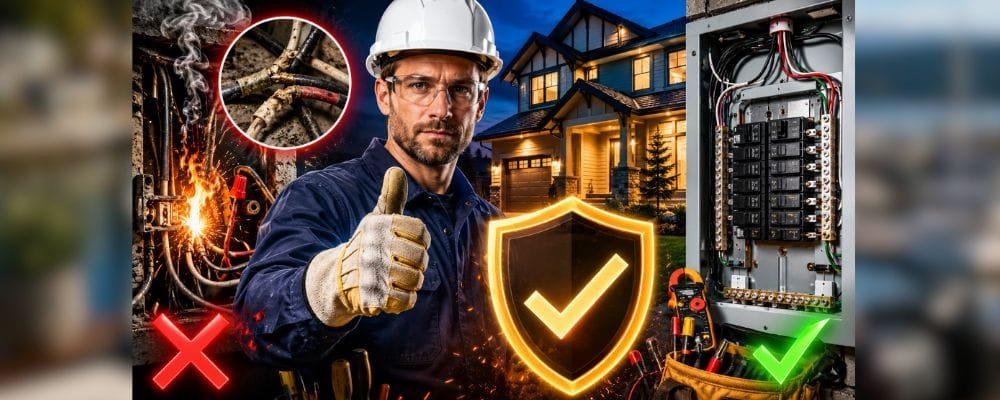
Olympia’s electrical contractors face a silent credibility problem that most don’t realize until leads stop coming.
Government agencies, property managers, and commercial clients in Olympia aren’t just looking for someone who can wire a building. They’re looking for someone who won’t create liability. They’re looking for licensure, certifications, compliance knowledge, and a track record of safety. When your website fails to communicate those credentials immediately, potential clients simply assume you don’t have them and move to the next electrician.
The problem isn’t that Olympia’s electrical market is oversaturated. The problem is that most electrical services websites look identical—generic photos of wire spools, stock images of hard hats, and vague messaging like “trusted electrical services for your home.” To a decision-maker reviewing your site in 45 seconds, that generic approach reads as “We’re hoping you trust us” instead of “You can verify our expertise immediately.”
In Olympia’s capital city market, where government contractors, state agencies, educational institutions, and healthcare facilities dominate the customer base, credibility isn’t optional. It’s foundational.
The Real Cost of Invisible Credentials: How Electrical Services Websites Quietly Lose High-Value Contracts
Olympia’s economic foundation rests on three major employment sectors: state government (23% of jobs), healthcare systems, and educational institutions. Every one of these sectors operates under compliance frameworks. When a government agency, hospital, or university selects an electrical contractor, the decision flows through procurement processes. Those processes require documentation of licensing, insurance, certifications, and safety records.
Most electrical services websites treat credentials as a footnote—buried on an “About Us” page alongside a paragraph about the owner’s garage startup story. Meanwhile, competing electricians structure their entire online presence around the exact proof that Olympia’s decision-makers need to see.
Here’s what happens: A procurement officer for a state building renovation project searches for “electrical contractor Olympia” or “commercial electrician Olympia services.” They visit your website. Within seconds, they should see:
- Current licensure and license numbers
- Industry certifications and specializations
- Insurance coverage documentation and limits
- Safety compliance record or safety training certifications
- Government projects completed (if applicable)
- Electrical system specializations (commercial wiring, data center infrastructure, emergency systems, etc.)
If your website requires them to dig, email, or call to verify these fundamentals, you’ve already lost the contract to an electrician whose website makes verification instantaneous. As per most commercial procurement best practices, visible credibility eliminates friction in the decision process.
Olympia Electricians vs. Generic Websites: Why Your Market is Different
Tacoma electricians can sometimes build their business on residential lead volume and local referrals. Olympia’s market operates differently. Consider the composition of Olympia’s customer base:
The City of Olympia employs thousands through state government offices. The Evergreen State College maintains extensive facilities and electrical systems. Providence St. Peter Hospital and other healthcare facilities require continuous electrical maintenance and upgrades. School districts manage aging infrastructure that needs renovation. Every one of these organizations has purchasing procedures that reward transparent credibility and punish vagueness.
Additionally, Olympia’s business climate emphasizes professional accountability and sustainable practices. Residents and institutional buyers in Olympia hold businesses to higher standards for professionalism, compliance, and transparency than markets dominated by residential or retail customers. A website that would work adequately in a trades-focused market often fails in a capital city environment where every buyer assumes higher professional standards.
An electrician’s website in Olympia isn’t just a lead-generation tool. It’s a credibility document. Government procurement officers, facility managers, and commercial contractors are evaluating your website as if it were your business license application. Missing elements register as red flags.
For comparison, review how other professional services in Olympia structure credibility. Read our complete strategy on professional services positioning to understand how capital city markets evaluate expertise and trust.
The Three Problems Electrical Services Websites Create (Without Realizing It)
Problem 1: Credentials Are Invisible
Government agencies, hospital administrators, and property managers need immediate access to proof of licensure, insurance, and safety compliance. Most electricians’ websites assume visitors will trust them based on testimonials or years in business. That assumption is incorrect in Olympia’s professional market.
Real-time visitor behavior analysis reveals this problem consistently: Procurement officers land on an electrician’s homepage, spend 30 seconds looking for credentials, find nothing accessible, and leave. They move to the next result. You never get a phone call because the credibility verification step failed before any conversation could begin.
The solution isn’t to create a credentials page buried in navigation. The solution is to integrate proof of expertise, licensure, and safety into the primary message. Government decision-makers should recognize your legitimacy within 10 seconds of arriving at your site.
Problem 2: Specializations Aren’t Clear
Electrical services encompass vastly different skill sets: residential wiring, commercial systems, emergency power systems, data infrastructure, solar installation, energy efficiency upgrades, code compliance work, and equipment replacement. A website that lists “we do all electrical work” appears to have shallow expertise across all categories.
Olympia’s market includes highly specialized facilities. The Evergreen State College has unique electrical needs. Healthcare facilities require different compliance than government offices. Educational institutions need different systems than retail buildings. Contractors who specialize and can articulate their specific expertise win higher-value contracts than generalists.
When your website fails to specify your specializations, prospects assume you lack depth in the areas they need. A facility manager looking for someone to upgrade emergency power systems will assume a generic “electrical services” site means the contractor handles basic residential work.
Problem 3: Safety Isn’t Your Opening Statement
The Occupational Safety and Health Administration (OSHA) enforces electrical safety requirements at the federal level, but Washington state adds additional requirements and oversight. Olympia-based facilities must comply with state-level regulations beyond federal standards. Electrical contractors in Olympia demonstrate safety compliance not as a feature but as the baseline expectation.
Most electricians’ websites make safety a secondary message—something mentioned in a few sentences about “safe installations” or “OSHA compliance.” This approach treats safety as an afterthought rather than the core value proposition.
In reality, every facility manager, procurement officer, and building owner is asking: “Can this contractor work on my property without creating liability?” That question should be answered before any other conversation begins. A website that doesn’t lead with safety documentation and compliance track record signals to decision-makers that safety awareness isn’t your priority.
How Olympia’s Most Credible Electricians Actually Communicate Online
The electricians capturing government contracts and facility management work in Olympia structure their websites around a single principle: make credibility visible before any other conversation begins.
This means the homepage immediately shows:
- Current Washington State electrical license number
- Insurance coverage details (liability, workers compensation, bonding)
- Safety certifications and training records
- Completed government or institutional projects
- Areas of specialization (with explanation of what makes you different)
- Compliance knowledge (understanding of state regulations, not just federal standards)
The secondary message then addresses customer concerns: responsiveness, experience, cost transparency, and service guarantees. That ordering matters. For high-value commercial and government clients, credibility verification is the first filter. Customer service satisfaction is the second filter.
Most websites reverse this sequence. That reversal costs contracts.
The Strategy: Building an Electrical Services Website That Wins Olympia Contracts
Step 1: Organize Your Site Around Buyer Segments
Similar to the principle that “when you talk to everybody, you talk to nobody,” electrical services websites fail when they try to appeal equally to residential homeowners, small commercial businesses, and large institutional facilities. These segments have entirely different decision criteria.
Government agencies and large facilities care about compliance, safety, and institutional fit. Residential customers care about availability and price. Small commercial customers care about efficiency and cost management. A website structured to address all three equally satisfies none of them.
The effective approach segments your website by customer type. Facility managers arriving at your site should immediately see that you specialize in their category. Government contractors should see your compliance experience. Each segment should find the specific credibility information they need to verify you’re qualified for their scope of work.
This is not about creating separate websites. It’s about architecting your primary website so different audiences find their specific pathway within seconds of arrival.
Step 2: Make Your Credentials Visible on Every Entry Point
Your license number, insurance information, and safety certifications should not be hidden behind navigation. Many electricians include this information but bury it on a hard-to-find “credentials” page.
The most effective strategy places credentials in immediate view: on the homepage, in the navigation, and in the footer. A facility manager or procurement officer should be able to verify your license within 10 seconds of landing on your site without needing to dig or search.
Real-time visitor tracking reveals that most site visitors never navigate beyond the homepage. If your credentials aren’t accessible from your entry point, they might as well not exist online.
Step 3: Document Your Specializations With Proof
“We handle commercial electrical work” means nothing. “We’ve upgraded electrical systems in three government buildings and two hospitals, specializing in emergency power systems and high-voltage infrastructure” means something.
Your website should include case studies or project summaries for each specialization. The case study doesn’t need to be lengthy. It needs to show: what was the challenge, what systems did you install, what compliance or safety requirements did you meet, and what was the outcome.
Government and facility managers are evaluating your website as a proxy for your technical competence. Written proof of past work in similar facilities builds confidence that you can handle their project.
Step 4: Communicate Safety as Your Foundation, Not Your Feature
Safety compliance should not be a sidebar or a testimonial. It should be central to how you describe your services.
An effective message sounds like this: “Every electrical project in Olympia must comply with Washington State Electrical Code, OSHA requirements, and the National Electrical Code. We maintain current training in all three frameworks and structure every project around safety compliance first.” This approach positions safety as non-negotiable, not as something you added on request.
Your website should explain what safety compliance means for the types of projects you handle. Government agencies care about different safety documentation than homeowners. Commercial facilities care about emergency protocols. Educational institutions care about system redundancy. Addressing these specific concerns demonstrates that safety thinking is built into how you operate.
Step 5: Display Your Responsiveness and Accessibility
In Olympia’s capital city market, large facilities and government agencies have limited availability windows for electrical work. Emergency outages must be resolved quickly. Scheduled work often has strict timelines.
Your website should clearly communicate your availability model. Are you available for emergency calls? What’s your typical response time? Do you offer after-hours service? Can you commit to specific project timelines?
This information should be accessible from your main navigation, not buried in fine print. Facility managers searching for electrical services during a power outage need to know immediately whether you can help.
Why This Website Strategy Wins Contracts in Olympia’s Professional Market
Olympia’s business landscape is shaped by government employment, educational institutions, and healthcare systems. These organizations operate under budget cycles, procurement procedures, and compliance frameworks. Electricians who structure their websites to work within these frameworks win contracts consistently.
Generic websites fail in this environment because they don’t acknowledge how these organizations actually make decisions. Specialized websites succeed because they anticipate the exact questions decision-makers ask and answer them before the questions are even voiced.
When you structure your electrical services website around Olympia’s market reality—compliance first, credentials visible, specializations clear—you transform the website from an optional marketing exercise into a functional business tool. Procurement officers, facility managers, and building owners use it exactly as intended: to verify credibility and make a hiring decision.
As per commercial procurement research, 73% of B2B buying decisions begin with online research. For electrical services in Olympia, that online research typically focuses on credential verification and specialization fit. Your website either facilitates this process or obstructs it.
The electricians capturing institutional and government contracts in Olympia have learned this truth. Their websites work as credibility documents, not as creative experiments. They organize information the way their audience needs it. They answer questions before they’re asked. They make verification easy. They communicate safety as foundation, not feature.
The Difference Between Websites That Collect Digital Dust and Websites That Generate Contracts
Your website can function as a 24/7 credibility verification system for every potential client who searches for electrical services in Olympia. It can work while you’re focused on active projects. It can qualify leads before they call you. It can demonstrate your expertise, safety compliance, and specialization to hundreds of decision-makers monthly without requiring your direct involvement.
Or your website can sit online collecting digital dust—generic, vague, and failing to communicate the exact information your most valuable customers need to hire you.
The difference between these outcomes is entirely structural. It’s about how you organize information, what you prioritize in your messaging, and whether you understand how Olympia’s professional market actually evaluates contractors.
Most electricians never question their website approach. They assume if they have a site, lead generation should naturally follow. The reality is that without alignment to how your market actually makes decisions, your website becomes liability rather than asset. It looks incomplete to procurement officers. It appears generic to facility managers. It fails to build the credibility that wins high-value contracts.
The electricians in Olympia who consistently win government and institutional work have restructured their online presence around one principle: make every credibility question answerable without requiring a phone call. Let the website verify expertise, safety compliance, and specialization. Let it eliminate friction from the decision process. Let it qualify leads before they ever contact you.
When your website functions this way, you stop chasing contracts. You start receiving requests from qualified prospects who’ve already verified you’re capable of handling their scope of work.
How Service Contractors Position Expertise in Capital City Markets
Understanding how to position your electrical services in a capital city context requires studying how other professional services win institutional contracts. Review how service businesses in Tacoma structure their messaging to understand the framework that applies to Olympia’s professional market. The principle is identical: lead with specialization and credibility, then build customer relationships through proof of expertise.
For electricians specifically, the challenge is different from general contractors. Read how contractors structure their websites to compete for institutional and government work to see how specialization messaging applies to trade services.
Why Local Search Visibility Matters More Than You Realize
Government agencies and facility managers in Olympia don’t scroll through page 15 of Google results. They search locally and call the contractors who appear at the top with the strongest credibility signals. Local search positioning directly determines which electricians get procurement requests.
Learn the complete strategy for ranking on Google Maps and local search to understand how visibility connects to contract generation. For electrical services, the contractors who rank highest are those whose websites communicate credibility most effectively.
Evaluating Website Quality: What Commercial Buyers Actually Look For
When a facility manager or procurement officer evaluates electrical contractors online, they apply the same evaluation criteria they’d use to assess any professional service provider. What actually separates contractors in your prospect’s mind?
Review the complete framework for evaluating web design companies to understand what institutional buyers look for in online credibility. The same evaluation criteria apply to electrician websites. Government clients are assessing: Is this contractor legitimate, capable, and professional? Your website must answer those questions immediately.
The Hidden Cost of Invisibility in Olympia’s Market
Every day your electrical services website remains generic is a day that potential contracts flow to competitors with better-structured online credibility. The cost isn’t measured in website redesign expenses. It’s measured in lost contracts and missed opportunities.
Understand the true cost of operating without proper market positioning to see how invisibility compounds over time. For electricians, the cost of a weak website is the difference between steady government contracts and sporadic residential leads.
FAQ
1: How do I verify an electrician’s license in Washington State?
You can verify an electrical contractor’s Washington State license through the Department of Labor & Industries (L&I) website. Enter the contractor’s license number to confirm current licensure status, license type (journeyman, master, or administrator), and any complaints or violations. A reputable electrical services website should display their current license number so verification takes seconds, not searches. Licensed electricians welcome this transparency because it protects both the contractor and the customer by ensuring compliance with state requirements.
2: What’s the difference between commercial and residential electrical work?
Commercial electrical work involves systems designed for businesses, institutions, and industrial facilities. These systems handle higher voltages, require compliance with commercial building codes, and often involve complex emergency power systems, data infrastructure, or specialized equipment. Residential electrical work involves lower-voltage systems designed for homes and smaller residential buildings.
Commercial work typically requires more advanced certifications, deeper code knowledge, and understanding of compliance requirements for government agencies, hospitals, and educational institutions. An electrician specializing in commercial work has training most residential electricians lack.
3: Why should I hire a local Olympia electrician instead of a contractor from out of state?
A local electrician understands Washington State’s specific electrical codes, which are often stricter than federal standards. They’re familiar with Olympia’s building infrastructure, institutional requirements, and procurement processes used by government agencies and facilities. A local contractor can respond quickly to emergencies, maintain relationships with local inspectors and building departments, and understand the unique compliance landscape of Olympia’s institutional buildings.
For government work, state contracts often require local contractors. For all work, local relationships and local knowledge reduce project complexity and timelines.
4: What certifications should an electrical contractor have?
Washington State requires all electrical contractors to hold a current license (journeyman, master, or administrator level). Beyond licensure, contractors may hold additional certifications in specialized areas: emergency power systems, solar installation, data center infrastructure, energy efficiency upgrades, or OSHA safety training.
Contractors working on government projects should have demonstrated experience with government compliance requirements. A reputable contractor’s website displays their licenses and certifications prominently so you can verify qualifications before hiring.
5: How do I know if an electrical contractor will complete work safely and on budget?
Review their insurance documentation to confirm coverage limits appropriate for your project scope. Request references from similar projects they’ve completed. Ask about their project management process and how they handle timeline and cost changes. Verify their safety compliance record through their website or L&I database.
Most importantly, a contractor’s website should clearly communicate their process, their specializations, and examples of similar work they’ve completed. Transparent communication about how they operate is the strongest predictor of safe, on-budget project completion.
What Comes Next: Building Your Credibility-First Electrical Services Website
Your website isn’t your finish line. It’s your starting point for converting qualified prospects into contracts. When government agencies, facility managers, and building owners search for electrical services in Olympia, your website should be structured to answer their credibility questions immediately, eliminate decision friction, and demonstrate that you understand their specific needs.
As an electrical contractor, your most valuable asset isn’t your reputation in the community. It’s your ability to be found by the specific prospects who need exactly what you do, verify you can deliver safely and compliantly, and move forward without hesitation.
A website built around that principle changes how you acquire contracts. Instead of hoping word-of-mouth generates leads, your website quietly qualifies prospects and builds credibility while you focus on active projects.
Olympia’s market requires electricians to think like institutional providers, not just service providers. When you structure your website accordingly, institutional clients start finding you. Facility managers start verifying your credentials. Procurement officers start treating you as a credible option. That shift transforms your entire business model.
The question isn’t whether you need a better website. The question is whether your current website is actually working as hard as you are to win Olympia’s most valuable contracts.
Latest Insight: How Professional Services Build Credibility in Capital City Markets
Recently, we published research on how professional services in Olympia build market authority. The strategy for an insurance agency website applies directly to how electricians should position themselves. As per our latest research, the most successful professional services websites in Olympia lead with credibility, then build customer relationships through transparency and specialization.
Read our complete analysis on how insurance agencies build government employee client bases in Olympia to see how the credibility-first positioning works across different professional services. That same principle applies to electrical services. You lead with license, insurance, and safety compliance. You build customer relationships through demonstrating specialization and project experience. You communicate that you understand Olympia’s market requirements.
Related Strategy Articles: How Olympia Professionals Build Market Authority
To understand how service businesses in Olympia communicate expertise and win high-value contracts, review these complementary frameworks:
Understanding Audience Segmentation: Learn why “when you talk to everybody, you talk to nobody” by reading how service businesses structure their messaging. The principle applies directly to how electricians should segment their Olympia website by customer type (residential, commercial, government, institutional).
Contractor Website Strategy: Understand why most contractor websites fail to generate qualified leads by reviewing this complete analysis. The same problems plague electrical services websites in Olympia—from invisible credentials to unclear specializations.
Evaluating Professional Credibility: For perspective on how to position your business against competitors who lack online credibility, review the complete evaluation framework. Government and facility managers in Olympia use identical evaluation criteria when assessing contractors.
Local Search Positioning: For guidance on making your services findable by institutional buyers in your market, learn the complete strategy for Google Maps and local search. Local search dominates how government agencies and facility managers locate electrical contractors.
The Economics of Invisibility: Understand the true cost of operating without proper market positioning to see how invisibility compounds over time. For electricians, the cost of a weak website is measured in lost contracts and missed institutional opportunities.
Takeaway: Transform Your Electrical Services Website Into a Contract-Generating System
Your electrical services website isn’t a marketing expense. It’s your most scalable sales asset. When structured around Olympia’s market requirements—visible credentials, clear specializations, safety-first messaging—it works as a 24/7 qualification system for government contracts, facility management work, and institutional projects.
The electricians consistently winning Olympia’s most valuable contracts aren’t necessarily the ones with the most experience. They’re the ones whose websites communicate credibility most effectively. They make verification easy. They answer questions before they’re asked. They demonstrate that they understand capital city procurement processes.
When your website functions this way, leads don’t trickle in from sporadic referrals. They flow in from qualified prospects who’ve already verified you’re the right choice for their scope of work.
The question isn’t whether you can redesign your website. The question is whether you’ll build it around market reality or keep hoping generic messaging generates institutional contracts.