
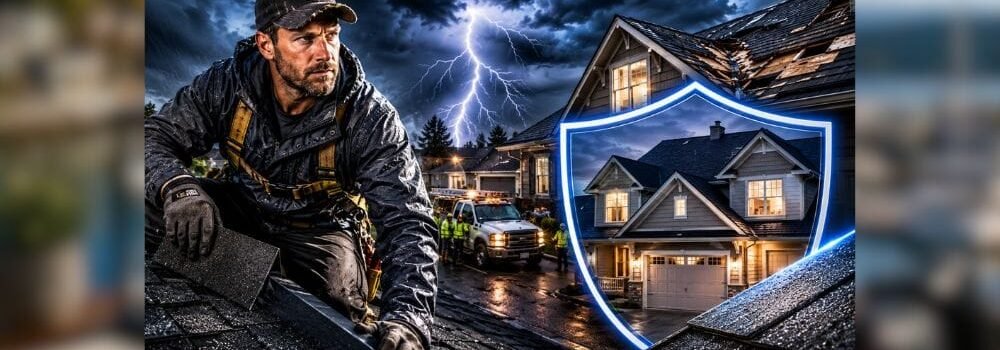
The Silent Problem Costing Olympia Roofing Contractors $50,000+ Per Year
Olympia receives 55 inches of rain annually, more than double the national average. When storms arrive and roofs fail, homeowners and property managers search for contractors immediately. The moment that decision begins, your website determines whether you win the contract or your competitor does.
The problem isn’t that Olympia roofing contractors lack skill or experience. The problem is that most roofing websites fail to communicate the one thing that matters most to frightened homeowners and cautious property managers: that your company has successfully handled exactly this situation before, and you can handle it again, right now.
Homeowners don’t call contractors who “seem competent.” They call contractors they trust immediately. Trust on a roofing website doesn’t come from photos, testimonials, or claims. It comes from portfolio evidence, emergency response positioning, and professional credentials that eliminate doubt before the phone call is placed.
When a roofing website fails to showcase this clearly, potential clients experience hesitation. They scroll further. They call three other roofers. They compare estimates. That hesitation costs you contracts every single week, and most roofers never know it’s happening.
Why Olympia’s Roofing Market Is Different From Other Washington Cities
Olympia is Washington’s capital city, and its roofing market operates differently than Seattle or Tacoma. The decision-makers in Olympia are professionals, government employees, property managers, business owners, and educated homeowners who approach contractor selection with research-oriented care. They verify licensing, check insurance coverage, review past projects, and want proof of emergency response capability.
<cite index=”3-1,4-1″>Olympia’s median household income is $81,302, with 51.8% of residents holding a bachelor’s degree or higher.</cite> This means your website visitor is likely educated, skeptical of marketing language, and expects credentials before trust. Your portfolio needs to demonstrate competence at the level they expect from professional services, not just “before and after” photos.
The other critical factor: <cite index=”21-1″>state government accounts for approximately 23% of all jobs in Thurston County.</cite> Government buildings, state facilities, and public properties represent a significant revenue opportunity for roofing contractors who position themselves correctly. Government procurement requires licensing verification, insurance proof, and verifiable project history, all of which belong prominently on your website.
When a roofing contractor’s website fails to showcase these elements with authority, potential clients outside the residential market never contact you. You remain invisible to the professional contracting segment where larger projects and year-round work exist.
The Website Problem Every Olympia Roofing Contractor Faces
Most roofing websites operate like online business cards collecting digital dust. They show a company name, a phone number, maybe some generic photos of roofs, and rely on the assumption that customers will call. The assumption is wrong.
Here’s what actually happens: A storm hits. A homeowner’s roof develops damage. They search “emergency roofing near me” or “roofer Olympia” on their phone. Your website appears. They arrive on your site and encounter:
Vague messaging about “quality” and “reliability” → Decision paralysis begins; they cannot distinguish your company from three others who make identical claims.
Generic stock photos of roofing work → No evidence that you’ve handled the specific type of damage they need fixed, and no proof this work was even performed by your company.
No clear emergency response communication → They don’t know if you answer after-hours calls, how quickly you respond, or whether you handle storm damage specifically.
Missing portfolio with project details → No evidence of past work in Olympia, no reference to similar projects completed under emergency conditions, no proof of performance.
Insurance and licensing buried or absent → They have to hunt for verification information instead of immediately seeing proof that you’re insured, licensed, and legitimate.
No government contracting positioning → If this customer represents a property management company or government facility, your website gives no signal that you work with institutions and understand compliance requirements.
The result: They call your competitor instead, not because your work is inferior, but because your competitor’s website removed the doubt and provided immediate evidence of credibility.
How Olympia’s Rain and Storm Season Create Constant Website Opportunity
The Pacific Northwest roofing market is defined by seasonal emergency response demand. October through March, Olympia experiences frequent storms, wind damage, and water intrusion, exactly when homeowners and property managers search for roofing contractors with proven emergency capability.
Your website should capitalize on this predictable seasonal demand by positioning emergency response as your core competitive strength. This requires more than offering 24/7 service. It requires visual proof that you have successfully responded to storm damage under pressure, that you understand the specific challenges of Olympia’s climate, and that your team mobilizes quickly when damage occurs.
A website built for emergency response works differently than a typical contractor site. It prioritizes:
Portfolio organization by damage type and urgency → Separate galleries showing storm damage repair, emergency tarping, water mitigation, and rapid response projects so visitors see exactly the scenario they’re facing.
Emergency response credentials front and center → Clear communication of after-hours availability, average response time, equipment positioning for rapid deployment, and team training for emergency conditions.
Before-and-after project evidence → High-quality photography that proves successful repair work, with project location, date, and scope clearly identified so potential clients see evidence of local Olympia experience.
Insurance partnership visibility → Clear identification of which insurance carriers you work with, your understanding of claims processes, and your ability to coordinate directly with adjusters, eliminating friction in the customer’s emergency response.
Government and institutional project history → Dedicated section showcasing commercial, government, and multi-unit projects that signal your capability to manage complex jobs, multiple stakeholders, and compliance requirements.
The Roofing Contractor Website Built for Visitor Psychology, Not Marketing Hype
Most roofing websites waste visitor attention on claims that every roofer makes: “We provide quality work,” “We’re professional and reliable,” “We have great customer service.” These statements create decision paralysis because they’re interchangeable. Your website should eliminate that paralysis by making decisions obvious.
A website built for roofing contractor success operates on a simple principle: remove thinking, not create it. The moment a visitor arrives on your site, especially during a storm emergency, they should instantly understand three things:
- You have done this exact job before Your portfolio demonstrates previous storm damage repairs, emergency response projects, and successful outcomes in Olympia’s climate conditions. Not generic roofing photos, but actual evidence of work you’ve completed under conditions the visitor is currently facing.
- You respond immediately and professionally Your website clearly states emergency response availability, average response times, and the process for emergency calls. If you answer phones 24/7 during storm season, that’s front-and-center. If you have equipment staged and crews ready, visitors see that. If you partner with insurance companies and coordinate claims, that’s visible immediately.
- You’re credible and verified Licensing information, insurance verification, bonding, industry certifications, and references are easy to find, not buried in small print. For professional customers (property managers, government facilities), credentials are prominently displayed because that’s the first thing they verify before calling.
This approach eliminates decision paralysis. The visitor arrives, sees immediate evidence of competence, trusts that you can handle their emergency, and calls your number. That’s the purpose of a roofing website.
Building Local Authority in Olympia’s Professional Roofing Market
Local authority in roofing doesn’t come from placing photos of Mount Rainier on your homepage or adding an Olympia address in the footer. Local authority means understanding Olympia’s specific climate challenges, demonstrating experience with local weather patterns, and proving that you work with Olympia property managers, government facilities, and homeowners who understand the market.
A roofing contractor who builds local authority in Olympia does this:
Showcases Olympia project history specifically. Your portfolio section includes projects completed in Olympia, Lacey, Tumwater, and surrounding areas. Each project shows the location, date, scope, and challenges overcome. Visitors see proof that you’ve worked in their neighborhood, understand local weather patterns, and have relationships with local property managers or inspectors.
References Olympia climate conditions explicitly. Your website acknowledges the specific challenges of Olympia’s 55-inch annual rainfall, seasonal storm patterns, and the types of roof damage most common in this region. You’re not a generic roofing contractor; you’re a contractor who understands this specific market’s specific problems.
Demonstrates government and institutional experience. If you work with government buildings, school facilities, or property management companies operating in Olympia, that’s prominently featured. Professional buyers (property managers, facility directors) need to see that you’ve managed institutional projects, understand compliance requirements, and can coordinate with multiple stakeholders.
Targets professional decision-makers specifically. Your website isn’t just built for homeowners. It’s built for property managers, facility directors, HOA boards, and government procurement officers who evaluate contractors differently. They need to see institutional project history, response to bid requirements, and professional credentialing.
When your roofing website demonstrates genuine local authority, not generic stock imagery, but real Olympia projects, real local experience, and real institutional credibility, you become the contractor that professionals call first.
The Roofing Website Problem Most Contractors Miss: Visitor Hesitation Points
Every roofing website loses customers at specific decision points. Most contractors never identify these hesitation moments because they don’t have visibility into how visitors actually behave on their site.
Here’s what typically happens: A potential customer lands on your roofing website from an emergency search. They browse for 20 seconds, then hesitate at one of these invisible friction points:
Portfolio friction: They want to see if you’ve done work like theirs, but your portfolio is poorly organized by damage type. They can’t quickly find storm damage examples. They leave.
Credibility friction: They want to verify your insurance and licensing before calling, but this information is missing or buried on a separate page. They don’t want to hunt. They call someone else.
Response time friction: They need emergency service urgently, but your website doesn’t clearly state your after-hours availability or average response time. The uncertainty causes hesitation. They call a competitor who promises faster response.
Insurance friction: They want to know if you work with their insurance carrier before calling, but you don’t list partner insurance companies. They worry about friction during the claims process. They keep searching.
Professionalism friction: Your photos, layout, and writing communicate amateur quality instead of professional capability. Visitors make snap judgments that you’re not experienced enough for a major project. They move on.
Government/institutional friction: Your website looks built only for homeowners, with no signal that you handle commercial or government work. A property manager searching for a contractor assumes you’re too small for their needs and keeps looking.
Each of these friction points is invisible to you unless you’re observing actual visitor behavior. You can guess, but you’re probably wrong. A website built with Private VIP Analytics visibility reveals exactly where visitors hesitate, which pages they navigate to before leaving, and which portfolio images receive the most attention.
That visibility changes everything. Instead of wondering why you’re not getting calls, you see the exact moment potential customers lose confidence and exit. Then you fix it.
The Roofing Contractor Website as a 24/7 Emergency Response System
Here’s what separates roofing contractors who grow from those who stay stuck: Understanding that your website is not a brochure. Your website is a 24/7 sales and emergency response system that works while you’re sleeping, during weekends, and while your crew is in the field.
When a storm hits at midnight, homeowners search for roofing contractors while the emergency is happening. Your website is available. Your competitors’ websites are available. The one that provides immediate evidence of emergency response capability, portfolio credibility, and clear contact options gets the call.
A roofing website built as an emergency response system does this:
Responds to emergency search intent immediately. When someone searches “emergency roofer Olympia” or “storm damage roof repair,” your website landing page speaks directly to that emergency scenario. Not generic roofing information, but specific addressing to the urgent problem they’re facing right now.
Eliminates contact friction. Your phone number, emergency contact process, and response time commitment are immediately visible. A visitor should never have to hunt for how to reach you during an emergency.
Provides portfolio evidence of past emergency work. Photos and descriptions of storm damage repairs, emergency tarping, rapid response projects, and successful emergency outcomes prove you’ve handled this exact situation before.
Communicates 24/7 availability clearly. If you staff emergency calls around the clock during storm season, your website says so. If you have crews ready to deploy immediately, visitors see that. If you offer temporary tarping and water mitigation within hours, that’s communicated upfront.
Demonstrates insurance coordination. Many emergency callers are unsure about insurance coverage. Your website clarifies that you work directly with adjusters, understand claim processes, and can coordinate repairs without confusion.
Builds decision confidence through social proof. Customer testimonials specifically addressing emergency response, rapid repair completion, and insurance coordination reduce hesitation for potential emergency clients.
This approach transforms your website from a passive business card into an active emergency response partner. The moment a crisis hits, your website is already working, building confidence, and making the decision to call your number feel obvious.
Portfolio Positioning: Turning Before-and-After Photos Into Credibility Evidence
The difference between a weak roofing portfolio and a credible one comes down to specificity and context. Generic before-and-after photos prove nothing; they could be from anyone. A portfolio that positions you as the expert in Olympia’s roofing challenges tells a specific story about your competence.
A credible roofing portfolio for Olympia includes:
Project type and urgency. Each photo is labeled with the damage type (storm damage, emergency tarping, water mitigation, full replacement, leak repair), the circumstances (severe weather event, ice damage, age-related failure), and the sense of urgency the client faced. Visitors see proof that you handle the exact emergency they’re experiencing.
Location specificity. Projects are organized by Olympia neighborhoods and surrounding areas. Visitors in the Westside, South Capitol, or Eastside neighborhoods can see work completed in their specific area. Government facilities and property management projects are listed by name (with client permission) so institutional buyers see proof of commercial experience.
Timeline and response. For emergency projects, your portfolio mentions response time and timeline to completion. “Emergency response: Roof tarped within 2 hours, temporary protection deployed, permanent repair completed within 5 days.” This communicates your emergency capability better than any written claim.
Complexity and scope. Your portfolio includes projects of varying complexity: simple repairs, major replacements, multi-unit properties, institutional buildings, and specialized installations. This signals capability across different scenarios, not just basic residential work.
Before-and-after photography quality. Professional photography matters. High-quality before-and-after images communicate professionalism and careful documentation better than smartphone photos. Institutional buyers and property managers expect professional portfolio presentation.
Client testimonials tied to specific projects. Instead of generic testimonials, connect specific feedback to specific projects. “John M., property manager: ‘They responded to our emergency within 2 hours, coordinated with our insurance adjuster, and completed permanent repairs within 5 days. No surprises, no delays.'” This specificity builds credibility better than anonymous praise.
Government and institutional credentials. If you work with government buildings, school districts, or property management companies, those projects should be highlighted prominently. Government procurement often requires referrals from comparable institutional clients, so institutional portfolio evidence is valuable for winning government work.
When your portfolio is organized this way, with specificity, location, urgency, and scope clearly communicated, potential customers see a contractor who has successfully handled scenarios exactly like theirs. That evidence builds confidence and makes the decision to call obvious.
Positioning for Government Contracting: Olympia’s Hidden Revenue Opportunity
Most roofing contractors compete for homeowner business and ignore a larger, more stable market: institutional and government facility roofing contracts. <cite index=”21-1″>State government accounts for approximately 23% of all jobs in Thurston County, making it the largest employment sector.</cite> Government buildings, school facilities, university infrastructure, and state agency properties all require roofing maintenance, emergency repair, and major replacement work.
Government contracting is typically higher-dollar, longer-term, and more stable than residential work, but it requires different positioning. Government and institutional buyers evaluate contractors differently than homeowners. Your website needs to demonstrate:
Licensing and bonding verification. Government procurement requires proof of licensing and bonding. Make this immediately visible, not a footnote. Institutional buyers verify this before they call, and your website should make verification frictionless.
Insurance documentation and coverage limits. Government work requires specific insurance limits and coverage types. Your website should clearly state your insurance requirements compliance and provide documentation of coverage without requiring phone calls.
Previous government project history. Reference previous institutional and government projects (names and locations where permitted by contract). If you’ve worked on school buildings, state facilities, or government properties, that’s institutional credibility that attracts similar work.
Compliance and safety protocols. Government facilities have strict compliance, safety, and documentation requirements. Your website should reference your compliance protocols, safety record, and project documentation standards.
Response to procurement processes. Government contracting involves bid processes, change order procedures, and formal communication protocols. Your website should signal that you understand these requirements and manage projects according to institutional standards.
Multi-year service and maintenance relationships. Unlike one-time residential repairs, government facilities need ongoing roofing maintenance and inspection services. Your website should position long-term service relationships and maintenance planning as core capabilities.
When your roofing website targets institutional and government buyers explicitly, you access a market larger and more stable than residential emergency repair. This positions your business for consistent year-round revenue instead of seasonal emergency demand cycles.
The Role of Trust Signals in Roofing Website Credibility
A roofing contractor’s credibility depends entirely on trust signals that eliminate doubt before the phone call is made. For homeowners facing emergency roof damage, trust signals are what convert hesitation into action. For institutional buyers evaluating contractors, trust signals are what determine whether you make the shortlist.
Trust signals in a roofing website include:
Visible licensing and insurance information. Not hidden on a separate page, not behind contact form. Prominently displayed with verification information that allows potential customers to independently verify your credentials immediately.
Specific project examples with verifiable details. Before-and-after photos with project location, date, and scope that can be independently verified. Vague claims don’t build trust; specific, verifiable evidence does.
Customer testimonials tied to specific results. “We fixed the leak and saved us thousands on water damage” is weaker than “We identified the leak source on Day 1, coordinated with our insurance adjuster, and completed permanent repairs by Day 5. Final cost was 40% less than the initial estimate because we diagnosed accurately.”
Transparency about scope and pricing. Roofing projects vary dramatically in cost depending on scope, materials, and complexity. Your website should explain that clearly and avoid vague statements like “affordable pricing.” Institutional buyers expect transparent scope definition and pricing structure.
Emergency response credentials. If you offer emergency service, prove it with response time commitments, 24/7 contact availability, and past emergency project examples. Claims about emergency response need evidence, not just statements.
Professional presentation and documentation. Professional website design, high-quality photography, clear writing, and organized portfolio communicate that you take professionalism seriously. Sloppy websites communicate sloppy contractors.
References and verifiable results. Offer to connect potential clients with previous customers (with permission) so they can independently verify your reputation. References are trust signals that can’t be faked.
As per findings from Trust Building Research in Professional Services, potential customers in Olympia’s professional market, property managers, facility directors, government procurement officers, make credibility judgments within seconds of landing on your website. They’re evaluating licensing visibility, portfolio professionalism, communication clarity, and responsiveness. Your website either builds trust immediately or loses the prospect to a competitor.
Web Design That Converts Emergency Calls Into Contracts
A roofing website built for conversion isn’t fancy or creative. It’s purposeful. Every element exists to accomplish one goal: make the decision to call your number feel like the obvious choice.
Here’s how this differs from typical contractor websites:
Navigation removes friction. Instead of burying your phone number in the footer or hiding it behind a contact form, emergency contact is immediately visible. Visitors searching during a storm crisis should see how to reach you within two seconds of landing on your site.
Portfolio is organized by visitor need. Don’t make visitors hunt for examples of work relevant to their problem. Organize portfolio sections by damage type (storm damage, emergency tarping, water intrusion, full replacement, specialized installations) so visitors see relevant examples immediately.
Call-to-action is specific to urgency. Instead of generic “Contact us” buttons, emergency-specific messaging communicates “Emergency service available 24/7” or “Call for immediate response.” The language acknowledges the actual emotional state of your visitor.
Institutional and government pathways are distinct. If you serve both residential and institutional markets, your navigation might include separate pathways: “Residential emergency service” and “Commercial/government contracting.” This allows institutional buyers to find relevant information quickly without wading through residential content.
Response time is guaranteed and visible. Instead of promising “prompt service,” commit to specific response times: “2-hour response during emergency calls” or “Crew on-site within 24 hours for non-emergency repairs.” Specificity builds confidence.
Contact form is simplified for emergencies. Homeowners in emergency situations don’t want to fill out lengthy forms. Your emergency contact should be phone-first, with an option for immediate live chat or simple text message communication for after-hours situations.
Social proof addresses emergency scenarios. Testimonials and reviews should emphasize emergency response quality: “They came out immediately during the storm,” “They worked with our insurance adjuster without confusion,” “They kept us updated throughout the process.”
This conversion-focused design transforms your website from an information repository into an emergency response tool that creates customers.
Connecting Roofing Websites to Broader Digital Strategy
A roofing website doesn’t exist in isolation. It’s part of a larger digital strategy that includes search visibility, local positioning, social media presence, and review management. When these elements work together, your roofing contracting business becomes visible at exactly the moment when potential customers search for your services.
Websites designed with geographic specificity and local market understanding significantly outperform generic contractor sites. Your Olympia roofing website should be built specifically for Olympia’s market conditions, Olympia’s professional buyer expectations, and Olympia’s seasonal storm patterns.
Local search engine optimization ensures that when homeowners search “roofer near me” or “emergency roofing Olympia,” your website appears where potential customers are looking. Search visibility alone, however, doesn’t convert customers. The website itself must complete the conversion by building trust and making the decision to call obvious.
Small roofing businesses often face budget constraints that make marketing efficiency critical. A website built as a 24/7 sales system works continuously, converting emergency searches into contracts while you’re completing other projects. This efficiency becomes especially valuable during seasonal demand cycles when emergency call volume peaks.
Building instant trust with professional decision-makers requires credibility positioning that transcends typical contractor websites. Government and institutional buyers are skeptical of hype; they want evidence, documentation, and verified credentials.
Professional roofing website design doesn’t require inflated budgets. A website designed specifically for roofing contractor needs, portfolio clarity, emergency positioning, institutional credibility, delivers results without unnecessary cost or complexity.
The Roofing Contractor Who Wins Isn’t the Cheapest; It’s the Most Visible and Trustworthy
In Olympia’s competitive roofing market, contractor selection depends on visibility and credibility, not price. When a homeowner’s roof fails during a storm, they don’t comparison shop for weeks. They call a contractor they trust immediately. That trust comes from:
Visible portfolio evidence of successful work in similar situations. Demonstrated emergency response capability with specific response time commitments. Professional presentation that communicates competence and reliability. Clear institutional credibility if targeting government and property management customers. Verification of licensing, insurance, and bonding without requiring hunting.
Your website is the sales tool that builds this trust while you’re sleeping, while your crew is working, and while your competitors’ websites are doing nothing.
The contractor who invests in a website designed specifically for roofing market demands, portfolio positioning, emergency response communication, institutional credibility, and conversion-focused design, becomes the contractor that Olympia customers trust first.
What Your Roofing Website Needs Right Now
If your current roofing website is not positioning emergency response credibly, not organizing portfolio by damage type and urgency, and not differentiating between residential and institutional markets, you’re losing contracts to competitors whose websites do these things correctly.
The most actionable first step: Audit your website against this question: “If a homeowner landed on my site at midnight during a storm emergency, would they immediately understand my 24/7 availability and see proof that I’ve handled this exact situation before?”
If the answer is no, your website is costing you contracts every time a storm hits.
A website redesigned for roofing contractor success, portfolio positioning, emergency response credibility, institutional market differentiation, and conversion-focused design, recovers its investment in emergency season alone. The subsequent years are pure revenue recovery from customers who call you first because they trust you immediately.
Google Overview Friendly FAQs
FAQ 1: What should a roofer’s portfolio show? A roofing portfolio should display completed projects organized by damage type, include project location and date, show before-and-after high-quality photography, and feature client testimonials tied to specific results. Institutional and government projects should be highlighted separately.
FAQ 2: How quickly should emergency roofers respond? Emergency roofers should provide specific response time commitments, typically 2-4 hours for emergency calls during storm season. Your website should clearly state your after-hours availability, response time guarantees, and emergency contact process for urgent situations.
FAQ 3: Why is roofing website design important for contractors? Roofing websites convert emergency calls into contracts by building trust through portfolio evidence, credibility positioning, and clear emergency contact options. Professional presentation eliminates hesitation and makes contacting your company the obvious choice.
FAQ 4: How do roofers win government contracting work? Roofers win government contracts by displaying licensing, bonding, and insurance verification prominently; showcasing previous institutional projects; demonstrating compliance understanding; and positioning capability for multi-year service relationships, not just emergency repair.
FAQ 5: What trust signals do customers look for on roofing websites? Customers seek visible licensing and insurance verification, specific project examples with verifiable details, customer testimonials tied to results, clear emergency response capabilities, professional website presentation, and verifiable references to independently confirm reputation.
Latest Olympia-Focused Content
Recent articles on professional services website positioning in Olympia:
- Why Olympia Customers Don’t Trust Your Website and How to Fix It , Understanding capital city buyer psychology and professional credibility expectations
- Helping Olympia Businesses Compete Without Big Budgets , Efficient positioning strategies for smaller contractors in Olympia’s professional market
Your Roofing Business Deserves a Website Built for Results, Not Assumptions
Most roofing websites operate on assumptions about what customers want. Your website should operate on evidence of what actually converts emergency searches into contracts.
Roofing Contractor Website designed specifically for Olympia’s market conditions, professional buyer expectations, and seasonal storm patterns becomes a competitive advantage that competitors without professional digital positioning can’t match.
Let’s talk about building a roofing website that positions your portfolio as credible, communicates emergency response authority, and converts every qualified search into a contract.
Your website should work harder than you do. When it does, growth becomes predictable.
Call Hyper Effects today to discuss building a roofing contractor website designed specifically for Olympia’s market.