
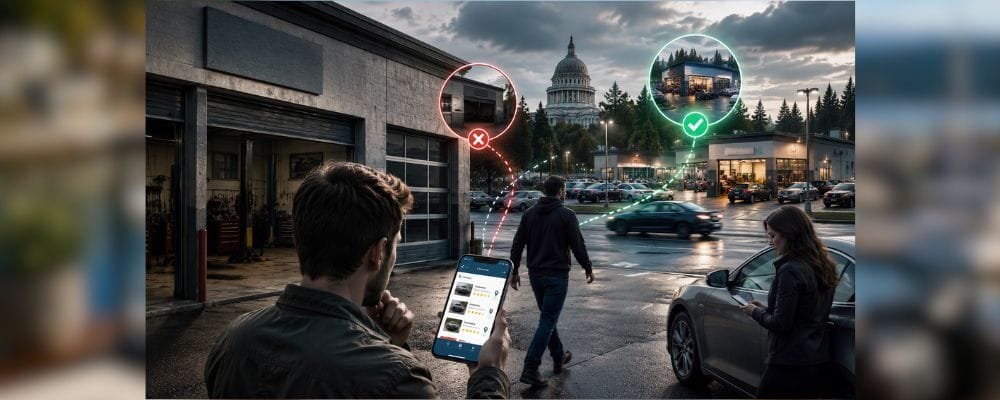
OLYMPIA MECHANICS LOSE CUSTOMERS BEFORE THEY EVER CALL
When something goes wrong with a car in Olympia, the decision happens fast. A transmission warning light appears. A strange noise emerges from under the hood. A government employee driving to Capitol Lake notices their brakes feel soft. In that moment, a customer has a specific psychological need that your website either satisfies or fails to address entirely.
Olympia customers, many of them government workers and professionals accustomed to credibility-driven decisions, run silent checks before they pick up the phone. They do not pick up the phone first. They visit your website first. In those initial seconds, they are asking themselves three critical questions: Do I trust this person? Can they handle my emergency? Can I reach them when I need them?
Most auto repair websites answer none of these questions clearly.
The result is predictable. A potential customer lands on your site, finds no emergency authority, sees no trust signals, and quietly closes the browser tab. They call your competitor instead. The entire transaction dies before it begins, not because your mechanics are inferior, but because your website communicated uncertainty rather than expertise.
This is not a traffic problem. This is a trust problem. Olympia customers do not need to find you. They need to trust you the moment they see you.
WHY OLYMPIA’S MARKET IS DIFFERENT (AND WHY IT MATTERS)
Olympia is a mid-sized capital city with a median household income of $81,302 and 51.8% of residents holding a bachelor’s degree or higher. This demographic composition shapes how customers evaluate service providers online. Government employees and professionals in Olympia are accustomed to credentials, transparency, and clear authority.
This is not Tacoma, where trade services compete on quick response and practical efficiency. Olympia’s professional market demands that your website communicate credibility before convenience. Your customer base includes state government employees, educational professionals, and business owners who evaluate service providers the way they evaluate other professional relationships, by credentials, process clarity, and proven reliability.
The second distinction: Olympia residents value local business loyalty and community trust. When an Olympia customer chooses your shop, they are not just buying a service. They are choosing to keep money in the community, to support a local business, and to build a relationship with someone they trust. Your website must reflect this understanding. Stock photography of a generic mechanic will not work here. Generic claims about customer service will not work here.
The third distinction affects emergency authority specifically. Olympia drivers include legislative staffers, healthcare professionals, and state employees whose vehicle failure directly impacts their work performance. These are not discretionary customers. When their vehicle breaks, they need a mechanic now. Your website must communicate that you understand emergency response and that you are prepared to handle urgent situations.
WHY MOST AUTO REPAIR WEBSITES FAIL AT BUILDING TRUST
Most mechanics’ websites are built around information architecture, not visitor psychology. They organize content in a logical order, About Us, Services, Contact, but this structure tells the visitor nothing about whether the shop is trustworthy, competent, or available during emergencies.
The typical auto repair website shows: a photo of the shop, a vague statement like “We’ve been serving the community for 15 years,” a list of services, and a phone number. This structure creates decision paralysis. The visitor reads the information but finds no clear reason to trust it. No credentials are displayed. No emergency response protocol is explained. No social proof is offered. The website essentially says, “We exist, we do things, please trust us.” That is not how trust works.
The second failure: most mechanics’ websites ignore the specific fear that drives emergency customers. When someone’s car breaks down, they are not thinking about logistics. They are thinking about anxiety. Can I afford this repair? Will this shop overcharge me? Will they call me with honest information or try to upsell unnecessary work? What if the shop mishandles my car? A website that does not address these fears explicitly will not convert emergency customers into callers.
The third failure: auto repair websites do not establish emergency authority. They do not clearly communicate: “When your car breaks down, here is exactly what happens when you call us,” “Here are our response times,” “Here are our certifications,” “Here is how we diagnose problems honestly.” Without this clarity, customers call competitors instead.
Finally, most mechanics’ websites are built for the wrong audience entirely. They are built for customers browsing casually on a Sunday afternoon. Olympia mechanics need websites built for customers in crisis, people whose check engine light just came on, whose transmission is slipping, or whose steering feels wrong. These customers are searching at midnight, on a Friday evening, or while sitting in a disabled vehicle. The website must address this emergency mindset, not a casual browsing mindset.
THE SOLUTION: BUILD EMERGENCY AUTHORITY THROUGH TRUST SIGNALS
What Trust Signals Actually Mean
Trust signals are not testimonials alone, though testimonials help. Trust signals are the combination of evidence that together convince a visitor that your shop is competent, reliable, and worth their money. In Olympia’s professional market, these signals include:
- Certifications and Credentials (The Foundation)
Government employees and professionals in Olympia are accustomed to credentials mattering. Your website must display them prominently: ASE (Automotive Service Excellence) certification, manufacturer certifications (Ford, Toyota, Honda, etc.), state licensing, and any specialized training.
The key difference from other service websites: do not just list certifications. Explain what they mean. “ASE Certified Master Technician” should include a line explaining: “This means our lead technician has passed rigorous national exams covering engine repair, transmission systems, electrical systems, braking systems, and more. ASE certification is renewed every five years, ensuring current knowledge.”
Olympia customers do not need to know you are certified. They need to understand what that certification guarantees them.
- Response Time Transparency (The Emergency Authority)
Emergency customers need to know: If I call right now, what happens? When will my car be diagnosed? When will I hear back from you?
Your website should include: “Emergency calls answered within 1 hour,” “Diagnostic appointments available within 24 hours,” “Most repairs completed within 48 hours.” These are not just conveniences. These are trust signals. They communicate that you have systems in place and you take urgency seriously.
- Honest Pricing and Diagnostic Process (Removing Fear)
The second fear Olympia customers hold is the fear of being overcharged. Address this directly on your website.
Include a section: “How We Diagnose Your Car Honestly.” Explain: “Step 1: You bring your car in and describe the problem. Step 2: We perform a diagnostic scan ($X or free with repair). Step 3: We call you with the exact problem and repair options, we always give you options. Step 4: You approve the repair before we begin. Step 5: We show you the parts we removed and explain exactly what we fixed.”
This transparency removes decision paralysis. Customers know what to expect.
- Real Customer Testimonials (Local and Specific)
Generic testimonials, “Great service!”, do not work. Olympia customers trust specific stories from people like them.
Ideal testimonials come from: government employees who mention trusting you with their work vehicle, professionals who mention reliability, customers who mention honest pricing, customers who mention emergency response. The testimonial should include the customer’s name, their profession (if appropriate), and a specific story: “When my transmission started acting up, I was nervous about the cost. The team diagnosed the problem, explained my options, and got me back on the road without any surprises. Highly trusted.”
This is local authority in action.
- Emergency Availability (Answering the Real Question)
Olympia customers search for mechanics at odd times, Friday evening, Saturday morning, midnight on a weeknight when they notice a problem. Your website must communicate availability clearly:
“We answer emergency calls 24/7. During business hours (M-F 7am-6pm, Sat 8am-4pm), we can often fit emergency diagnostics same-day. After hours, you can leave a message and we return calls within one hour.”
Post this prominently. Link to it from your homepage. Visitors in emergency mode are searching for this information specifically.
- Local Authority (Olympia-Specific Positioning)
Your website should reference Olympia specifically: “Serving government employees, healthcare professionals, and Olympia business owners since [year],” “Local mechanic trusted by Capitol Lake professionals,” “Olympia’s reliable choice for emergency vehicle repair.”
This is not generic marketing. This is positioning yourself as part of Olympia’s professional community. It signals: “We understand your market, we serve your community, we are not a chain.”
HOW TO STRUCTURE YOUR AUTO REPAIR WEBSITE FOR EMERGENCY AUTHORITY
Homepage First Section: Emergency Authority
Do not start with “Welcome to our shop.” Start with emergency messaging:
Headline: “Your Car Broke Down. We Get It. Here’s Exactly What Happens Next.”
Subheading: “Emergency diagnostic appointments within 24 hours. Real diagnosis, honest pricing, transparent process. Trusted by Olympia government employees and professionals since [year].”
Call to Action: “Call Now for Emergency Diagnostic” (with phone number prominently displayed, clickable on mobile)
Second Section: Why Olympia Chooses Us (Trust Signals)
- ASE Certified Master Technician (with explanation of what this means)
- [Year] of local service
- 24/7 emergency response
- Transparent diagnostic process
- Real customer testimonials from Olympia professionals
Third Section: The Diagnostic Process (Remove Decision Paralysis)
Step-by-step explanation of what happens when someone calls with an emergency repair need. Link to more detailed pages on your website.
Fourth Section: Customer Testimonials (Local Stories)
3-5 testimonials from Olympia customers with names, professions, and specific stories about emergency situations.
Service Pages: Emergency Authority for Each Service
Do not list services generically. Build authority around emergency situations:
Transmission Repair: “Transmission failing while you’re commuting to Capitol? We diagnose the problem, explain your repair vs. replacement options, and get you back on the road without surprises.”
Brake Repair: “Soft brakes are an emergency. We have the parts in stock to handle most brake emergencies same-day. Certification: ASE Brake Systems Expert.”
Electrical Repair: “Check engine light? Electrical gremlins? We use factory diagnostic tools and real expertise to solve electrical problems the right way, not by guessing.”
This language communicates emergency authority, not just service availability.
FAQ
1: How Do I Know If a Mechanic Shop Is Trustworthy?
Look for ASE certifications, transparent diagnostic processes, clear emergency response times, local customer testimonials from your community, and honest pricing communication. Trustworthy shops explain problems in plain language.
2: What Should an Auto Repair Website Include?
A trustworthy mechanic’s website includes certifications, emergency availability times, step-by-step diagnostic process explanation, transparent pricing, customer testimonials, and clear call-to-action for emergencies. Mobile accessibility matters for emergency customers.
3: How Quickly Can You Respond to Car Emergencies in Olympia?
Most Olympia mechanics offer same-day diagnostics for emergency calls. High-quality shops answer emergencies within one hour and provide next-available appointment times. Ask about response times when calling.
4: Why Is Local Authority Important for Auto Repair Shops?
Local mechanics understand Olympia’s community, government employee needs, and climate challenges. Local shops build trust faster with community members and offer personalized service. National chains lack local credibility.
5: What Questions Should I Ask an Auto Repair Shop?
Ask: What certifications do you hold? What’s your diagnostic process? Can you explain repairs in plain language? Do you offer warranties? Can you provide local customer references? How quickly can you respond to emergencies?
WHY THIS MATTERS: THE REAL COST OF AN UNCLEAR WEBSITE
Olympia mechanics lose revenue quietly, not from lack of skill, but from lack of clarity. A government employee’s transmission needs attention, so they search “emergency transmission repair Olympia” at 6 p.m. on a Friday. They find three auto repair websites. The first clearly states: “Emergency calls answered within 1 hour. Here’s our process. Here are our certifications. Here’s what customers say.”
They call that shop.
The other two websites provide information but communicate nothing about emergency authority or trust. Those shops lose the customer before they ever have a chance to prove their competence.
The solution is not complicated. It requires building a website that answers the actual questions emergency customers are asking: Do I trust you? Can you handle this right now? Will you be honest with me?
Hyper Effects Olympia Web Design Services specializes in positioning professional service businesses, including auto repair shops, to build authority and trust in Olympia’s competitive market. The approach is the same whether you’re an electrician, a mechanic, or a consulting firm: understand your customer’s fear, address it directly, and build credibility before they ever call.
Takeaway –
Your Olympia auto repair website can become your most reliable employee, answering emergency questions 24/7, building trust before phones ring, and qualifying customers before they call. That is the difference between a website that collects digital dust and one that actually drives business.
Ready to build an auto repair website that communicates emergency authority? Let’s Talk about your shop’s positioning in Olympia’s professional market.