
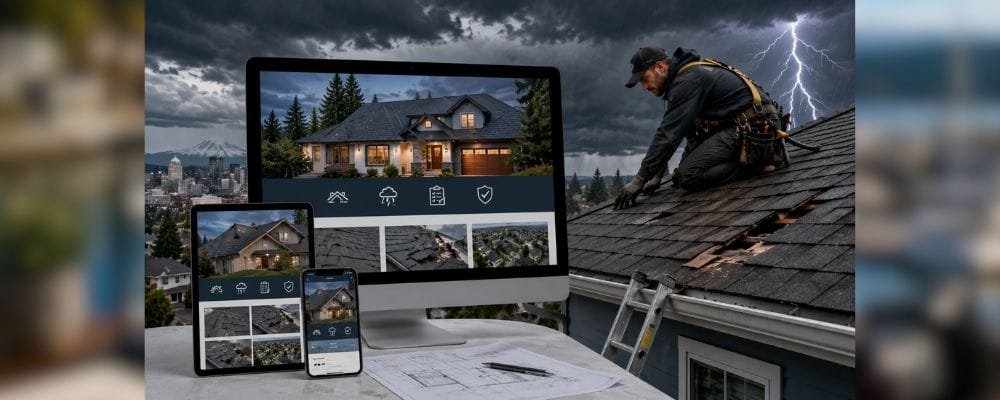
Here’s what most Tacoma roofing contractors don’t realize: Your website is either positioned to capture the storm damage surge that appears after heavy weather, or it’s watching those high-profit calls go to competitors who anticipated the surge.
Roofing is unique among trades. Most roofing work is invisible until it fails. Homeowners don’t think about roofing maintenance until weather damage creates visible urgency. This means your website must do two jobs simultaneously: Generate steady lead-flow during normal periods while positioning to explode during post-storm surges when call volume spikes and profit margins skyrocket.
A roofing website built for steady renovation work fails to capture storm-surge opportunities. Roofing website messaging must address both planned roof replacements and emergency storm damage. Your website must communicate: We handle both your planned roofing project and your emergency storm damage with equal professionalism.
This guide reveals exactly how roofing contractors in Tacoma should position their websites to capture routine roofing work, explode during storm damage surges, and establish authority across multiple roofing service types.
The Roofing Services Psychology: Invisible Until Crisis
The Dual Customer Psychology
Roofing services address two distinct customer types with completely different decision-making psychology:
Planned roof replacement customers: Making deliberate, comparison-shopping decisions. Researching options, requesting quotes, evaluating contractors over weeks or months.
Storm damage customers: Facing urgent, insurance-driven situations. Already have insurance company involvement. Need fast assessment and fast approval process. Decision-making is compressed into days.
Your website must address both psychologies. Most roofing websites address one or the other. The best websites address both equally.
What Roofing Customers Actually Need to Know
When homeowners land on your roofing website, they need specific information depending on their situation:
Planned replacement customers need:
- Types of roofing materials and their costs
- Warranty information and longevity
- Installation quality assurance
- Multi-year pricing and financing options
- Contractor experience and portfolio
Storm damage customers need:
- Emergency response capability and timeline
- Insurance claim process understanding
- Damage assessment cost (is it free?)
- Approval speed (how fast can we get insurance approval?)
- Same-day assessment availability
Websites addressing only planned replacements miss storm damage opportunity. Websites addressing only emergency response miss steady lead flow. The best roofing websites address both.
Essential Roofing Website Elements
1. Dual-Purpose Messaging Architecture
Your roofing website must communicate competence with both planned replacements and emergency storm damage.
Homepage messaging approach: “Tacoma roofing contractor specializing in planned roof replacements and emergency storm damage repair. Same-day damage assessment. Insurance process handling. We serve both your planned projects and emergency situations.”
What to feature prominently:
- Storm damage expertise specifically called out
- Emergency assessment availability
- Insurance claim process support
- Roofing material options and costs
- Portfolio of completed work
- Years of experience and licensing
Why this matters: Homeowners visiting after storms need to know you handle storm damage. Homeowners planning replacements need roofing expertise. Communicating both builds broader market access.
2. Storm Damage Specific Content and Positioning
Storm damage creates urgent, high-profit roofing work. Your website must position for these surges.
What to feature after severe weather:
- “Storm damage assessment: $0 cost, included in repair estimate”
- “We work directly with insurance companies”
- “Same-day damage assessment available”
- “Insurance approval timeline: typically X days”
- “We handle your claim from damage assessment to final payment”
Content addressing storm damage:
- “How to document roof damage for insurance”
- “What insurance covers in roof damage”
- “How to file a roof damage insurance claim”
- “What to expect during damage assessment”
- “Storm damage that requires immediate tarping”
Why this matters: Post-storm, homeowners search “roof damage assessment” or “storm damage roofer.” Websites addressing these concerns capture the surge. The roofers prepared for storm surges build annual revenue around these high-profit periods.
3. Insurance Process Expertise Display
Roofing damage often involves insurance claims. Positioning as someone who handles insurance processes differentiates you from competitors.
What to communicate:
- “We work with all major insurance companies”
- “We understand the claim process and timeline”
- “We provide detailed damage assessments for insurance”
- “We handle communication with adjusters”
- “We expedite insurance approval processes”
- “We’re experienced with insurance deductibles and coverage”
Why this matters: Homeowners dealing with insurance claims want a roofer who understands the process. Positioning this expertise builds trust with insurance-claim customers.
4. Material Options and Transparency
Roofing material choice is significant for planned replacements. Clear material options and pricing build confidence.
What to include:
- Asphalt shingle roofing (most common, cost-effective)
- Metal roofing (durability, modern aesthetics)
- Architectural shingles (enhanced appearance)
- Tile or slate roofing (premium options)
- Cost ranges for each material
- Durability and warranty information
- Aesthetic considerations
Messaging approach: “We install all major roofing materials. Different materials serve different budgets and preferences. We’ll explain the pros and cons of each option and help you choose what makes sense for your home and budget.”
Why this matters: Clear material positioning helps homeowners understand options and make confident decisions.
5. Portfolio and Workmanship Display
Roofing quality is visible in finished work. Showcase your best projects prominently.
What to include:
- Before-and-after photos of completed roofs
- Different roofing types in your portfolio
- Various architectural styles (ranches, colonials, modern)
- Different materials (asphalt, metal, tile)
- Quality details visible in photos
- Client testimonials tied to specific projects
Why this matters: Homeowners evaluate roofing contractors heavily through portfolio. Strong photos build confidence in your workmanship quality.
Roofing-Specific Content and Positioning Strategy
Seasonal Content Strategy
Roofing work follows seasonal patterns. Your website content should align with these patterns.
Fall/winter content (storm season):
- Storm damage assessment and repair
- Roof safety after storms
- Ice dam prevention
- Winter weather preparation
Spring content:
- Post-winter roof inspection
- Winter damage assessment
- Spring roof maintenance
- Roof replacement planning
Summer content:
- Roof replacement projects
- Attic ventilation and heat management
- Roof maintenance during good weather
- Planning fall/winter projects
Year-round content:
- Roof longevity and when to replace
- Roofing material comparisons
- Installation quality standards
- Warranty and coverage information
Service-Area Targeting for Roofing Searches
Roofing contractors serve specific geographic areas. Your website should optimize for neighborhood searches.
Create pages addressing:
- “Roof replacement Proctor District”
- “Storm damage repair downtown Tacoma”
- “Roofing contractor Stadium District”
- “Emergency roof repair University Place”
These neighborhood-specific pages capture local roofing searches better than generic regional positioning.
Local SEO for Roofing Services
Roofing services depend heavily on local search, especially during post-storm surges.
As per best practices outlined in our Local SEO Checklist for Tacoma Businesses, roofing services should focus on:
- Google Business Profile optimization highlighting emergency assessment
- Service area mapping showing neighborhoods served
- Local citations in roofing contractor directories
- Neighborhood-specific page optimization
- Consistent NAP (Name, Address, Phone) across all listings
- Storm damage expertise emphasis in local profiles
Common Roofing Website Mistakes
Mistake 1: Ignoring Storm Damage Positioning
What fails: Roofing website focused only on planned replacements, missing storm damage opportunity.
Fix: Prominently position storm damage expertise, emergency assessment availability, insurance process support.
Mistake 2: Vague Material and Pricing Information
What fails: “We install roofing” without explaining materials, costs, or options.
Fix: Clear material options with cost ranges. Explanation of durability, warranties, aesthetic differences.
Mistake 3: Weak Portfolio Presentation
What fails: Few photos or low-quality portfolio images.
Fix: Strong before-and-after photos of completed roofs. Diverse styles and materials showcasing range.
Mistake 4: No Insurance Process Guidance
What fails: Website ignores insurance claim complexity.
Fix: Clear communication about insurance claim process, assessment procedures, approval timeline.
Mistake 5: Missing Emergency Contact Options
What fails: Storm-damaged homeowners can’t quickly reach you.
Fix: Prominent, clickable phone number. Emergency contact form. Quick-response commitment.
Roofing Website Conversion Strategy
The Dual-Track Conversion Funnel
Roofing conversions follow two distinct paths:
Planned replacement path: Research period (weeks) → Compare contractors → Request quotes → Evaluate options → Decision → Contract
Storm damage path: Storm damage occurs → Search roofer → Call for assessment → Same-day assessment → Insurance documentation → Approval → Installation
What your website must do:
- For planned replacements: Build confidence through portfolio, material information, testimonials
- For storm damage: Enable rapid response, clarify assessment process, show insurance expertise
Post-Storm Website Strategy
Roofing websites should prepare for post-storm surges with pre-planned messaging and content.
Post-storm website adjustments:
- Homepage emphasizes “Emergency storm damage assessment”
- Storm damage content moves to prominent positioning
- Quick-response guarantees are emphasized
- Insurance expertise is highlighted
- Contact options are made ultra-prominent
Why this matters: The roofers who explode during post-storm surges are prepared. They’ve pre-positioned their website for rapid response when storms create demand surges.
FAQ: Roofing Website Questions
Q: Should my roofing website emphasize planned replacements or storm damage?
A: Both equally. Planned replacements provide steady lead flow. Storm damage provides surge revenue. The best roofing websites capture both by addressing both customer types.
Q: How important is showing roofing material options on my website?
A: Very important. Homeowners making replacement decisions need to understand material options, costs, and durability. Clear material information builds confidence in planned replacement decisions.
Q: What should I say about insurance claims on my roofing website?
A: Clearly communicate insurance expertise. “We work directly with insurance adjusters,” “We help expedite claim approval,” “We handle all documentation.” Insurance process expertise differentiates you from competitors.
Q: How do I position for post-storm roofing surges?
A: Pre-position your website to emphasize emergency response before storms hit. “Same-day damage assessment,” “Emergency response available,” “Insurance claim handling.” When storms occur, you’re already positioned for the surge.
Q: Should roofing websites include project financing options?
A: Yes. Many homeowners can’t pay full roof replacement costs upfront. Financing options expand your addressable market and increase close rates. Website should clearly explain financing availability.
Q: What roofing content converts best?
A: Material comparisons and cost information for planned replacements. Storm damage guidance and insurance process clarity for emergency situations. Educational content addressing homeowner actual concerns drives conversions better than promotional messaging.
The Financial Reality of Roofing Storm Damage Calls
Roofing calls generated during post-storm periods have dramatically different economics than planned replacement calls.
Post-storm roofing work has higher profit margins, faster decision-making, and insurance-funded budgets. Homeowners aren’t comparing costs—they’re selecting contractors to handle their insurance-funded repairs.
The roofing contractors positioned to explode during post-storm surges earn annual revenue concentrating in the weeks following major weather events. Roofers unprepared for surges watch opportunity pass to competitors who anticipated it.
Taking Action: Your Roofing Services Website Strategy
Your roofing website should simultaneously position for planned replacement projects and storm damage surges. Anything less is quietly losing calls to competitors during peak revenue periods.
Schedule a free roofing website strategy consultation with Hyper Effects to evaluate whether your website is positioned to capture both planned replacements and storm damage surges, identify specific positioning gaps, and develop a clear roadmap for maximizing roofing revenue across seasonal variations and post-storm opportunities.
This consultation determines whether you’re currently losing roofing revenue through poor positioning, and what specific changes would position you to explode during post-storm surges while maintaining steady lead flow during normal periods.
Must Read-
- Service Business Web Design for Tacoma — Lead generation principles for roofing services
- Effective Website Design for Tacoma Businesses — Core framework for working websites
- How to Rank on Google Maps in Tacoma — Critical for local roofing searches
- Website Analytics for Tacoma Business Owners — Measure whether your roofing website generates calls
- Cost of NOT Having a Professional Website — Revenue impact of poor positioning